
A Journey Into Hand Tool Craftsmanship
Woodworking with hand tools offers a calm and intentional way to shape natural materials. It encourages a slower pace that highlights the grain structure and the tactile qualities of timber.
Many woodworkers value this approach because it strengthens their connection to the craft and supports a creative lifestyle built on patience and precision.
The quiet rhythm of hand tools creates an atmosphere that aligns with thoughtful making and a deeper appreciation for the material.
The Enduring Appeal of Hand Tool Craftsmanship.
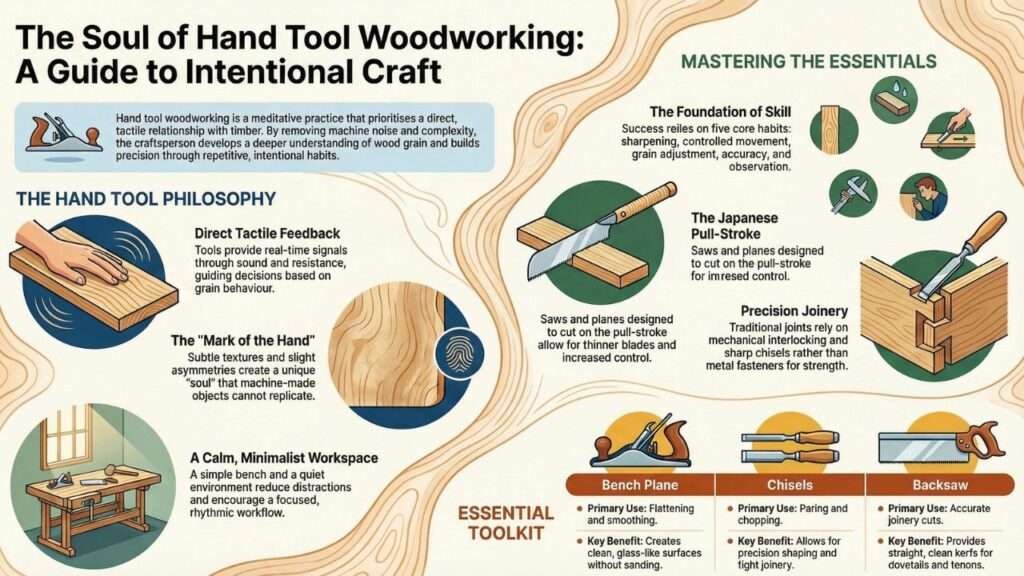
Hand tool woodworking provides a direct relationship with the wood.
Each stroke of a plane or chisel reveals subtle details that guide the next decision.
This approach supports a working environment that feels grounded and focused. It also encourages a sense of presence because the woodworker responds to the feedback of the tool and the grain in real time.
The absence of machine noise allows the natural sounds of the process to become part of the experience.
The appeal also lies in the simplicity of the setup. A bench a few essential tools and a clear workspace are often enough to begin.
This minimalism encourages clarity and reduces distractions. It also supports a home workshop environment where the atmosphere remains calm and welcoming.
Developing Skill Through Repetition and Observation.
Mastery of hand tools develops through steady practice.
Each tool requires familiarity with its mechanics and its interaction with different wood species. The learning process is gradual and rewarding because progress becomes visible in the quality of each surface and joint.
Repetition builds confidence and strengthens the ability to make consistent cuts and smooth surfaces.
Skill development often focuses on a few core habits that shape the entire workflow.
1. Sharpening blades to reliable angles.
2. Maintaining smooth and controlled tool movements.
3. Adjusting technique based on grain direction.
4. Refining accuracy through repeated cuts.
5. Observing the surface for signs of tear out or irregularities.
These habits form the foundation of confident hand tool work. Over time the woodworker gains a deeper understanding of how small adjustments influence the final result. The process encourages patience and attention to detail because each improvement becomes part of the craft.
Understanding the Nature of Wood Through Direct Feedback.
Hand tools provide immediate feedback that helps woodworkers understand the structure of timber.
The resistance of the blade the sound of the cut and the feel of the surface all contribute to a clearer sense of how the grain behaves. This tactile information supports better decision making and leads to more refined outcomes.
Different species respond in distinct ways. Softwoods compress under the blade while hardwoods require firmer control. Interlocked grain demands careful attention to avoid surface irregularities.
These lessons become intuitive through repeated interaction with the material.
The woodworker learns to read the grain not only with the eyes but also through the feel of the tool in motion.
This understanding becomes especially important when preparing surfaces or fitting joints. A well tuned plane reveals the grain direction through the quality of the shaving. A chisel indicates density changes as it moves through the wood.
These signals guide the next step and help prevent mistakes.
Building Precision Through Traditional Joinery.
Traditional joinery highlights the strengths of hand tool woodworking.
The accuracy required for dovetails mortise and tenon joints and housing joints encourages careful planning and steady technique.
The satisfaction of completing these joints by hand reinforces the value of patience and attention to detail.
Joinery work often follows a sequence that rewards consistency.
1. Marking lines with a knife for crisp edges.
2. Sawing to the line with controlled pressure.
3. Paring waste with deliberate chisel strokes.
4. Fitting joints through gradual refinement.
5. Checking alignment through dry fitting.
These methods create strong and reliable connections that showcase the natural beauty of the wood.
The process also strengthens the woodworker’s ability to judge fit and adjust technique. Each joint becomes a demonstration of skill and a reflection of the time invested in learning the craft.
Creating a Calm and Purposeful Workspace
A hand tool focused workspace supports a peaceful woodworking experience. Without the noise of machines the environment becomes more reflective.
This atmosphere encourages thoughtful craftsmanship and strengthens the connection between the woodworker and the material. The workspace becomes a place where focus and creativity can develop without interruption.
A simple and organised bench setup helps maintain clarity. Tools remain within reach and the workspace stays clear. Natural light enhances visibility and highlights the grain patterns that guide each step.
The arrangement of tools and materials influences the flow of the work and supports a steady rhythm.
Many woodworkers choose to keep only the tools they use regularly on the bench. This reduces clutter and encourages intentional selection.
The workspace becomes an extension of the craft because it reflects the values of simplicity and attention to detail.
Selecting and Maintaining Essential Hand Tools.
A small collection of well maintained hand tools can support a wide range of projects. Quality matters more than quantity because each tool must perform reliably and predictably.
Proper maintenance ensures consistent results and extends the life of the tools. Sharpening becomes a regular part of the workflow because sharp edges produce clean surfaces and require less effort.
Essential tools often include the following.
1. Bench plane for flattening and smoothing.
2. Block plane for end grain and fine adjustments.
3. Chisels for joinery and shaping.
4. Backsaw for precise cuts.
5. Marking tools for accurate layout.
6. Spokeshave for curved work.
7. Cabinet scraper for final surface refinement.
Each tool contributes to a specific part of the process. The bench plane prepares surfaces. The chisel shapes joints.
The backsaw defines lines with accuracy. The marking knife establishes boundaries that guide every cut. Together these tools create a complete system for shaping wood by hand.
Table of Common Hand Tools and Their Uses.
Tool | Primary Use | Key Benefit | Typical Application |
Bench plane | Flattening and smoothing | Creates clean surfaces | Panels and boards |
Block plane | End grain trimming | Fine control | Fitting components |
Chisels | Paring and chopping | Precision shaping | Joinery work |
Backsaw | Accurate cuts | Straight and clean kerfs | Dovetails and tenons |
Marking knife | Layout lines | Crisp and reliable marks | Joint preparation |
Spokeshave | Shaping curves | Smooth and controlled cuts | Chair parts and edges |
Cabinet scraper | Surface refinement | Polished finish | Final smoothing |
Strengthening Craft Through Intentional Practice.
Hand tool woodworking encourages a mindset that values steady improvement. Each project becomes an opportunity to refine technique and deepen understanding.
The process builds confidence and supports a creative lifestyle that appreciates natural materials and thoughtful craftsmanship. The woodworker learns to trust the tools and respond to the grain with sensitivity.
Intentional practice also strengthens problem solving skills. When a surface tears out or a joint does not fit as expected the woodworker adjusts technique and tries again. These adjustments become part of the learning process and contribute to long term growth. The craft becomes a continuous journey rather than a series of isolated tasks.
Many woodworkers find that hand tool practice enhances their appreciation for the material. The grain patterns the scent of the wood and the feel of the surface all contribute to a deeper connection with the craft.
This connection supports a calm and fulfilling woodworking experience.
The Unmistakable Mark of the Hand.
Beyond the calm process and the development of skill, hand tool woodworking leaves a distinct signature on the finished piece, a quality that machine-made work can only imitate.
This is not about perfection in the sense of mathematical precision, but about a different kind of perfection: one that carries the narrative of its own creation.
The surface of a board planed by hand possesses a subtle, undulating texture that captures and plays with light in a way a uniformly sanded surface cannot.
It feels different to the touch, alive and responsive.
This “mark of the hand” is most evident in the finer details. The gentle, almost imperceptible facets left by a well-sharpened plane blade on a wide panel speak to the tool’s journey across the wood.
The slight asymmetry in a row of hand-cut dovetails, far from being a flaw, becomes a testament to the maker’s presence.
It is a quiet declaration that this object was made by a person, not a machine.
These subtle nuances give a piece of furniture its soul, transforming it from a mere object into a heirloom with a story embedded in its very fibers.
The maker’s touch becomes an integral part of the object’s character, inviting not just use, but contemplation.
Japanese Hand Woodworking.
Japanese hand woodworking represents a refined branch of the craft where precision simplicity and respect for natural materials come together.
It is shaped by long standing traditions influenced by temple building joinery cabinetmaking and fine carpentry.
The distinction lies not only in the tools but also in the philosophy that guides their use. The approach encourages an attentive mindset where the craftsperson works with the wood rather than relying on force.
A defining feature of this tradition is the pull stroke technique. Japanese saws and planes cut on the pull which allows for thinner blades reduced effort and increased control.
The motion supports a steady rhythm that promotes accuracy. The tools respond well to careful technique and reinforce the values of patience and consistency.
Japanese joinery reflects another important characteristic. Traditional joints rely on mechanical interlocking rather than metal fasteners.
Each component must be shaped with precision so that it fits cleanly and securely. This method reflects an understanding of the natural strength of timber when its fibres remain intact and its movement is respected.
Joints such as scarf joints and lattice structures demonstrate how form and function align through disciplined craftsmanship.
Sharpening is central to Japanese woodworking. Blades forged from laminated steel combine a hard cutting edge with a softer backing that supports durability. This design requires consistent maintenance.
Sharpening on waterstones becomes a regular part of the workflow because a keen edge is essential for producing clean surfaces.
The process aligns with the broader philosophy of refinement because improving the tool improves the work.
Japanese hand tools highlight the importance of subtlety.
The kanna or hand plane requires careful setup to produce thin and consistent shavings. The nokogiri or saw creates clean kerfs that support precise joinery.
The nomi or chisel balances strength and finesse which allows controlled paring and crisp details. Each tool is designed to enhance the connection between hand blade and wood.
These elements reflect a cultural mindset that views the workshop as a place of focus and respect. The wood is treated as a material with its own characteristics rather than as an obstacle to overcome.
The task is to understand the timber and respond to it with clarity.
This perspective encourages a working style that is quiet attentive and intentional which aligns naturally with hand tool woodworking.
Japanese woodworking offers techniques and principles that complement Western practices. Its emphasis on precision preparation and mindfulness provides woodworkers with additional ways to approach the bench.
By integrating these ideas the craft becomes a practice that values clarity patience and thoughtful engagement with natural materials.
Closing Thoughts.
Hand tool woodworking reveals the structure of wood with clarity and precision.
A sharp plane or chisel shears fibres along the grain and produces a surface that reflects the natural qualities of the timber.
The result feels smooth and consistent because the tool exposes the true surface rather than abrading it.
This interaction encourages close observation and strengthens the woodworker’s understanding of how the material responds. Working at this pace builds accuracy through direct feedback.
The woodworker responds to changes in resistance as the blade moves through earlywood and latewood.
The sound of the cut indicates whether the tool is aligned with the grain.
The quality of the shaving shows whether the angle or direction needs adjustment. These cues guide each pass and support the creation of tight joints flat panels and clean edges with a small set of reliable tools.
A focused approach becomes accessible with a few well chosen tools and regular sharpening. A quiet workspace a bench plane a backsaw and a set of chisels provide a complete foundation for thoughtful work.
This setup reduces reliance on complex machinery and encourages a deliberate rhythm that supports careful judgement. Each project becomes an opportunity to refine technique and develop a deeper connection to the material.
Hand tool woodworking offers a calm and rewarding way to work with natural materials. Clean shavings from a plane the feel of a well fitted joint and the appearance of a finished surface created without sanding all contribute to a sense of purpose. This experience turns woodworking into a craft that invites continued practice and steady improvement at the bench.