Woodworking Has Shaped Our Lives Across Centuries
There is a particular quality of light in a home workshop at dusk.
The sawdust settles. The grain of a half-finished board catches the last warm angle of sun through a small window.
The smell of freshly planed oak hangs in the air like a quiet announcement. This is not merely a hobby room. It is, for many people, the place where something essential happens.
Woodworking has followed the human story from the beginning.
It has clothed, sheltered and fed us. It has carried our goods, held our food and framed our sleep. But somewhere along the way, something changed.
The necessity became desire. The craft became philosophy. And the workshop became one of the few places in modern life where a person can feel, without apology, entirely themselves.
That shift deserves careful attention. It is not simple, and it is not recent. It runs through history, psychology, neuroscience and culture in ways that continue to surprise even those who have spent a lifetime at the bench.
From Survival to Choice: The Historical Arc.
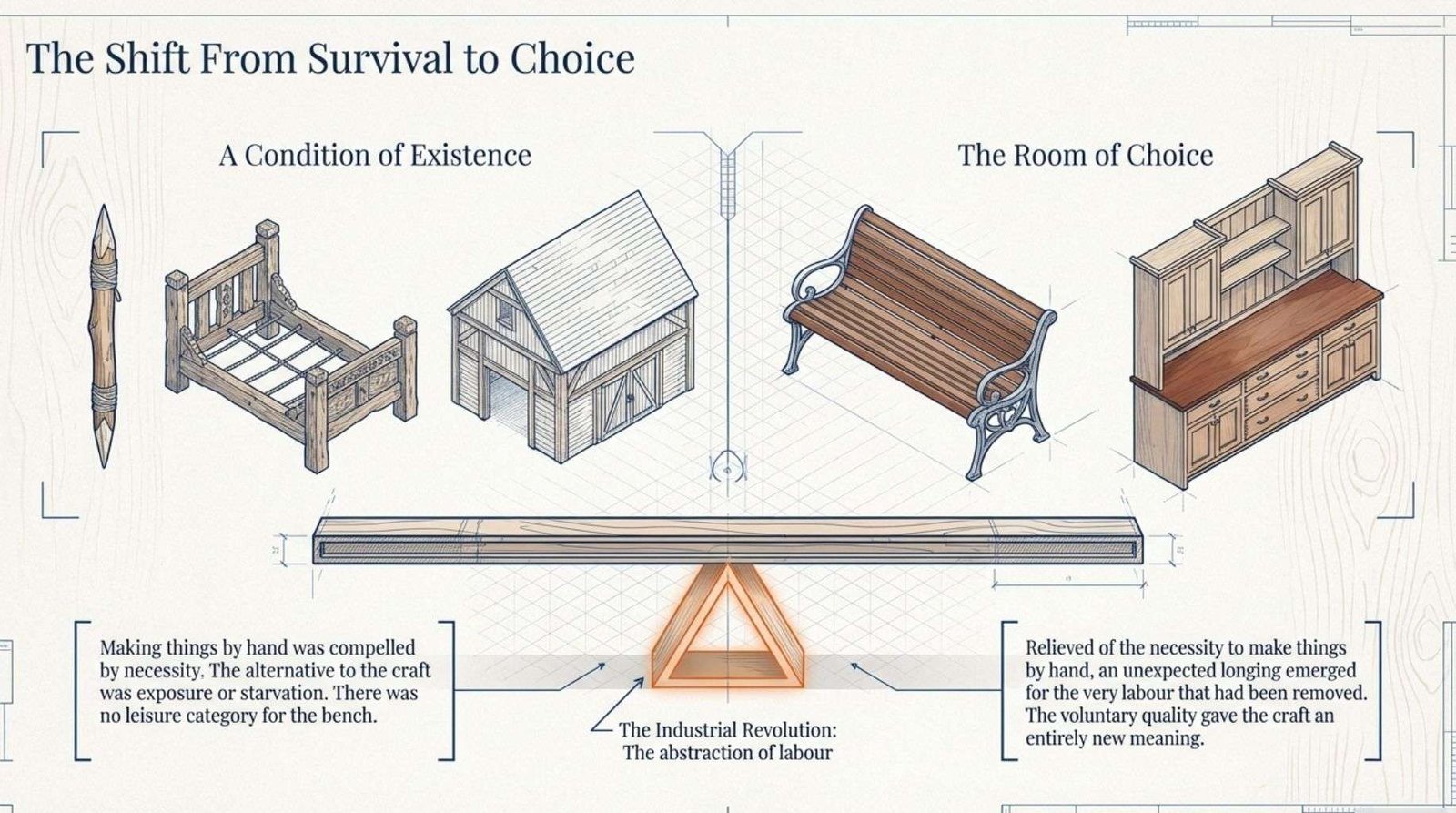
For the greater part of human history, woodworking was not a pastime. It was a condition of existence.
The Neolithic farmer shaped a digging stick not for pleasure but because the alternative was starvation. The medieval joiner built a bed frame because sleeping on bare earth carried its own consequences.
The colonial carpenter raised a barn before winter arrived, or the family suffered. There was no leisure category in which the craft could sit.
That changed with the Industrial Revolution. As factory production took over the making of furniture, tools and household goods, the average person was gradually relieved of the necessity to make things by hand.
Work became specialised and abstract. And in that abstraction, something unexpected emerged: a longing for the very labour that had been removed.
By the early twentieth century, woodworking had become a favourite pastime of homeowners across Britain, North America and much of Europe. Magazines began publishing plans for garden benches and kitchen cabinets.
Hardware stores expanded their hand-tool sections. The home workshop, once a room of necessity, became a room of choice.
It was I believe, the first time in history that making things from wood was something a person could elect to do rather than be compelled to do.
That voluntary quality gave the craft an entirely new meaning.
The result, by the mid-twentieth century, was a domestic woodworking culture with genuine depth. Readers collected plans.
Families built heirlooms. Children watched fathers shape wood and absorbed something they would carry for the rest of their lives.
Making Under Pressure: What the Depression Taught the Craft.
The Great Depression did not diminish woodworking. It intensified it.
When money disappeared and the consumer economy contracted to almost nothing, the ability to make things with wood became, once again, a form of survival. But it was also something more than that.
People made toys for children who would have had nothing at Christmas.
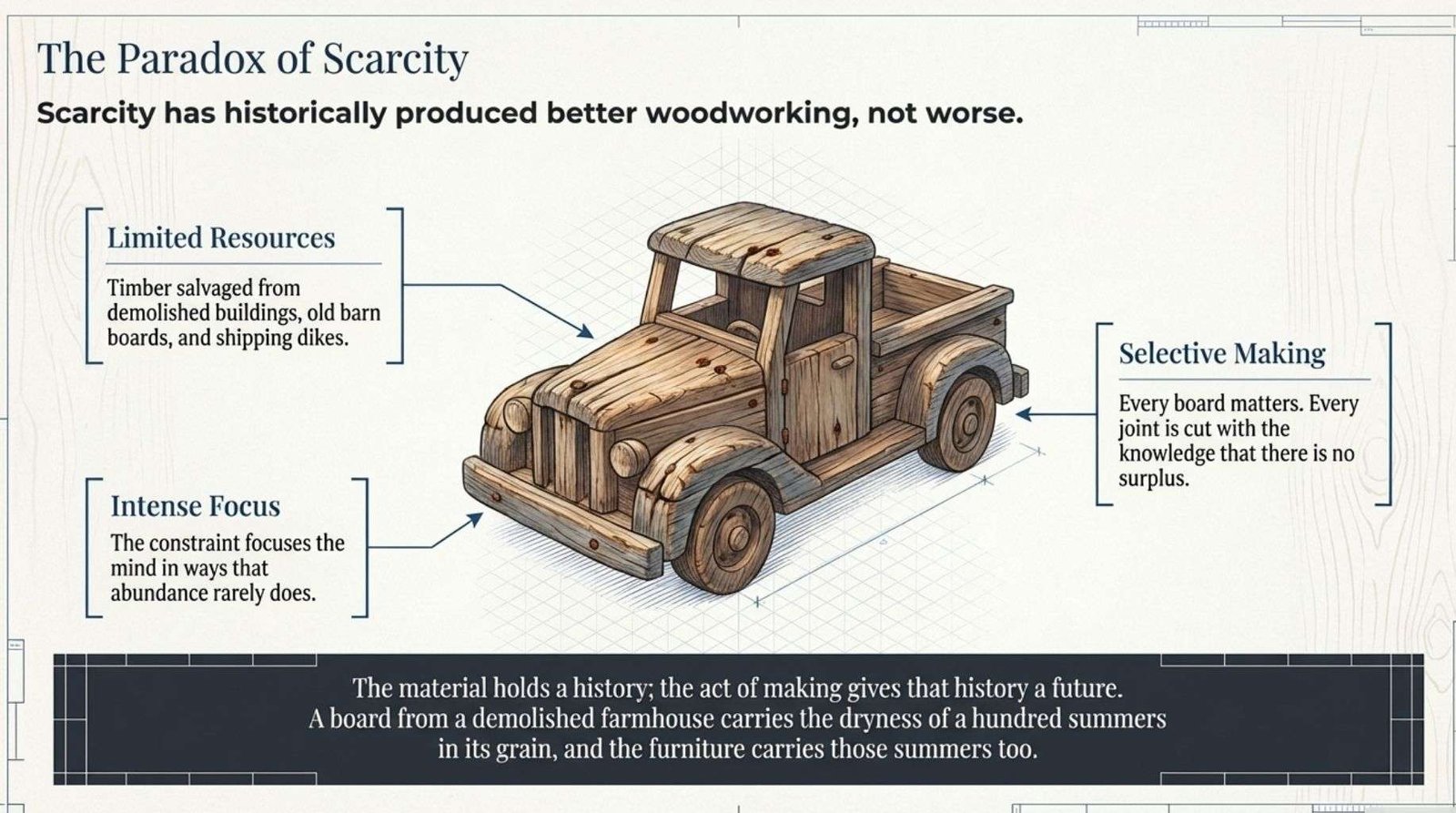
They built furniture from salvaged timber pulled from demolished buildings, from old barn boards, from shipping dikes and structural timbers that the economy had discarded.
The result was not just functional. It was beautiful. And it carried weight.
A board from a demolished farmhouse carries the dryness of a hundred summers in its grain. Furniture built from that board carries those summers too. Depression-era woodworkers understood this instinctively.
They were not just building chairs and boxes. They were preserving something. The material held a history, and the act of making gave that history a future.
This is the counter-intuitive truth at the heart of the craft: scarcity has historically produced better woodworking, not worse.
When resources are limited, makers become selective. Every board matters. Every joint is cut with the knowledge that there is no surplus.
The constraint focuses the mind in ways that abundance rarely does.
Some of the finest amateur work of the twentieth century came from workshops where almost nothing was bought new.
The Neuroscience of the Bench: What Happens Inside the Brain.
Modern neuroscience offers a precise account of why the workshop feels the way it does. It is not vague wellness. It is biology.
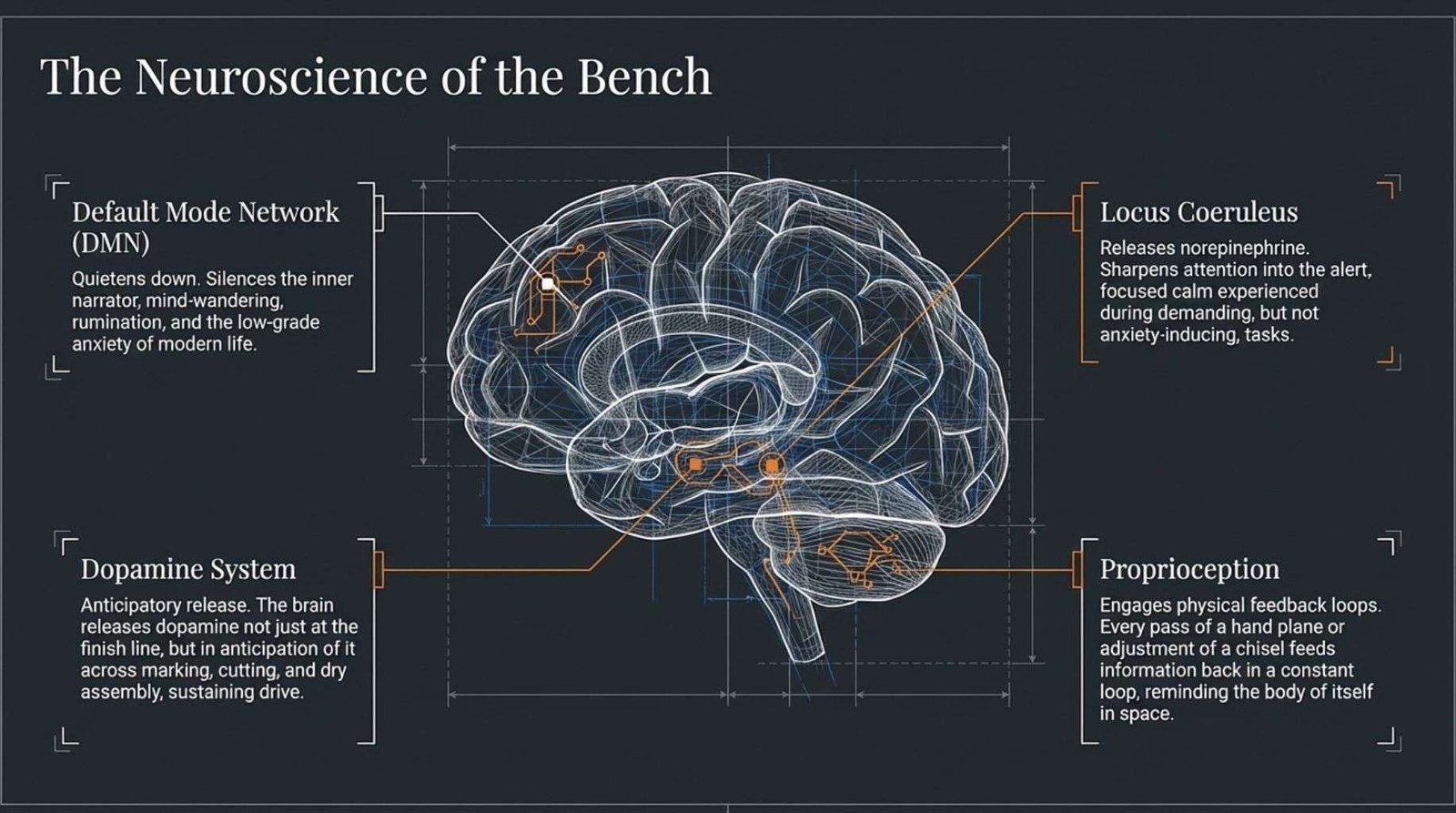
When a person begins a woodworking task, the locus coeruleus, a small cluster of neurons in the brainstem, begins releasing norepinephrine.
This chemical sharpens attention and creates the alert, focused calm that experienced woodworkers describe as one of the pleasures of the craft.
The task needs to be at the right level of difficulty: demanding enough to hold attention but not so difficult as to produce anxiety. Woodworking, across its range of skills and projects, offers that range almost perfectly.
Deeper in the session, the Default Mode Network quietens. This is the brain circuit associated with mind-wandering, rumination and the low-grade anxiety that characterises much of modern life.
When attention is genuinely occupied, this network stands down. The inner narrator stops commenting. The workshop, neurologically speaking, is one of the most reliable routes to that silence.
There is also the proprioceptive dimension. Proprioception, the sense of where the body is in space, is engaged intensely when shaping wood.
Every pass of a hand plane across a board surface, every adjustment of grip on a chisel, feeds information back to the brain in a constant loop.
This is the body being reminded of itself. In an era when most professional work involves no physical feedback at all, that reminder carries considerable psychological weight.
The dopamine mechanism completes the picture. The brain releases dopamine not only when a reward is received but in anticipation of it.
Every stage of a project, the marking out, the first cuts, the dry assembly, the final glue-up, generates its own anticipation.
The woodworker who stays at the bench until late evening is not being stubborn. The brain is simply very good at persuading itself to continue.
Wood as Material: Why the Substance Itself Carries Meaning.
Not every craft produces the same attachment. People who work with metal, concrete or plastic do not typically describe the same relationship with their material that woodworkers describe with theirs. The reason is specific.
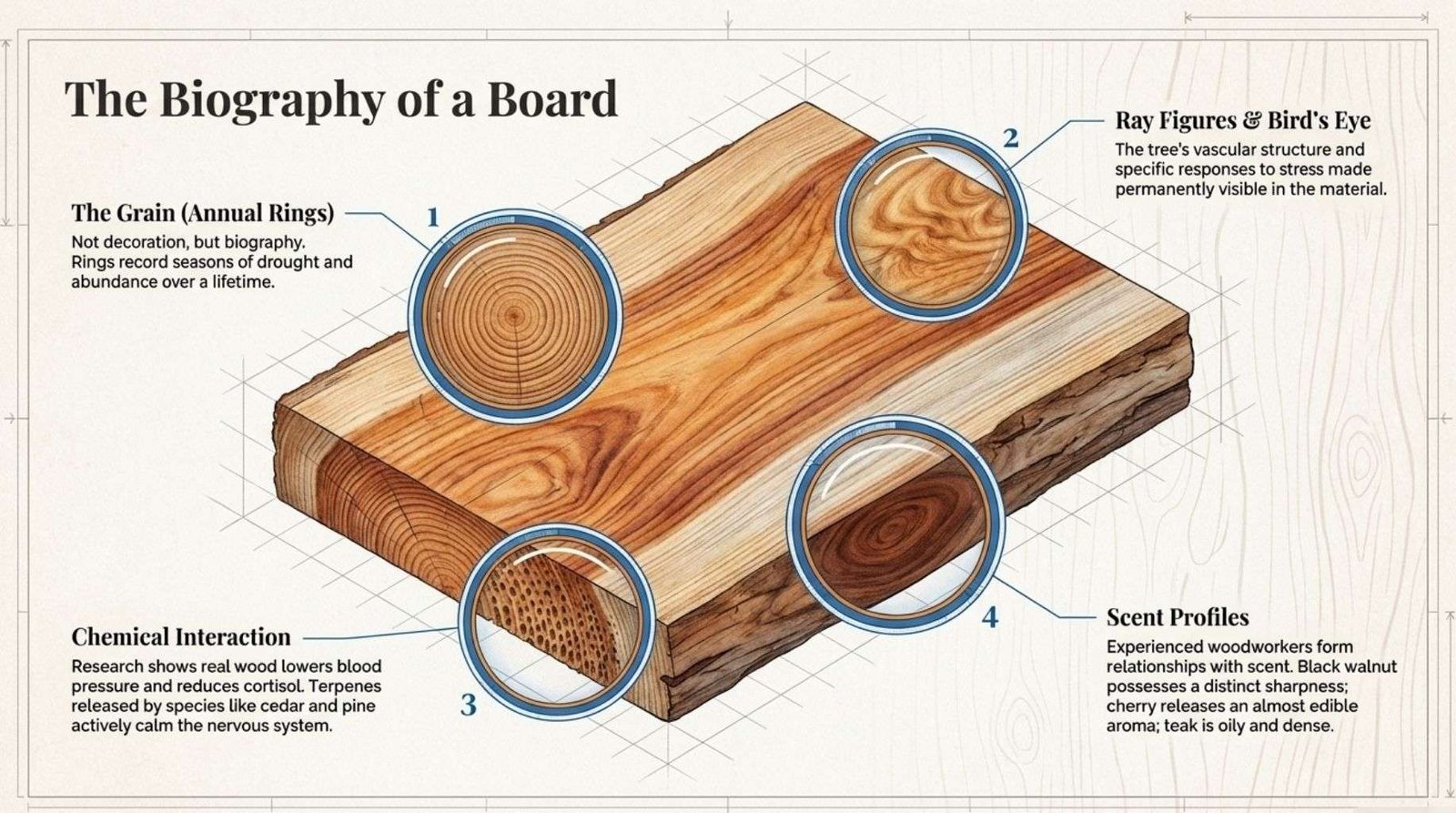
Wood was alive. It grew in response to its environment, laid down annual rings that record drought and abundance, twisted toward available light and thickened against prevailing winds.
The grain visible on a finished surface is not decoration. It is biography.
A ray figure in quartersawn oak is the tree’s vascular structure made visible.
A bird’s eye pattern in maple is the tree’s response to a particular kind of stress.
Running a hand along a finished board is, in a precise sense, touching a life’s history. Research has shown that the presence of real wood, as distinct from laminates and synthetic surfaces, can lower blood pressure and reduce cortisol.
The terpenes released by species such as cedar and pine have documented calming effects on the nervous system. These are not small findings.
They suggest that the woodworker’s affinity for the material is not aesthetic preference but something closer to a physiological response, one that has been reinforced across tens of thousands of years of human association with trees.
There is a tangential observation worth noting here: the smell of freshly cut wood differs meaningfully by species, and experienced woodworkers often describe the scent of a timber as part of their relationship with it.
Black walnut has a particular sharpness. Cherry releases something almost edible. Teak is oily and dense. These are not incidental qualities.
They are part of the material’s character, and they influence the experience of working with it in ways that are rarely discussed but widely felt.
The Therapeutic Record: From Field Hospitals to the Men’s Shed.
The therapeutic value of woodworking has a formal institutional history that runs from the wards of military hospitals in 1917 to community programs operating today. Understanding that history clarifies why the craft’s appeal is not merely recreational.
After the First World War, clinicians treating soldiers with what would now be called post-traumatic stress disorder introduced craft activities, woodworking prominent among them, as occupational therapy.
The logic was direct: focused making interrupted the cycle of traumatic recall, restored a sense of competence, and produced visible results that the patient could hold and take pride in.
Those principles have not changed. Contemporary therapeutic programs use the same mechanism.
The Men’s Sheds movement, which began in Australia and has since spread across the United Kingdom, Ireland and beyond, offers a contemporary version of the same model.
Shared workshops where men work alongside each other on woodworking and other craft projects have been shown to reduce social isolation, lower rates of depression and improve general wellbeing.
The mechanism is partly the making and partly the community. The bench becomes a reason to be somewhere, with others, doing something real.
Individual recovery stories follow a similar pattern. People working through grief, redundancy, serious illness or major life transitions describe turning to the workshop as a way of regaining a sense of agency.
The specific trade-off here is worth stating plainly: woodworking offers genuine psychological relief, but it requires sustained time and a certain quality of attention. It does not function as a brief distraction.
Projects that are abandoned halfway through can produce frustration rather than resolution. The therapeutic benefit is earned, not immediate.
Lineage and Material Memory: The Generational Thread.
Woodworking is unusual among hobbies in the frequency with which it is passed through families.
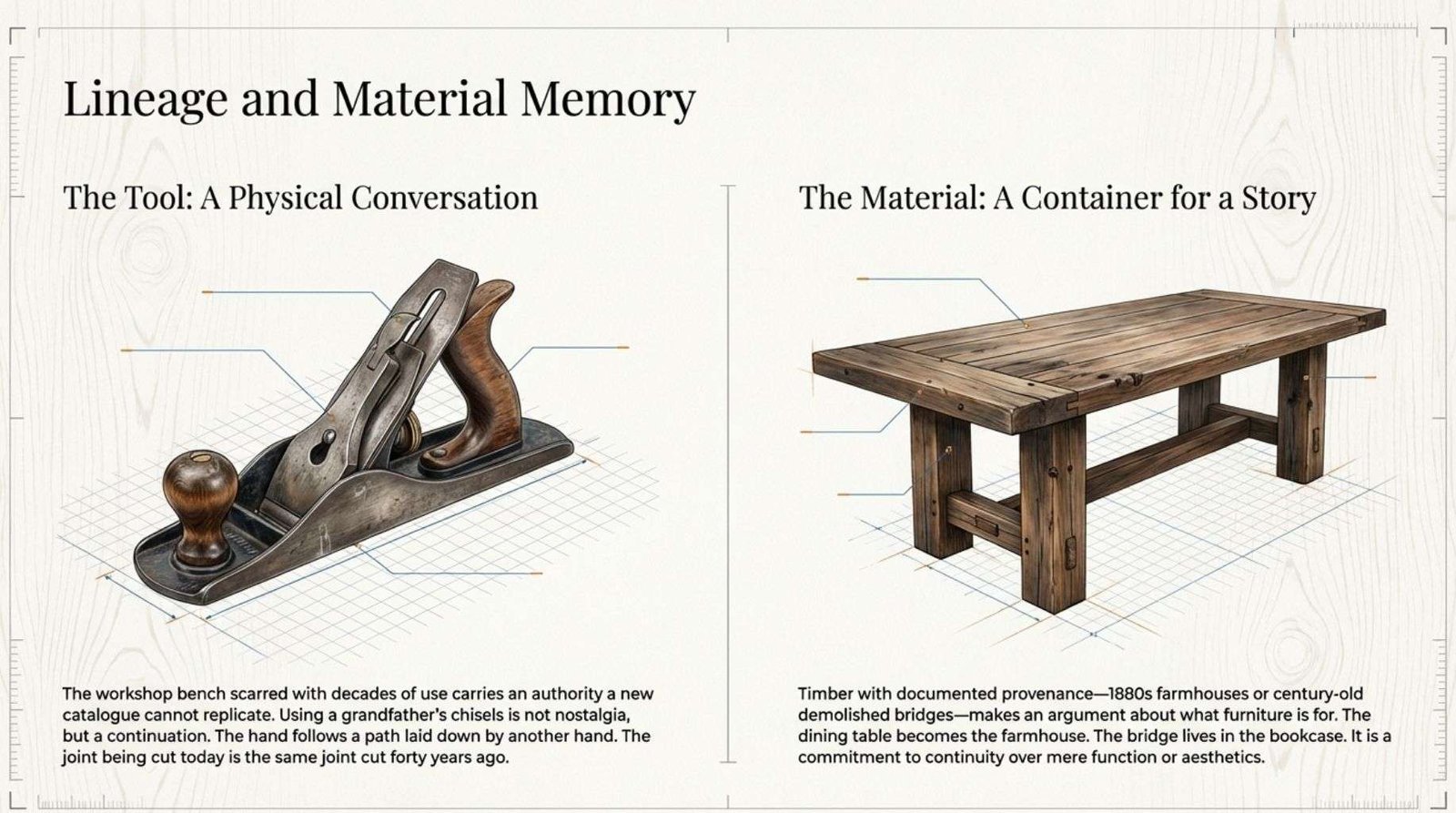
The workshop bench that belonged to a grandfather, scarred and stained with decades of use, carries an authority that a new workbench from a tool catalogue cannot replicate. The plane handle worn to the shape of a particular hand. The square with a name scratched into the stock.
Many woodworkers describe their practice as a form of conversation with people who are no longer alive. Using a grandfather’s chisels is not nostalgia.
It is a continuation. The hand follows a path laid down by another hand. The joint being cut today is the same joint that was cut in a workshop forty years ago on a winter morning that neither person shares but both, somehow, inhabit.
The choice of timber extends this logic. Some makers specifically seek out wood with documented provenance: boards milled from a farmhouse built in the 1880s, timber salvaged from a bridge demolished after a century of use, oak from a tree that stood in a particular field.
The furniture built from these materials is not just well made. It is a container for a larger story. The dining table becomes the farmhouse. The bridge lives in the bookcase.
This is not sentiment in any diminishing sense. It is a considered approach to material culture. The woodworker who chooses timber with a history is making an argument about what furniture is for. Not just function. Not just aesthetics. Continuity.
The Spectrum of Practice: From Gift-Givers to Master Artisans.
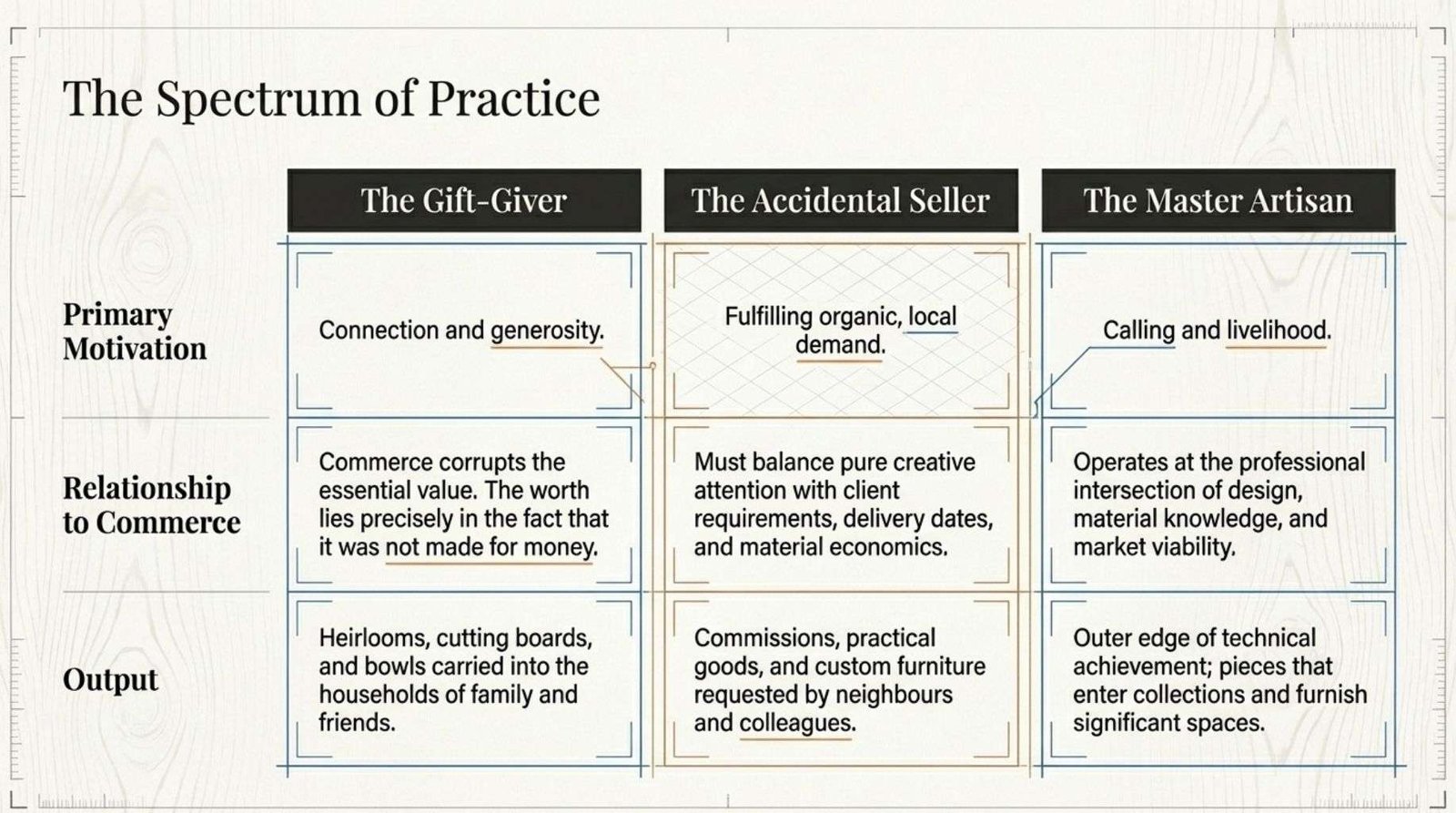
There is no single type of woodworker. The practice spans an enormous range of motivations, scales and relationships with the craft and understanding that spectrum matters for understanding why the ecosystem around it has grown to its current size.
At one end are those who make entirely to give. They never sell a piece.
Every bowl, every cutting board, every piece of furniture leaves the workshop as a gift, carrying the maker’s time and attention into another household.
For these woodworkers, commerce would corrupt something essential. The value of the object lies precisely in the fact that it was not made for money.
Moving along the spectrum, there are makers who begin selling almost by accident. A neighbour asks to buy a stool. A colleague wants a kitchen table.
Commissions accumulate. The relationship with the craft shifts. What was pure creative attention must now accommodate a client’s requirements, a delivery date and the economics of materials.
Some makers thrive in that new arrangement. Others find that it changes the work in ways they did not anticipate and are not comfortable with.
At the other end of the spectrum are full professional artisans for whom woodworking is both calling and livelihood.
These are makers whose work enters collections, furnishes significant spaces and represents the outer edge of what the craft can achieve at the intersection of design, material knowledge and technical skill.
The Global Woodworking Ecosystem: Scale and Structure.
The depth of human investment in woodworking is reflected in the scale of the industry that has grown around it.
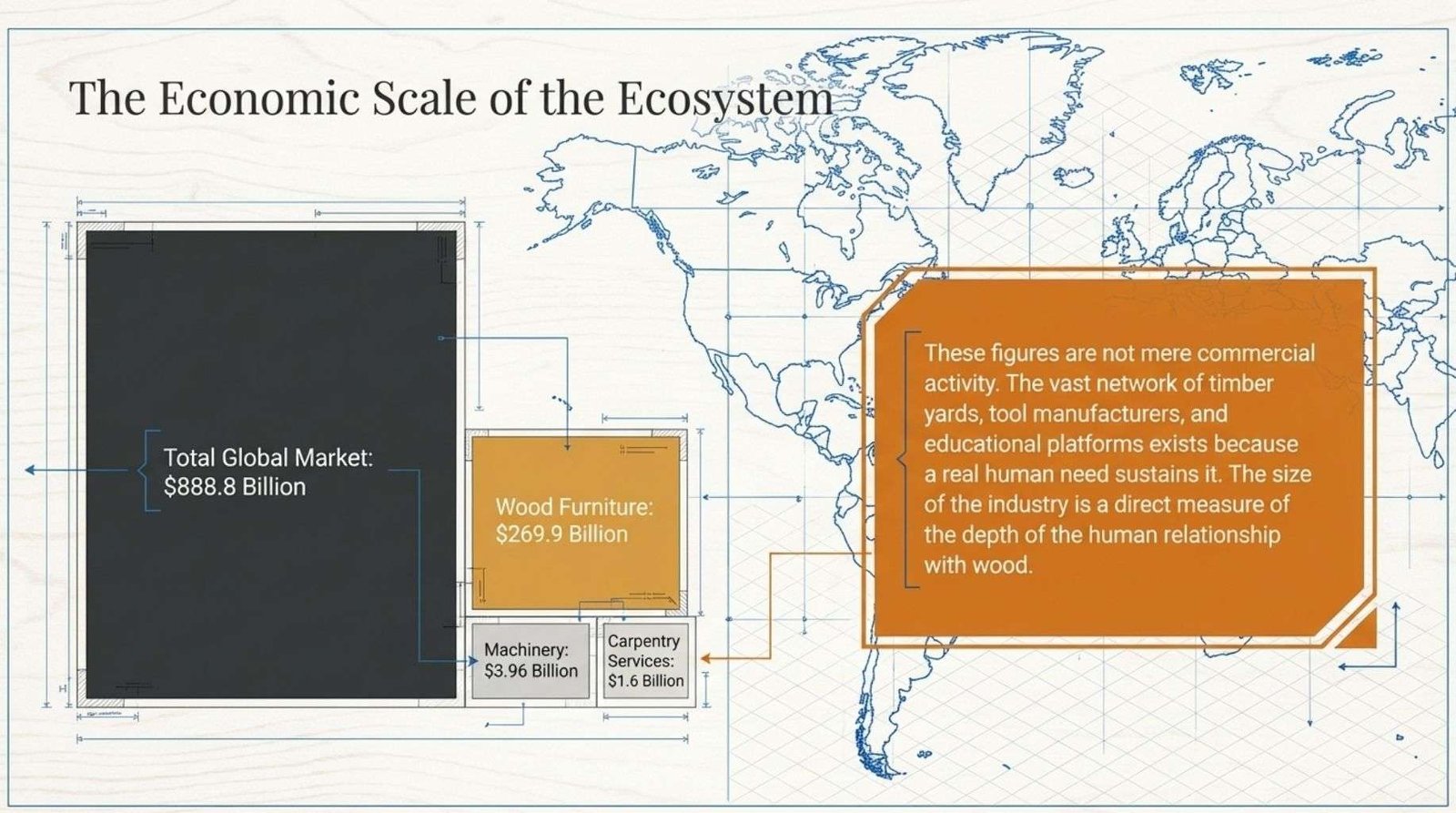
The following figures illustrate the reach of an ecosystem that extends from a backyard shed to a global supply chain.
Segment | Estimated Value (2024-2025) |
Global woodworking industry | Approximately $888.8 billion |
Wood furniture market | Approximately $269.9 billion |
Woodworking machinery market | Approximately $3.96 billion |
Carpentry services market | Approximately $1.6 billion |
These figures reflect more than commercial activity. Each segment of the ecosystem exists because a real human need sustains it.
Timber yards serve makers. Tool manufacturers respond to practitioners. Educational platforms and publications grow because people want to understand and improve their craft.
The size of the industry is a measure of the depth of the human relationship with wood, expressed in economic terms.
Technology, Tradition and the Path Ahead.
The woodworking ecosystem is changing. CNC router adoption has grown significantly in recent years, with small professional shops integrating computer-controlled cutting alongside traditional hand-tool work.
Digital design software has entered workshops that previously worked entirely from hand-drawn plans. These are real changes, and they are not reversible.
The interesting question is not whether technology will continue to enter the craft. It will. The interesting question is what it leaves intact.
The answer, so far, appears to be almost everything that actually matters.
The CNC machine cuts a shape. A person still decides what shape to cut, what wood to use and what the object means.
The design software generates a plan. A person still decides what to build and why. The relationship between maker and material remains entirely human, even when the cutting is done by a servo motor guided by code.
Sustainability is reshaping sourcing decisions. Certified timber, reclaimed wood and design approaches that minimise waste are becoming standard considerations rather than premium choices. Digital optimisation tools can plan a cutting list that reduces off-cuts to near zero.
The woodworker who builds a dining table from certified, locally milled timber is making a material argument about how resources should move through the economy. That argument sits comfortably alongside the philosophical traditions of the craft.
The customisation trend points in a related direction. Mass production cannot make an object that fits a specific room in a specific house with a specific meaning attached to it.
A maker can. Demand for furniture that is genuinely unique, built to order from materials chosen by the buyer, continues to grow precisely because it answers something that no factory run can satisfy.
The more the designed world converges on identical surfaces and standard sizes, the more a handmade table with figured walnut and hand-cut dovetails at the corners asserts a different set of values.
The Enduring Thread.
What connects the Neolithic toolmaker, the Depression-era father turning toy wheels in a cold garage, the occupational therapist guiding a veteran through a first dovetail and the contemporary maker choosing certified timber for a commission? Not technique. Not material.
The same underlying need: to make something real from something natural and to leave it in the world as evidence of attention and care.
The workshop is one of the few places where the full range of human faculties, physical, cognitive, aesthetic and emotional, converges on a single act.
The body works. The mind focuses. The hands remember what they were shaped across a very long time to do. The result outlasts the session. Often, it outlasts the maker.
Woodworking endures because it answers questions that the rest of modern life tends to defer or ignore. What does this hour amount to? What will remain?
What is made versus what is merely consumed? The bench is where those questions get answered, one shaving at a time, in the particular smell of a wood that was once a tree in a particular place and is now, in this workshop, becoming something else entirely.

Conclusion.
Woodworking is much more than a pastime. It is one of the oldest human behaviours, an unbroken thread running from Neolithic survival to modern creative expression.
For thousands of years, wood shaped our shelters, tools, transport and daily rituals. Yet as industrialisation removed the necessity to make things by hand, something unexpected happened: people began choosing to work with wood not out of obligation, but out of longing.
The workshop became a place where a person could reconnect with something deeply human.
Across history, scarcity has often sharpened the craft rather than diminished it. During the Great Depression, families built toys, furniture and household essentials from salvaged timber.
These objects carried the weight of their origins, sun‑dried barn boards, beams from demolished homes, timber with a century of weather in its grain.
Woodworkers understood instinctively that they weren’t just building objects; they were preserving stories.
Modern neuroscience apparently now explains why woodworking feels uniquely grounding. It’s a craft that activates focused attention, quiets the brain’s rumination circuits, engages proprioception (the quiet sense that tells us where our limbs are and how we’re moving through a space, grounding us in the physical world).
It is one of the few activities where the mind, body and senses align in a single, absorbing task. Wood itself deepens the experience: its scent, grain and biological history evoke physiological calm and emotional connection.
The therapeutic value of woodworking has been recognised for more than a century, from post‑WWI field hospitals to today’s Men’s Sheds.
The bench offers structure, purpose and community, especially for those navigating grief, isolation or major life transitions.
Woodworking also carries lineage. Tools passed down through generations, timber with provenance, and techniques learned at a parent’s elbow create a sense of continuity that few modern activities can match.
Whether practiced as a gift‑giving hobby, a side craft or a professional art, woodworking forms part of a global ecosystem worth hundreds of billions of dollars. What endures is simple: the human need to make something real, meaningful and lasting.
In a world of abstraction and consumption, woodworking remains one of the few places where attention becomes creation and creation becomes legacy.