DIY Home Renovation
Home renovation often begins with a sense of possibility. A room feels dated or a layout no longer suits daily life and the idea of reshaping it becomes appealing.
The early excitement is real, yet the work that follows is shaped by materials, sequence and the quiet discipline of seeing a project through.
Light falling across an unfinished surface or the grain of a timber trim can shift the pace of a day. Renovation is a physical conversation with a house and each decision leaves a trace.
Understanding Personal Scope.
Every renovation starts with an honest assessment of capability.
A fresh coat of paint or a new timber shelf can be completed with steady hands and patience. Structural changes or mechanical work require deeper knowledge and a clear understanding of limits.
The difference becomes obvious when a task moves from surface adjustments to the hidden layers of a building.
The texture of old plaster or the weight of a solid timber door can reveal how much experience is needed.
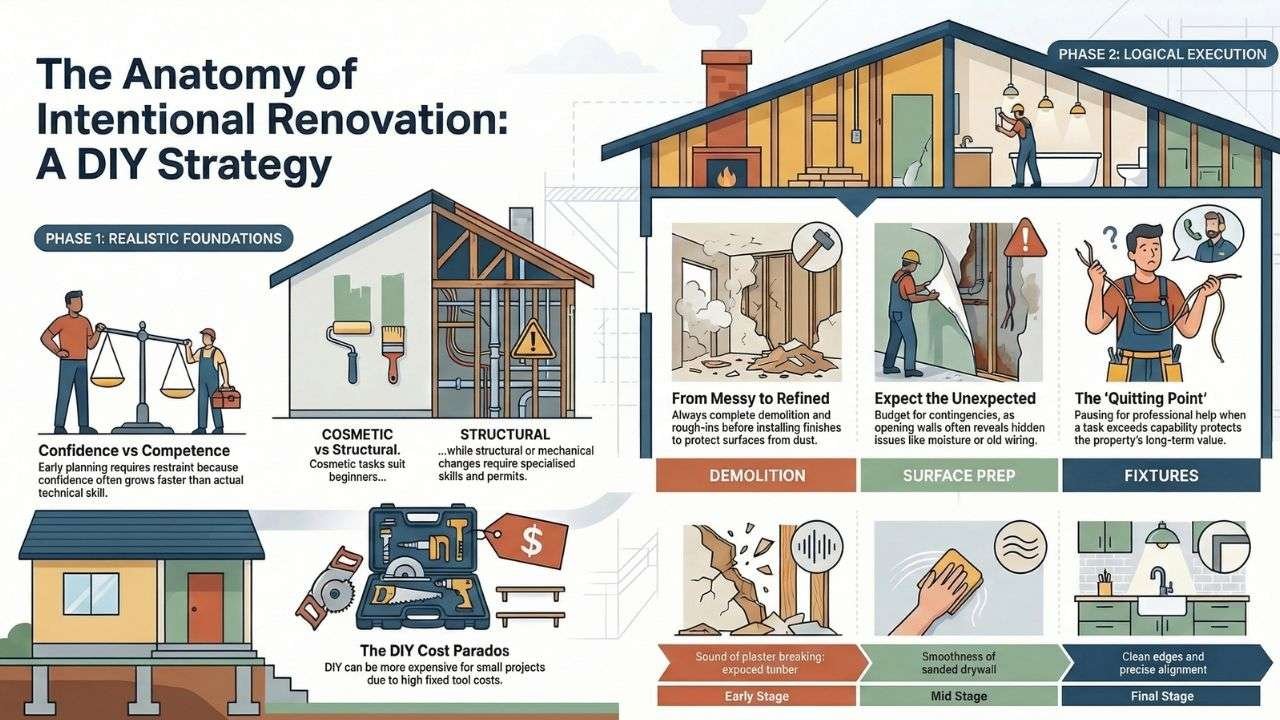
A surprising insight is that confidence often grows faster than competence which means the early stages of planning benefit from restraint.
- Cosmetic tasks suit beginners who want visible progress without complex preparation.
- Structural or mechanical tasks require specialised skills and should be approached with caution.
- Tools already owned often indicate the realistic scope of work.
A practical limitation appears when enthusiasm outpaces equipment.
A project that seems simple on paper can stall when a required tool is missing or unfamiliar.
Evaluating True Costs.
DIY renovation is often framed as a cost saving exercise.
The reality is more nuanced. Materials, tools and time all carry weight. A stack of timber boards leaning against a wall can look straightforward until the need for accurate cuts and consistent finish becomes clear.
The cost of a specialised saw or a set of chisels can exceed the price of hiring a professional for a small task. This does not diminish the value of learning but it changes the calculation.
- Tools purchased for a single project may not justify their expense.
- Material waste is common when learning new techniques.
- Time spent correcting errors can extend a project significantly.
A counter intuitive observation emerges here. DIY can be more expensive than professional work when the project is small because the fixed costs of tools and materials are spread across fewer tasks.
Permits and Legal Requirements.
Renovation intersects with regulation. Some work can be completed freely while other tasks require formal approval.
The distinction is not always intuitive. A simple cabinet replacement may be allowed without paperwork yet moving a plumbing fixture usually requires a permit. The grain of a new benchtop or the clean line of a tiled splashback may draw attention but the unseen compliance behind them matters just as much.
- Structural changes typically require permits.
- Electrical and plumbing work often falls under regulated categories.
- Inspectors assess work to the same standard regardless of who completes it.
A brief aside is worth noting. Older homes sometimes reveal previous work that would not meet current standards. Discovering this during a renovation can shift priorities unexpectedly.
Sequencing the Work.
Renovation follows a logical order that supports efficiency and quality. Starting with finishes is tempting because they are visually rewarding.
Yet the process moves from messy to refined. Dust from sanding or the fine powder from cutting fibre cement boards settles into every corner which means early tasks must be completed before surfaces are protected.
- Rough in work for electrical and plumbing.
- Wall closure and surface preparation.
- Installation of flooring and trim.
- Final fixtures and fittings.
A table can clarify the relationship between task type and typical timing.
| Task Type | Typical Stage | Sensory Detail |
| Demolition | Early | Sound of plaster breaking and timber studs exposed |
| Rough in | Early to mid | Cold metal of pipes and the rigid feel of conduit |
| Surface preparation | Mid | Smoothness of sanded drywall |
| Flooring and trim | Mid to late | Warmth of timber underfoot |
| Fixtures | Final | Clean edges and precise alignment |
The sequence protects finished surfaces and reduces rework. It also creates a rhythm that helps maintain momentum.
Uncovering Hidden Conditions.
Opening a wall introduces uncertainty. The interior of a building carries its own history. Timber framing may show signs of age or moisture.
Wiring may reflect standards from decades earlier. The smell of old insulation or the sight of uneven joists can shift a project from straightforward to complex. This is where contingency planning becomes essential.
- Unexpected conditions require time and budget allowances.
- Some discoveries require professional intervention.
- Progress may pause while decisions are made.
A practical trade off appears here. Investigating thoroughly reduces surprises but increases upfront effort.
Skipping investigation speeds the start but risks delays later.
Distinguishing Structural and Cosmetic Work.
Structural elements define the integrity of a home. Cosmetic elements shape its appearance. The two categories behave differently.
A timber architrave can be replaced with minimal disruption. A load bearing wall cannot be altered without engineering input.
The density of a structural beam or the alignment of joists above it provides clues that should not be ignored.
- Walls perpendicular to joists may be structural.
- Uncertainty requires professional assessment.
- Cosmetic changes should not affect the building’s stability.
This section benefits from brevity because the principle is simple. Structural work demands expertise.
Managing Moisture and Air Movement.
The building envelope protects the interior from moisture and uncontrolled airflow. Renovation that touches bathrooms, kitchens or exterior walls must respect this system.
The cool feel of a waterproofing membrane or the tackiness of a fresh sealant layer indicates its importance.
Tile is decorative. The barrier behind it is functional.
- Waterproofing must be continuous and correctly applied.
- Air gaps must be sealed before insulation is installed.
- Moisture control affects long term durability.
A small tangential observation fits naturally here. In older homes the scent of damp timber near exterior walls can reveal air leaks long before they are visible.
Finishing Work and Detail.
Finishing determines the visual quality of a renovation. Trim, paint and alignment all contribute to the final impression.
The crisp edge of a mitred corner or the smooth transition between wall and ceiling can elevate a room. These tasks require patience because imperfections become more visible as the work nears completion.
- Trim installation requires accurate measurement.
- Caulking must be applied neatly.
- Paint lines define the overall presentation.
The final stages often take longer than expected. This is not inefficiency. It is the natural pace of precision.
Recognising the Quitting Point.
Every renovator encounters a moment when the project exceeds their current capability. This is not failure. It is part of managing a home responsibly.
The weight of a misaligned door frame or the complexity of a plumbing junction can signal the need for professional support.
Knowing when to pause protects both the project and the property.
- Complex discoveries require expert intervention.
- Stopping early prevents compounding errors.
- Professional assistance can integrate smoothly with DIY work.
This decision strengthens the overall renovation rather than weakening it.
Closing Perspective.
DIY home renovation blends creativity with discipline. The texture of materials and the sequence of tasks shape the experience.
Each project teaches something new about how a home responds to change. With thoughtful planning and a clear sense of limits the process becomes a steady progression rather than a rush toward completion.
Renovation becomes a way of understanding a space more deeply and improving it with intention.