Reimagining Life With Rural Space And A Nice Big Shed
There is a moment many people reach when standing in a small backyard or playing around with a piece of salvaged timber in their hands.
The grain catches the light and the weight of it feels solid and honest.
At that point a clear thought tends to surface: the pace and shape of urban life may not be the right fit for what matters most.
This is not a crisis, not at all, it’s just an observation. The accumulated weight of city living presses steadily on personal ambition and creative output.
Woodworking, for many people, becomes a deferred interest: something to pursue once the space, the time and the proper workshop are finally available. That deferral tends to be indefinite.
The constraints are structural and familiar. Rising housing costs in major cities have made space a premium item rather than a baseline expectation.
Backyards where workshops take root have been traded for proximity to transport. The physical room required for a sustained creative practice is disappearing from city properties.
Woodworking is more than a hobby held in reserve. It is a lifestyle orientation that places wellbeing, balance and the freedom to make things at the centre of daily life. The path toward that lifestyle begins with a direct and practical question: what would need to change to make it possible now?
Reconsidering the Value of Space.
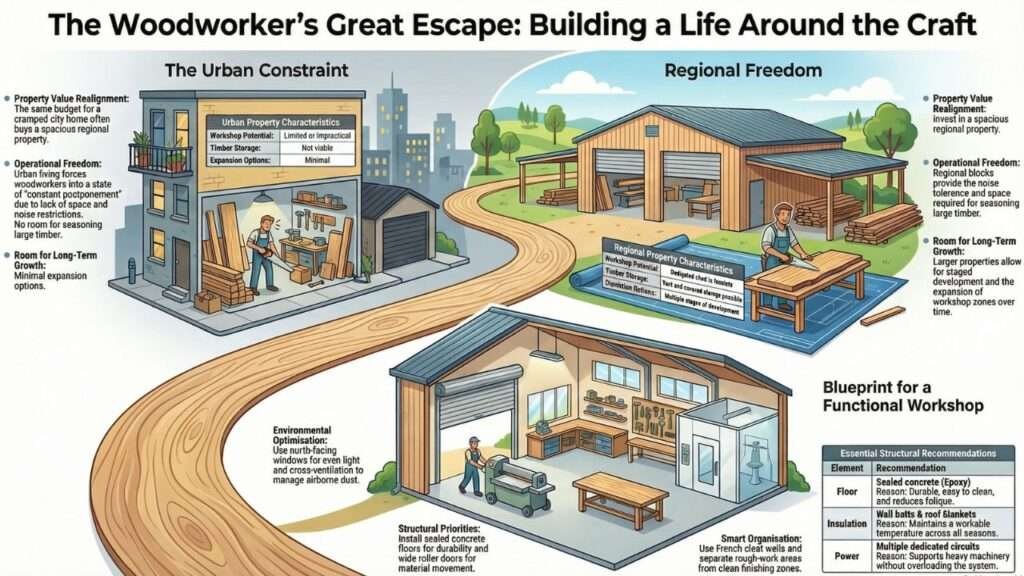
The Urban Constraint.
City living can at times normalise physical compromise.
A kitchen too small for serious cooking, a bedroom where furniture cannot open properly, a courtyard marketed as a garden.
For the woodworker, these compromises are not invisible.
A bench cannot fit where there is no room.
Timber cannot season on a balcony and power tools cannot run late in a terrace house without affecting neighbours.
The result is that woodworking exists in a state of constant postponement for many city residents. Tools purchased with good intentions sit unused.
A weekend course produces motivation that urban life then crowds out.
The interest remains real but the conditions to pursue it never quite arrive.
The Shift in Perspective.
An honest comparison of property values produces results that many people find genuinely surprising.
The cost of a modest city home with a small yard is frequently comparable to the cost of a spacious property on a large block in a regional area.
The same budget that buys constraint in the city can buy room to work, room to store materials and room to expand a workshop over time.
The value of space is systematically underestimated in a culture that prices urban proximity above most other factors.
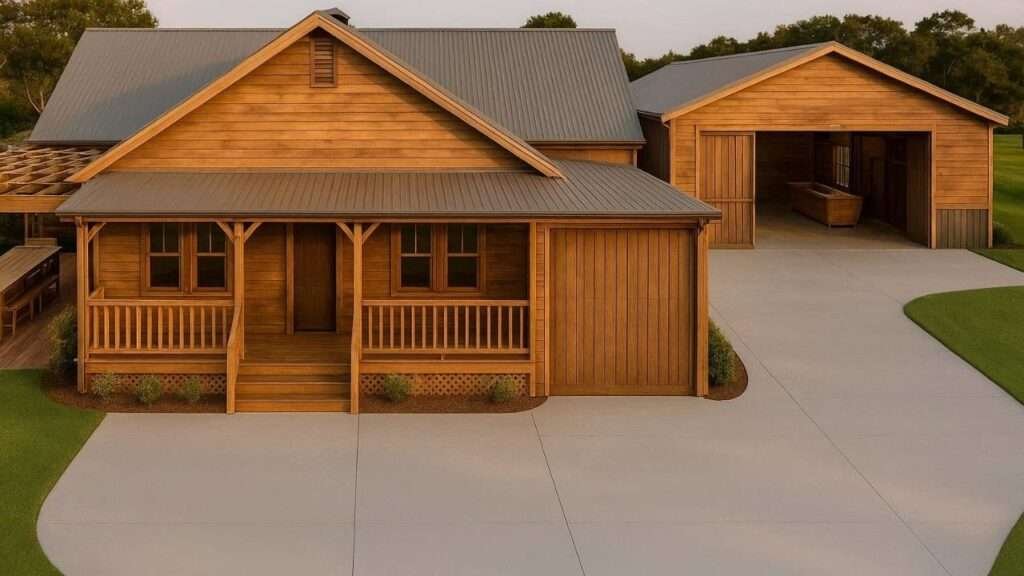
A larger block does not only mean a bigger backyard. It means a proper workshop, storage for seasoned timber, outdoor working areas and the kind of quiet that supports focused effort.
Space and Long-Term Goals.
Physical space shapes the type of thinking a person is able to sustain. Cramped environments make long-term planning feel theoretical rather than practical.
The inability to pursue a meaningful craft does not only leave time unfilled.
It reduces the sense that personal goals are achievable at all. Access to genuine working space changes that relationship directly and measurably.
The Ultimate Building Industry Tip: Moving to the Country.
The Core Recommendation.
People with long experience in building and trades tend to arrive at a consistent position: a creative, craft-based lifestyle requires the right physical environment.
A regional property with a proper shed is not a retreat from ambition.
It is the foundation that makes serious craft work possible over the long term.
The carpenter who owns a property with a workshop, who can store hardwood planks and let them season without restriction, operates at a fundamentally different level from someone fitting occasional work into a city flat.
Moving to a regional area is a deliberate act of organising life around the craft rather than fitting the craft around everything else.
What the Move Does and Does Not Mean.
A regional lifestyle does not mean abandoning access to services.
Modern regional towns offer quality schools, healthcare, retail and communities with their own established culture. The difference is the relationship with space, quiet and property size. For people who work remotely, run small businesses or are at a stage where location is flexible, the comparison is worth making directly.
Factor | City Property | Regional Property |
Block size | Small to minimal | Large, often half-acre or more |
Workshop potential | Limited or impractical | Dedicated shed feasible |
Timber storage | Not viable | Yard and covered storage possible |
Noise tolerance | Restricted by neighbours | Significant working hours available |
Property cost | High for limited space | Comparable or lower with more land |
Expansion options | Minimal | Stages of development over time |
Planning for the Long Term.
A larger property supports a kind of progressive development that smaller city lots cannot accommodate. A basic shed can expand as skill and project scale grow.
A timber yard can be established to store and season different species across months and years. Distinct working zones can be created: rough work separated from finishing, hand tool areas separated from machine areas.
Over time the property itself reflects the development of the craft. Structures can be modified and improved. The regional property is the first and most significant project in a long series.
Designing the Heart of the Property: The Woodworking Shed.
Purpose Over Storage.
A shed designed as a dedicated workshop is a different object from a storage shed. Every decision in a workshop design serves the work and the person doing the work. Orientation, floor finish, window placement, power layout and material flow all affect daily productivity and the quality of output over years of use.
Light and Ventilation.
Light quality is a primary design consideration. Fine woodworking depends on seeing surfaces accurately. A finish that appears flat in poor light may carry visible imperfections in daylight. North-facing windows in the Southern Hemisphere provide consistent even illumination. Skylights add further light without direct sun exposure. The investment in good natural light reduces eye strain and supports accurate work across long sessions.
Ventilation is a health requirement as much as a comfort factor. Woodworking produces fine airborne particles across all stages of the process. Cross-ventilation designed into the structure from the outset significantly reduces dust accumulation. Openable windows at opposing walls, combined with a good dust extraction system, keep air quality at a working standard.
Structural Priorities.
Element | Recommendation | Reason |
Floor | Sealed concrete with epoxy or polyurethane coating | Durable, easy to clean, reduces fatigue with matting |
Insulation | Wall batts and reflective roof blanket | Maintains working temperature across seasons |
Windows | North-facing, positioned above bench height | Even light, ventilation and visual rest |
Power | Multiple dedicated circuits, outlets at bench height | Supports multiple machines without overloading |
Doors | Wide roller or barn door on main entry | Allows movement of large sheets and finished pieces |
Organisation and Layout.
A disorganised workshop reduces both output and motivation. Good organisation begins at the design stage.
The following principles typically support a functional layout:
Ø Separate rough work areas from finishing areas to reduce contamination of surfaces.
Ø Mount frequently used hand tools on pegboard or wall panels at eye level.
Ø Use enclosed shelving for consumables including sandpaper, oils and fasteners.
Ø Apply a French cleat system along one or more walls for flexible reconfigurable storage.
Ø Label all storage clearly and maintain a consistent return-to-place discipline.
The Workshop as a Working Environment.
A workshop that is genuinely pleasant to occupy gets used more consistently than one that is merely functional.
A comfortable chair, a small heater for cold mornings and good task lighting all contribute to a space people return to by choice.
A piece of finished work displayed on a shelf, good audio through a modest speaker system and a clean organised layout transform the shed from a utility space into a professional working environment.
Mastering the Craft: From Hobbyist to Professional.
Foundational Knowledge: Wood Seasoning.
Before joinery is cut or surfaces are dressed, a working understanding of timber behaviour is essential. Wood continues to respond to moisture long after it is cut.
It expands and contracts with changes in humidity and does so in ways that can be managed if the seasoning process is understood and applied correctly.
Green timber carries its full moisture content and cannot be used directly for furniture or precision joinery.
It will move and split as it dries, destabilising careful work. Properly seasoned timber has reached equilibrium with its environment and behaves predictably under tools and across finished surfaces.
Method | Duration | Result |
Air drying | Approx. 1 year per 25mm of thickness | Stable, well-figured timber with low internal stress |
Kiln drying | Days to weeks depending on species | Faster but may reduce figure quality in some species |
Moisture meter check | Before use | Confirm timber is at working moisture content (approx. 8-12% for indoor use) |
Building a timber store and developing the habit of checking moisture content before committing to a project is one of the most practical steps available to any woodworker working toward professional-level output.
Continuous Learning.
The development from hobbyist to confident craftsman is a long accumulation of practical experience, formal study and deliberate practice.
Formal qualifications provide structure, technical depth and professional credibility. A carpentry apprenticeship followed by progression toward a Master Builder designation opens access to complex projects and professional networks that self-directed learning alone does not reach.
Informal learning platforms supplement formal study effectively.
Video resources from experienced craftspeople across multiple countries and traditions offer technique demonstrations that can be applied immediately at the bench. Learning from direct observation of skilled practitioners, whether in person or through recorded demonstration, accelerates the development of sound habits.
Mistakes are a productive part of the learning process when examined carefully. A board that splits because the grain direction was misread, a finish that fails because humidity conditions were wrong, a joint that moves because glue was applied to end grain without preparation: each failure examined honestly builds knowledge that successful outcomes alone do not produce.
Exposure to a wide range of timber species is another dimension of ongoing development. Australian hardwoods, softwoods and imported species each carry distinct properties, working characteristics and finishing requirements.
Building familiarity with multiple species over time expands both technical capability and the range of work a craftsman can confidently undertake.
Tool Progression.
Hand tools develop the foundational understanding of how wood behaves under a cutting edge.
They build sensitivity to grain direction, edge geometry and controlled pressure that remains relevant regardless of what power equipment is added later.
The following progression represents a practical path from entry level to specialist capability:
Ø Basic hand tools: bench chisels, block and smoothing planes, tenon saw, marking gauge and mallet.
Ø Bench machines: bandsaw and table saw or track saw for dimensioning stock accurately.
Ø Router and table: for joinery, edge profiles and template-guided work.
Ø Lathe: for turned forms including bowls, spindles, handles and decorative elements.
Ø Specialty equipment: drum sander, oscillating spindle sander and thickness planer as project complexity increases.
Each tool category represents a distinct area of skill development. Competence with each type builds independently and compounds over time into a broad and flexible capability.
The Social and Economic Value of Woodworking.
The Shed as a Social Space.
A well-maintained workshop with an open door attracts interest from neighbours, friends and family who may not share a technical interest in woodworking but respond to the activity of making.
The visible progress of a project, the smell of worked timber and the warmth of a functional shed all contribute to a naturally hospitable atmosphere.
A Saturday afternoon with a project on the bench and a BBQ set up outside represents a type of social gathering that is grounded, unhurried and easy to sustain.
The shed that functions as a gathering point also reinforces the woodworker’s motivation and connects the craft to the broader rhythms of family and community life.
Commercial Opportunities.
The market for handcrafted timber goods is active and in many segments growing. Consumer preference for quality, provenance and handmade objects has strengthened in response to the prevalence of mass-produced goods.
The woodworker with consistent skills and a reliable output has access to genuine commercial channels.
Weekend markets provide a direct point of contact between maker and buyer.
They allow rapid feedback on which pieces attract interest, support the development of a returning customer base and require modest initial investment.
The direct sales relationship is one of the more effective ways to build a craft reputation in a local area.
Social media platforms oriented toward visual content support commercial development at low cost.
Documenting the making process from material selection through to finished piece builds an audience that is invested in the work before it is offered for sale. Consistent posting, honest presentation of both successful and corrected work, and clear pricing information build the kind of credibility that paid promotion rarely achieves as efficiently.
Business Planning and Administration.
Commercial woodworking requires the same planning discipline as any small business. The following elements are the minimum required for a sustainable operation:
Ø A cost model that accounts for materials, time, consumables and tool depreciation.
Ø A pricing structure that covers costs and reflects the skill and time invested.
Ø A production capacity estimate that matches realistic working hours to order volume.
Ø A clear target market definition to focus product development and marketing effort.
Administrative requirements deserve early attention. Home insurance policies vary in how they treat commercial activity conducted from a residential property. Some policies exclude business use without an additional endorsement.
Council planning requirements may apply to shed size, signage or the frequency of client visits. These matters are straightforward to resolve when addressed at the start of commercial activity.
Administrative Area | Action Required |
Home insurance | Review policy for home-based business exclusions and update if necessary |
Council approval | Check local planning rules for shed size, signage and commercial use |
ABN registration | Required before invoicing customers in Australia |
Business banking | Separate account recommended from the point of first commercial sale |
Record keeping | Maintain records of income, expenses and materials from the outset |
Conclusion: A More Relaxed And Purposeful Life.
Space, creativity and calm are not luxuries in a well‑designed life; they are the conditions that allow long‑term personal and professional growth to take shape.
When those conditions are missing, the work that matters most is pushed to the margins. When they are present, the craft becomes sustainable, enjoyable and deeply rewarding.
Reorganising life around these principles is not an abstract ideal. It is a practical decision with measurable outcomes.
A regional property, a properly designed workshop, a structured approach to developing skills and a clear plan for commercial activity form a pathway that is achievable for many people once they examine their current arrangements honestly.
A woodworking shed is more than a building. It is the physical centre of a life oriented toward making things well.
It provides the room to think, the quiet to focus and the environment where ideas can develop at a natural pace. Over time, the shed becomes a record of progress, projects completed, skills refined and ambitions gradually realised.
The opportunity exists for anyone willing to take the first step: reassess priorities, choose space over constraint and build a life that supports the craft rather than postpones it.
A regional move, a new home, a purpose‑built shed and the steady rhythm of work that follows can create a lifestyle that is both productive and deeply satisfying.
In the end, the comparison is simple. A life built around space, calm and meaningful work offers a level of fulfilment that dense urban living rarely provides.
A day spent shaping timber in a well‑designed country shed carries a sense of purpose that no commute or crowded street can match.
It is a life made deliberately and lived with clarity.