You Can Transform Your Backyard With Creative Woodworking
A well-considered and tastefull Australian backyard does more than occupy land behind a house.
It absorbs the rhythms of daily life, holds seasonal gatherings and offers a place to slow down between the pressures of indoor schedules.
For many households, the backyard is the most underused space on the property. Its potential is rarely realised because the investment of thought and craft that transforms an interior has not been applied to the exterior.
Woodworking is one of the most direct ways to change that. It produces results that feel personal, proportionate and rooted in the natural world.
Timber has a presence that synthetic materials rarely replicate. Its warmth, its grain and its capacity to age gracefully make it a natural fit for outdoor living.
A yard shaped by handcrafted timber elements feels genuinely inhabited rather than staged.
The projects do not need to be ambitious or technically demanding to be effective. A single well-built bench, a raised bed positioned to catch morning sun or a pergola that filters afternoon light can shift how an entire yard feels and functions.
What matters is that each piece is made with attention to proportion, material and placement.
Handcrafted Furniture That Earns Its Place.
Outdoor furniture made by hand carries a different quality from mass-produced alternatives. The proportions feel considered. The surfaces invite contact rather than passive observation.
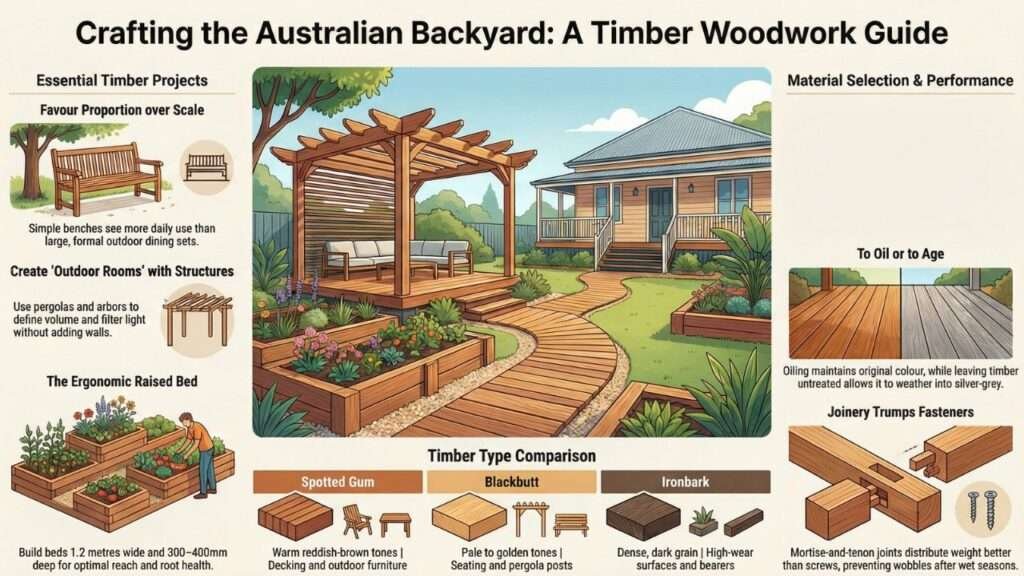
A wide-slatted bench built from spotted gum placed beside a garden bed becomes a fixture in the landscape rather than an afterthought pushed against a fence. A low patio table made from blackbutt offcuts, with legs mortised into a solid stretcher, holds its position through seasons without wobble or flex.
These are pieces built to last rather than to be replaced.
The grain of weather-resistant hardwoods develops character with exposure. Rain draws out the texture.
Sun deepens the tone. What begins as a smooth planed surface slowly becomes something more layered and particular to that yard.
Spotted gum, with its interlocked grain and warm reddish-brown tones, shifts in appearance depending on the angle of light.
Blackbutt takes on a silver quality when left unoiled and exposed to the elements. These changes are not faults. They are records of time spent outdoors.
The joinery used in handcrafted outdoor furniture matters beyond aesthetics.
A mortise-and-tenon joint at the leg-to-rail connection distributes load more evenly than a screwed bracket. The result is a piece that does not rock or loosen after a wet season.
One observation worth noting: modest furniture pieces often see more consistent daily use than larger elaborate settings.
A single bench or a compact two-seat arrangement integrates naturally into the landscape without demanding rearrangement or commanding too much visual attention. Large outdoor dining sets with matching chairs often sit unused between formal occasions.
A simple bench under a tree tends to get used most days as it simply belongs:
1. Wide-slatted bench designs suited to garden edges, shaded corners or along fence lines.
2. Compact hardwood tables with stable trestle or splayed-leg construction for casual meals.
3. Low lounge chairs built from durable timber offcuts using through-tenon or lap joinery.
4. Side tables scaled to accompany seating without crowding the surrounding area.
Garden Structures That Define Volume.
Pergolas, arbors and trellises introduce height and rhythm to a garden without enclosing it. They create volume and vertical interest in spaces that would otherwise feel flat and undefined.
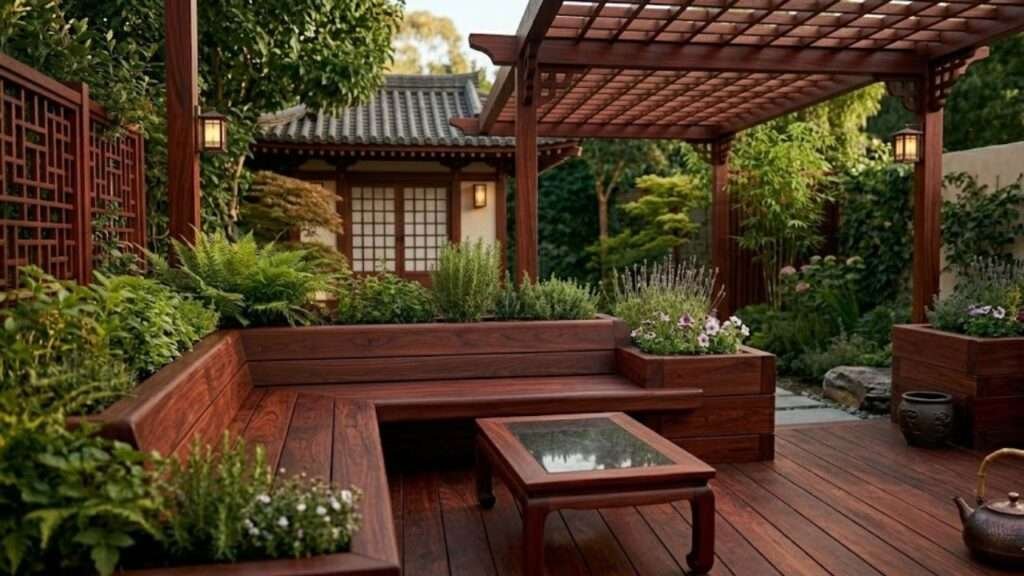
A pergola with evenly spaced hardwood rafters filters afternoon light into soft bands across the ground below.
The effect is calming and creates a distinct zone within the yard that functions like an outdoor room without walls.
Sitting beneath one in the late afternoon, when the light moves through the timber and the shadows shift, is a different experience from sitting in open sun.
An arbor positioned at the entrance to a path gives the garden a sense of sequence and arrival.
It marks the transition between one area and another in a way that a flat planting border or low edging never quite achieves.
The frame draws the eye forward and creates anticipation. That quality of spatial storytelling is achievable in a modest backyard with simple timber framing and a few planted climbers.
A trellis fixed to a fence or mounted on freestanding posts supports climbing plants and adds a textured backdrop to the garden.
As foliage fills in, the trellis becomes less visible and the planting takes over. That transition from bare structure to green coverage is part of the value of the project. It produces results that change and improve over time.
Fresh-cut cypress has a clean, resinous scent that fills the air during construction. That quality alone reinforces how directly timber connects the built structure to the natural setting it occupies.
The smell of the material is part of the experience of making it and it carries through into the finished piece in a subtler form during warm weather.
Larger structures do require periodic maintenance. Timber in fully exposed positions benefits from an annual application of penetrating oil or sealant to preserve the surface and slow the weathering process.
That is an honest trade-off. The visual and functional return over many years is considerable but ongoing care is part of the commitment that comes with a timber garden structure.
Planters and Raised Beds for Productive Corners.
Raised beds and timber planters introduce order to open ground. They make the productive parts of a garden feel intentional rather than improvised.
A bed built from untreated hardwood boards keeps soil contained, improves drainage compared to growing directly in compacted ground and brings vegetables or herbs within easy reach.
Kneeling is reduced and access from both sides means the bed can be managed without stepping on the growing surface.
The dimensions of a raised bed deserve thought before construction.
A width of no more than 1.2 metres allows comfortable reach from either side.
A depth of 300 to 400 millimetres provides sufficient root depth for most vegetables and herbs.
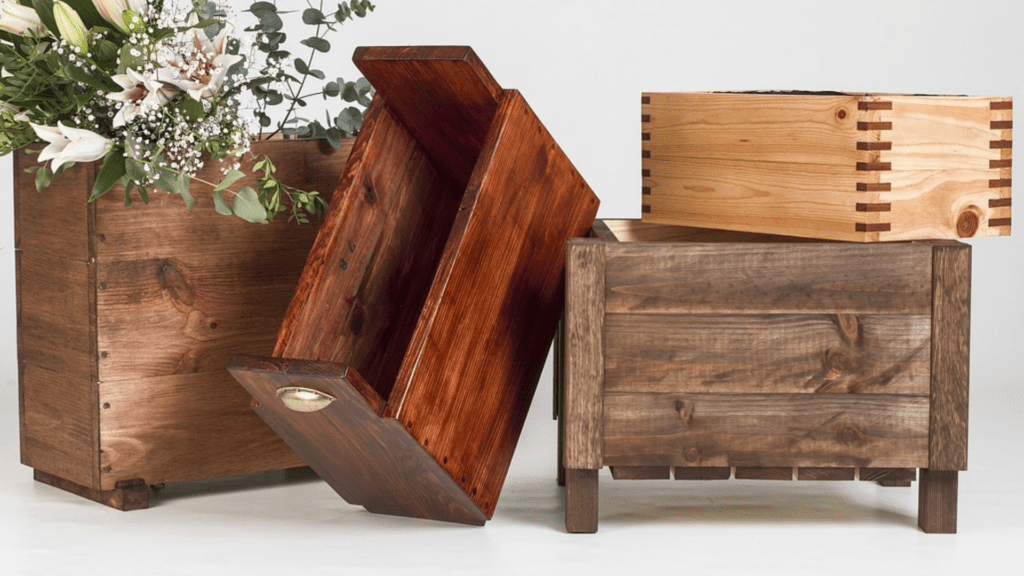
Narrow vertical planters made from recycled timber slats suit yards where horizontal space is limited.
They draw the eye upward and support climbing herbs or compact flowering plants without consuming ground area.
A series of three vertical planters mounted at different heights along a fence line creates a layered effect that adds depth to an otherwise flat boundary.
The recycled timber carries a weathered texture that no new board can replicate in the short term.
The sound of soil settling into a freshly built planter is a small sensory marker that signals the beginning of a new planting season. It is a detail that accumulates meaning over years of use.
Smaller planters often retain moisture more consistently than oversized ones.
That might run counter to the instinct to build large but it reflects how roots behave in practice.
Excess soil volume without sufficient root mass can hold moisture unevenly and create pockets of wet or dry soil that affect plant health.
Proportioning the planter to its intended contents produces more reliable growing conditions and better results.
1. Square planter boxes sized for compact patios, balcony edges or courtyard corners.
2. Long raised beds suited to vegetable growing positioned along a north-facing boundary.
3. Vertical timber frames designed for espaliered fruit trees or climbing flowering plants.
4. Freestanding herb planters at bench height for accessible kitchen garden use.
Outdoor Cooking and Bar Stations.
A timber bar or outdoor cooking station gives entertaining a fixed point and a sense of permanence. Simple construction using sturdy hardwood uprights and a polished timber top produces a surface that anchors casual gatherings and signals that the space has been considered for social use.
Shelves below the bench hold utensils, boards and condiments and keep the cooking area tidy without requiring a fully enclosed outdoor kitchen build.
The restraint of the design is part of its strength.
The choice of timber for an outdoor bar top matters more than in most other applications because the surface takes direct contact from food preparation, drink placement and hands.
A dense, close-grained hardwood such as ironbark or spotted gum is well suited to this use. It resists denting, takes an oil finish well and develops a warm sheen with use. Gaps or open joints in the top surface should be avoided as they collect moisture and organic debris.
The surface of oiled timber near a grill carries a sensory character that is difficult to describe but easy to notice.
The scent of natural oil in warm air adds something intangible to the experience of cooking outdoors. These details accumulate over time and become part of what makes the space feel genuinely used and familiar.
Timber bar tops warm quickly in direct sun. During cooler months that is a welcome quality.
A surface that holds warmth extends comfortable use into the early evening. In summer, a simple overhead structure or shade sail positioned above the bar addresses the issue without complicating the construction.
Planning for the sun path at the design stage, specifically which direction the bar will face and at what time of day it will see the most direct light, reduces the need for retrofitting later.
Decks and Privacy Screens.
A deck creates a level, stable surface that extends the functional floor area of the house outward. It removes the transition between indoor and outdoor space by making the exterior as comfortable and usable as the interior.
Wide hardwood planks laid with even gaps feel solid underfoot and develop character with age. Left unoiled, the timber weathers to a gentle silver-grey tone that suits naturalistic garden settings.
An oiled finish retains the warm original colour for longer and maintains a more polished appearance.
The construction of a deck involves more decisions than most backyard timber projects. Joist spacing, bearer sizing and the direction of decking boards relative to the house all affect the finished result.
Boards laid parallel to the longest dimension of the deck typically make the space feel larger. Laying boards at 45 degrees adds visual interest but increases material use and the complexity of cut work at the perimeter.
Privacy screens built from vertical timber slats provide seclusion without stopping the movement of air through the space.
The spacing between slats determines how much visual screening the panel delivers. A 20-millimetre gap between 90-millimetre slats provides a reasonable balance between privacy and airflow.
Narrowing the gap increases screening but reduces ventilation. Wider gaps feel more open but offer less definition.
This decision is worth considering in context of what the screen is positioned against and how it will be seen from inside the house.
Footsteps on hardwood decking produce a low, resonant sound that contributes to the calm quality of a well-built outdoor space. It is a small detail but it registers in a way that composite or concrete surfaces do not.
The response of the material underfoot gives the space a sensory quality that improves time spent on it.
Decks positioned in heavily shaded areas accumulate organic matter faster than those in open sun. Reduced drying time and leaf fall create surface buildup that affects appearance and long-term condition.
Factoring this into a maintenance routine, including seasonal sweeping and an annual wash, keeps the deck looking well considered. A sloped surface that directs water away from the house prevents pooling between boards.
Playhouses and Treehouses for Family Yards.
A small timber playhouse built from pine framing and plywood cladding gives children a defined space within the garden that belongs to them.
It draws activity to one area and frees the rest of the yard for other uses. The project does not need to be elaborate.
A pitched roof, a door opening, a window on each side wall and a small front deck are sufficient to create a space that children will use consistently.
Simplicity in the design often produces more durable results than complex forms. A treehouse offers a different quality of experience.
A simple platform built around the trunk of a mature tree with a low railing and a ladder gives children access to a perspective on the yard that ground-level play does not provide.
The elevation changes how the space looks and feels. Looking across the garden from above rather than through it produces a sense of discovery that is difficult to replicate at ground level.
Timber has a tactile quality that plastic and powder-coated metal structures rarely replicate.
The texture of rough-sawn pine under small hands, the sound of feet on a timber floor and the warmth the material holds in afternoon sun are details that register without needing to be named.
These qualities are part of why children develop a genuine connection to timber play structures in a way that does not always occur with synthetic alternatives.
These structures often become long-term fixtures in a yard. Placement decisions deserve careful thought because the structure will occupy that position for years.
Positioning a playhouse where it does not block natural light to the house, crowd established plantings or reduce usable open space preserves the overall balance of the yard. Locating the playhouse where it can be seen from inside the house allows for comfortable supervision without requiring physical presence in the garden at all times.
Timber Selection and Sustainable Choices.
Selecting the right timber for each application affects both the longevity of the project and its appearance over time.
Dense hardwoods suit structural and load-bearing elements such as deck joists, bench frames and pergola posts.
Lighter species work well for trellises, privacy screens and planters where weight and ease of handling matter more than compressive strength.
Using the appropriate grade and species for each component avoids over-engineering some parts while under-specifying others.
Australian hardwoods are among the most durable options available for outdoor use. Spotted gum, blackbutt and ironbark all carry high durability ratings for in-ground and above-ground exposure.
They resist insect activity and decay without requiring chemical treatment, which makes them well suited to projects near food-producing garden beds.
The density of these timbers also means they hold fixings well and resist surface damage from foot traffic and general outdoor use.
Responsibly sourced timber supports a more considered approach to building.
Certification from recognised forestry bodies provides confidence that the material has been harvested within managed and audited systems.
Reclaimed boards from old fencing, demolished structures or surplus pallet timber can be repurposed into planters, small tables or garden edging.
They carry a weathered texture and surface patina that new timber takes many years to develop naturally. That quality is part of their value.
Natural oil finishes applied to exposed timber surfaces highlight the grain and provide weather resistance without sealing the surface completely.
The timber continues to move with changes in humidity, which reduces the risk of surface cracking that can occur with film-forming finishes on exterior timber.
The faint aroma of linseed or tung oil during application reinforces the connection between the material and the natural environment it occupies.
|
Timber Type |
Appearance |
Durability |
Typical Application |
|
Spotted Gum |
Rich, varied grain with warm reddish tones |
High |
Decking and outdoor furniture |
|
Blackbutt |
Uniform pale to golden tone |
High |
Seating, pergola posts and structural elements |
|
Cypress |
Light colour with a distinct resinous scent |
Medium |
Garden structures and trellises |
|
Ironbark |
Dense, dark grain with tight texture |
Very High |
Posts, bearers and high-wear surfaces |
|
Reclaimed Pine |
Weathered, textured surface with visible history |
Low to medium |
Planters, edging and casual tables |
Sustainable timber choices sometimes carry a higher initial cost. That cost reflects the sourcing practices and certification systems behind the material.
It also tends to produce timber that is more consistent in quality and more durable in use than uncertified alternatives sourced without regard for origin.
Over the full life of a well-built outdoor piece the initial investment distributes across many years of reliable use and requires fewer replacements.
The wider benefit of choosing sustainable materials extends beyond the individual project.
Demand for responsibly sourced timber supports forestry practices that maintain ecological function while supplying a renewable material.
Making sourcing part of the planning process rather than an afterthought is a straightforward decision with long-term benefits.
Bringing the Backyard Into Shape.
Each timber project added to a backyard contributes more than its individual function. A bench invites sitting.
A raised bed organises the productive corner of the garden.
A deck connects the interior of the house to the outdoor area in a way that makes both spaces more useful.
A pergola defines a gathering point that functions in partial shade and partial sun. These elements work together over time to give a yard a coherent character that reflects how the people who use it actually live.
Starting with one well-proportioned and carefully placed piece often generates momentum toward further improvement.
The bench suggests a companion table. The table suggests a pergola overhead to define the space.
The pergola suggests a privacy screen along the boundary to make the zone feel enclosed without being closed off.
Over time the yard accumulates a collection of handcrafted elements that feel like they belong together because they share the same material logic, the same considered approach to proportion and the same respect for the landscape they sit within. That coherence is not achieved through uniformity.
A spotted gum bench alongside a cypress trellis alongside a raised bed made from reclaimed pine creates variation in colour, texture and weathering that gives the yard genuine character.
What connects the elements is the quality of craft and the care given to how each piece relates to its surroundings.
A plain outdoor area becomes a place worth spending time in when it has been shaped by decisions made at the scale of the human body, built from materials that respond to light and weather and assembled with enough skill that the joinery holds and the surfaces age well.
Woodworking offers a direct and practical path toward that outcome.