Woodworking has a way of clarifying what matters. Stand long enough at a bench and you begin to understand that the craft offers things no income can provide.
The returns
arrive quietly, in shavings and grain lines, in the specific silence of a joint
pulled tight. Money enters the workshop through the door of tools and timber.
What leaves is something else entirely.
The wood dictates the pace.
A finish coat of tung oil
needs twenty‑four hours between applications. Glue‑ups must sit overnight
regardless of how full the order book is.
These are not suggestions.
The material enforces a rhythm that no amount of capital can override, and in
doing so it teaches a lesson that is genuinely rare in modern working life:
quality is a function of time, not effort alone.
This patience is not
passive. Waiting for a dovetail layout to settle in the mind before scribing is
an active, deliberate discipline.
The craftsman who learns
to sit with a piece, to observe how the light catches the surface at different
hours, is cultivating something that no tool purchase can shortcut. The
seasoning of judgment takes years. It cannot be imported or expedited.
What the hand leaves behind.
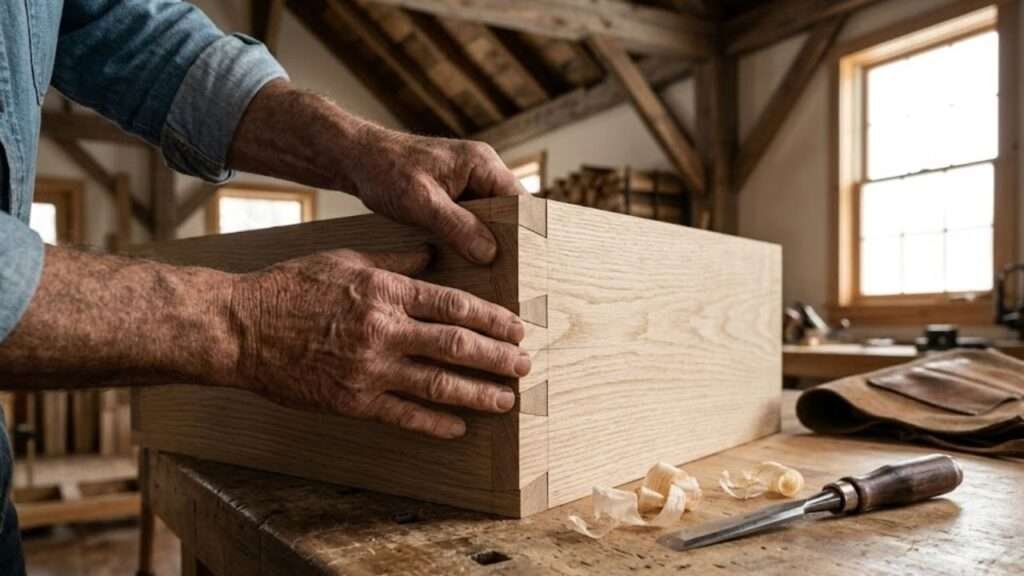
A machine‑cut dovetail is
geometrically correct. It is also entirely silent about who made it. The hand‑cut
version carries small evidence of its maker: a baseline that drops half a
degree at the fourth pin, a shoulder line with the faint ghost of a pencil.
These are not errors. They are the craft’s equivalent of a fingerprint.
Mass‑produced furniture
accounts for most of what fills homes today, and it is fine at what it does.
But it has no narrative.
The hand‑built piece
carries the specific afternoon in which it was made, the grain decision that
was agonised over, the joint that was remade twice before it seated cleanly.
That history is embedded in the object. Money can produce uniformity. It cannot
produce that.
Working with the wood, not against it.
A board with an
interlocked grain and a large pin knot near the mortise location presents a
problem.
The expensive solution is
to discard it and select a clear piece. The more interesting solution is to
redesign the joint so the knot sits outside the stress zone, then let the
figure become the visual anchor of the panel.
Wood is not a consistent
raw material. It moves with humidity, hides tension in the pith, and reveals
character in figure that no supplier can guarantee.
The craft of working with
this unpredictability is genuinely skilled work. It builds a particular kind of
intelligence: the ability to read a situation, adapt without frustration, and
find value in what initially appeared to be a setback. That capacity transfers
well beyond the workshop.
The workshop as a place of quiet return.
There is a specific
quality of attention that hand‑planing produces.
The focus required to hold
a consistent angle, to read the shaving as it curls, to hear the pitch of the
cut change as the grain reverses, occupies the mind in a way that leaves almost
no room for anything else.
Hours move differently.
This is what psychologists describe as flow state: a total absorption that
functions as genuine mental rest even while the body works.
The therapeutic dimension
of making is not incidental. It is one of the craft’s primary returns.
No salary figure can
replicate the specific calm of finishing a surface by hand, running a thumb
across the grain to check for high spots, and finding the wood smooth and
ready. That moment belongs entirely to the person who produced it.
Worth noting,
tangentially: the smell of freshly worked wood has a measurable calming effect.
The compounds released by
species such as cedar and pine are the same ones studied in forest‑bathing
research. The workshop is doing something physiological long before the project
is finished.
Building for the next generation.
A flat‑pack dining table
has a service life measured in years. A solid white oak table, properly
constructed with drawbored mortise and tenon joints and a hand‑rubbed oil
finish, has a service life measured in generations.
These are not comparable
objects despite occupying the same category in a furniture catalog.
|
Attribute |
Mass‑produced
furniture |
Hand‑built
heirloom piece |
|
Expected
lifespan |
5 to 15
years |
50 to
150 years or more |
|
Repairability |
Limited,
proprietary fittings |
Fully
repairable with standard tools |
|
Material
record |
Anonymous |
Traceable
to species, source and maker |
|
Emotional
value over time |
Depreciates |
Accumulates
with use and memory |
|
Monetary
value |
Declines
sharply |
Often
stable or appreciated |
The piece built for a
grandchild’s first home carries a weight that no receipt can confer. It is the
clearest expression of the craft’s relationship with time: woodworking is one
of the few activities in which a person can produce something that will almost
certainly outlast them.
Knowledge before capital.
A craftsman who
understands wood movement, grain orientation, and sharpening geometry can build
a stable, refined piece of furniture with a modest set of hand tools. A collector
who owns a fully equipped cabinet shop but lacks that understanding will
produce furniture that moves, cracks, or fails at the joints within a season or
two.
This is the counter‑intuitive
truth of the craft: more money spent on tools does not correlate with better
work.
Understanding how a given
species behaves across the moisture cycle, knowing that quartersawn oak moves
roughly half as much as flatsawn across its width, knowing how to sharpen a
plane iron so it pares end grain without tearing, these form the actual
foundation of the work.
They are acquired through
practice and instruction, not through purchase. Capital can equip a workshop.
It cannot stock it with understanding.
There is a practical trade‑off
here worth stating plainly. Hand tools require significantly more time than
powered equivalents for the same result.
Cutting a set of dovetails
by hand on a blanket chest takes an experienced craftsman several hours. A
router jig and a template reduce that to twenty minutes. Anyone building for
income must weigh this honestly.
The hand‑cut version is
not inherently superior as furniture; it is superior as an experience of
making. Those are different things, and conflating them leads to frustration.
The offcut pile as creative resource.
The end pieces from a
walnut glue‑up, the short lengths of reclaimed Douglas fir salvaged from a
demolished floor, the elm slab recovered from a tree removed from a city
street: these materials carry no acquisition cost and considerable character.
Some of the most accomplished small work in the craft emerges directly from
limitations imposed by available material.
Working from an offcut
pile forces decisions that would not arise from a fresh board. The length
determines the project.
The figure informs the
design. The maker becomes responsive rather than prescriptive, and that
responsiveness often produces work of genuine originality. The monetary value
of the raw material is zero.
The creative return on
that same material can be substantial.
What knowledge passes between hands.
Plans can be purchased.
Techniques can be learned from video. However, the specific knowledge that a
skilled craftsman holds, how much pressure to apply at the heel of a hand saw
to keep a cut vertical, how to read a slightly concave sole on a plane before
it becomes a problem, where to stand relative to a workpiece to see the surface
accurately in raking light, this passes only through proximity and time.
1.
The ability to sharpen a
chisel to a working edge by feel, without a guide, in under two minutes.
2.
The habit of checking a
board for wind across its length before marking out any joint.
3.
The instinct to work
slightly proud of a line and refine to it, rather than cutting directly to the
mark.
4.
The judgment to know when
a joint is close enough and when it genuinely needs to be remade.
None of these appear in a
product listing. They are the accumulated returns of a relationship between
teacher and student, passed through demonstration and repetition. Mentorship in
the craft is not sentimental. It is the most efficient transmission system the
trade has ever developed.
The lesson arrives uninvited.
Even experienced makers
lose pieces to split boards, lifted grain, and finishes that bloom overnight in
unexpected humidity. These moments are not failures of investment. They are the
craft’s version of instruction, delivered without softening.
Woodworking does not
protect its practitioners from imperfection. It requires them to develop a
tolerance for it, to analyse what went wrong without defensiveness, and to
begin again with the knowledge the failure provided.
The maker who can remake a
joint without resentment, who can strip a failed finish and start the process
over with genuine equanimity, has developed something more durable than a
skill.
They have developed a
posture toward imperfection that serves well in every other area of a
considered life.
The workshop keeps its own
accounts. Time deposited returns as capability. Patience compounds into
judgment. Failures, processed honestly, become the foundation of genuine craft.
None of this appears on a balance sheet.
All of it accumulates. The
woodworker who understands this earns more from the bench than any invoice could
reflect.