Timber, Tradies And The Architecture Of 1.2 Million Homes
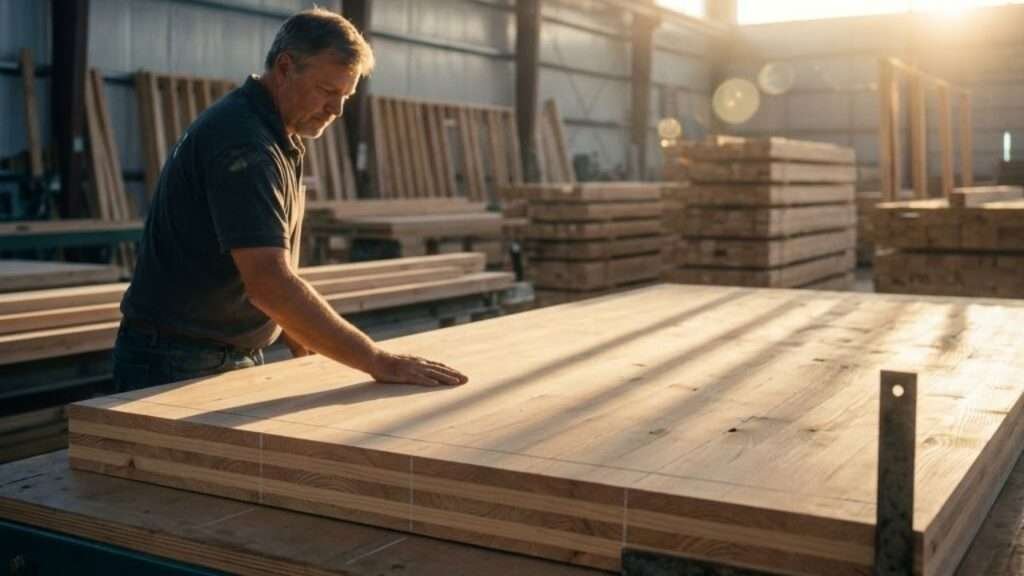
There is a moment in every serious woodworking centric project when the material stops being abstract. The plan on paper, the measurements in a notebook, the joinery sketched on a scrap of ply. All of it becomes real the instant you pick up a piece of timber and feel the weight of it.
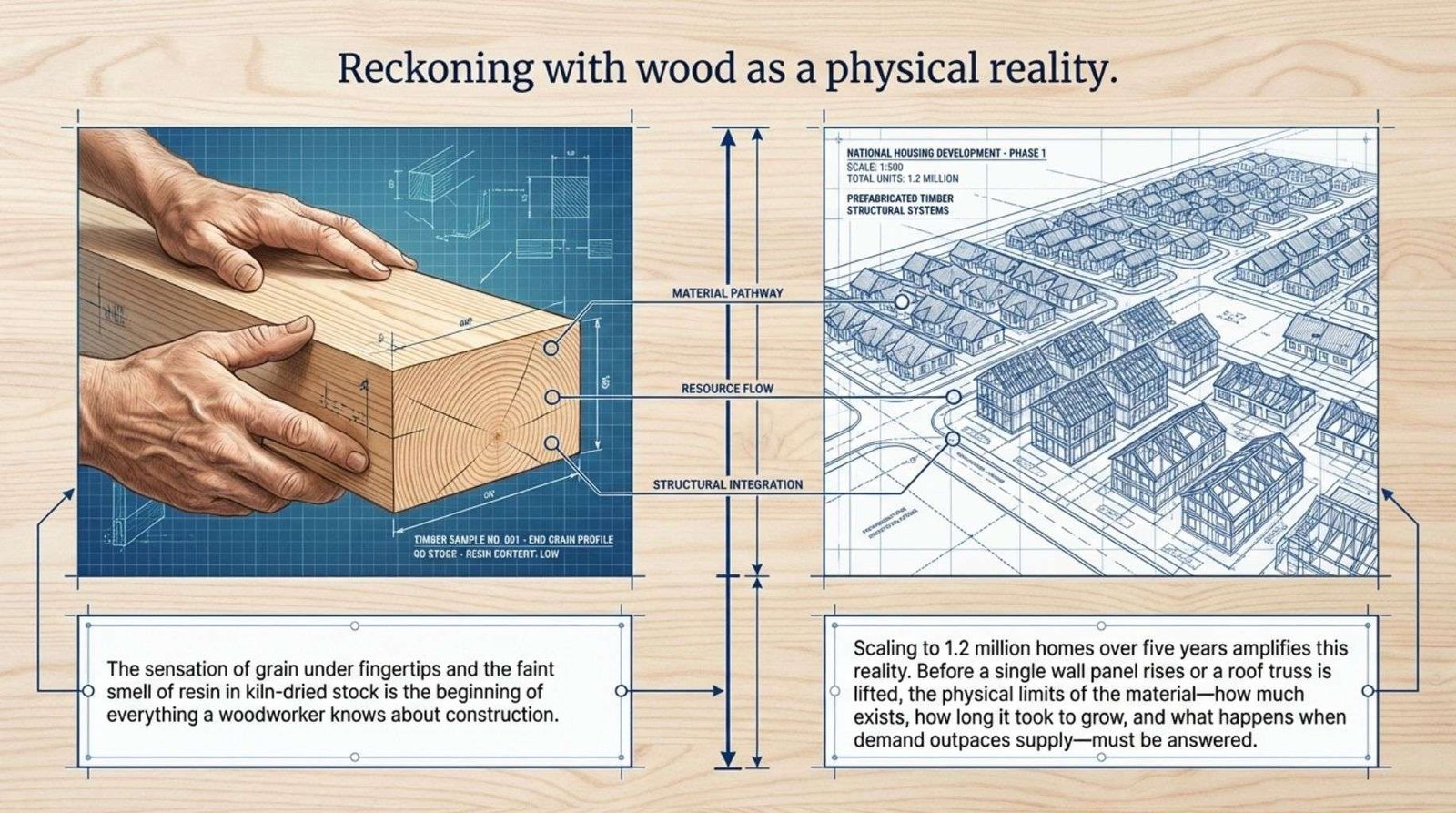
That sensation, grain under fingertips, the faint smell of resin still present even in kiln-dried stock, is the beginning of everything a woodworker knows about construction. Scaling that understanding to building 1.2 million homes over five years does not diminish it, it actually amplifies it.
After all, the logic is the same. Before a single wall panel rises, before a roof truss is lifted into position, before a timber-framed floor system is decked and fastened, someone has to reckon with wood as a physical thing.
Where it comes from. How much of it exists. How long it took to grow. +What happens when demand outpaces supply.
This article explores what that reckoning looks like at national scale and why the values that guide a woodworker’s bench, patience, material knowledge, structural honesty and respect for the grain of things, turn out to be exactly the values that a serious housing program requires.
The Forest Comes First.
Timber does not appear, it grows. That simple fact is the foundation of everything that follows and it is the fact that most housing policy discussions skip past too quickly.
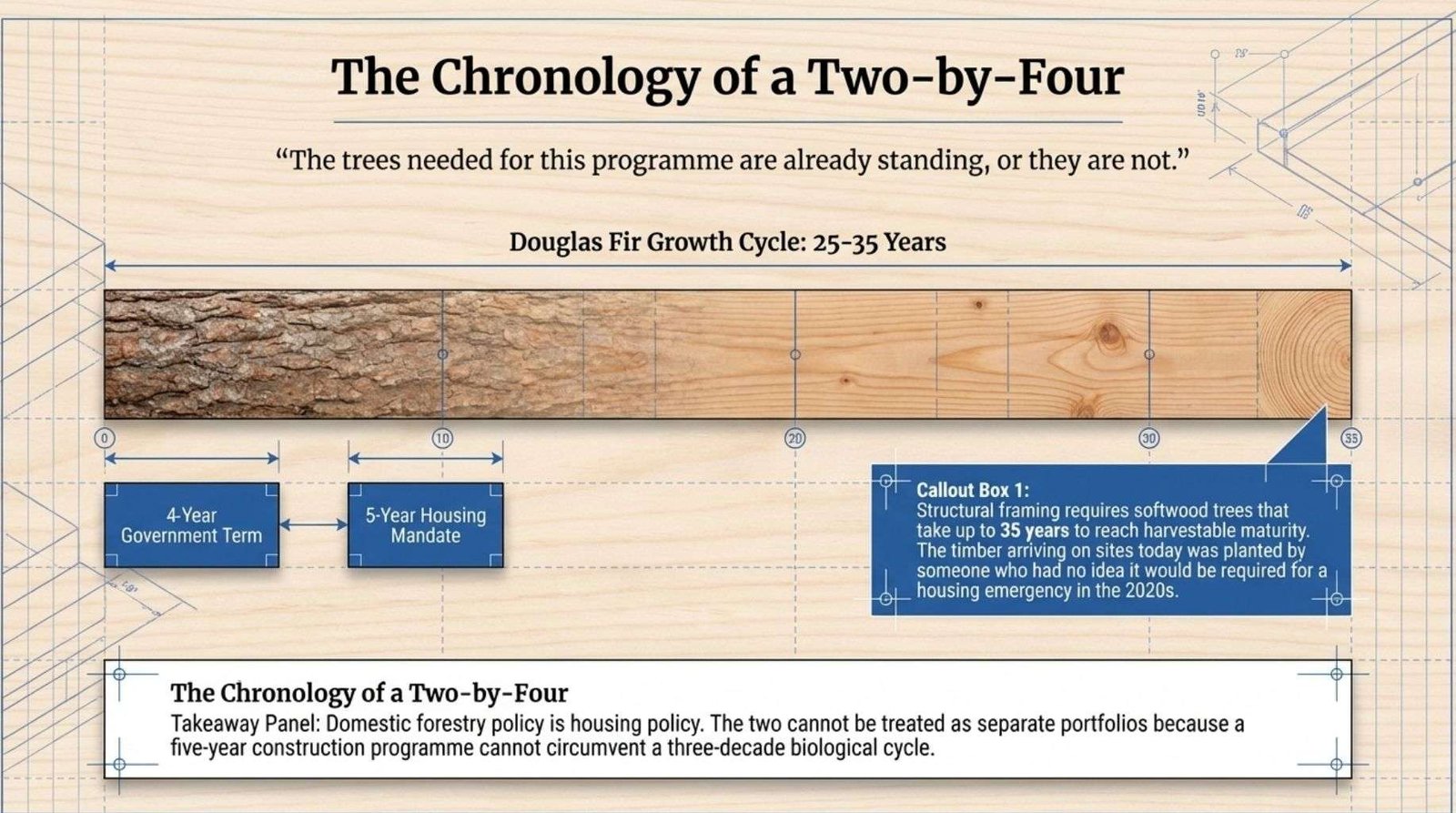
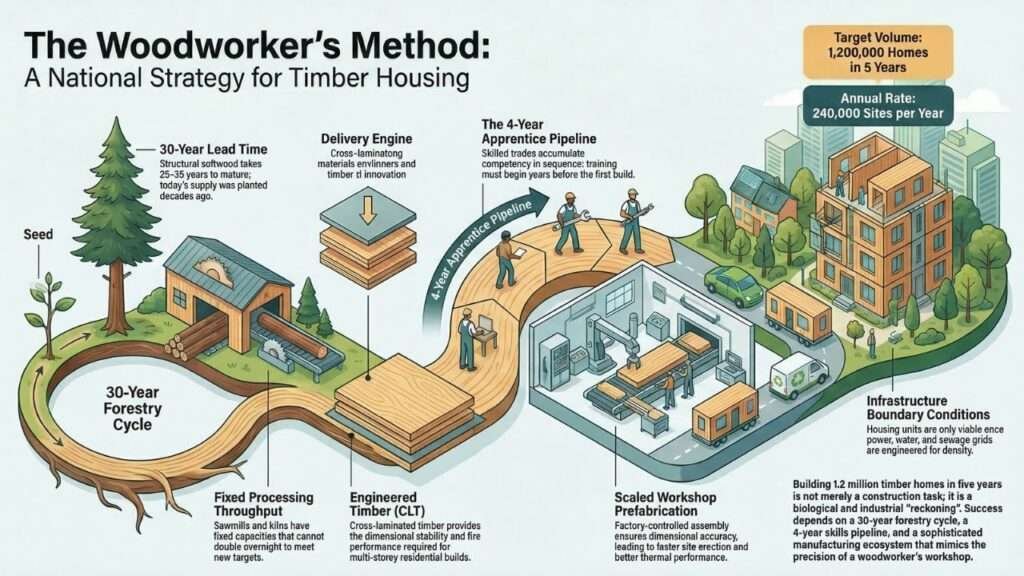
A softwood tree suitable for structural framing, a radiata pine or a Douglas fir, takes between 25 and 35 years to reach harvestable maturity.
The timber being milled and shipped to construction sites today was planted by someone who had no idea it would be needed for a housing emergency in the 2020s. That is not a coincidence or a stroke of luck.
It is the result of long-range forestry investment, land-use planning and replanting cycles that operate on timescales most government terms never reach.
For a five-year program producing 1.2 million homes, this creates a structural constraint that no amount of political ambition can dissolve.
The trees needed for that program are already standing, or they are not. If domestic forestry was adequately managed across the preceding three decades, the supply chain has a foundation.
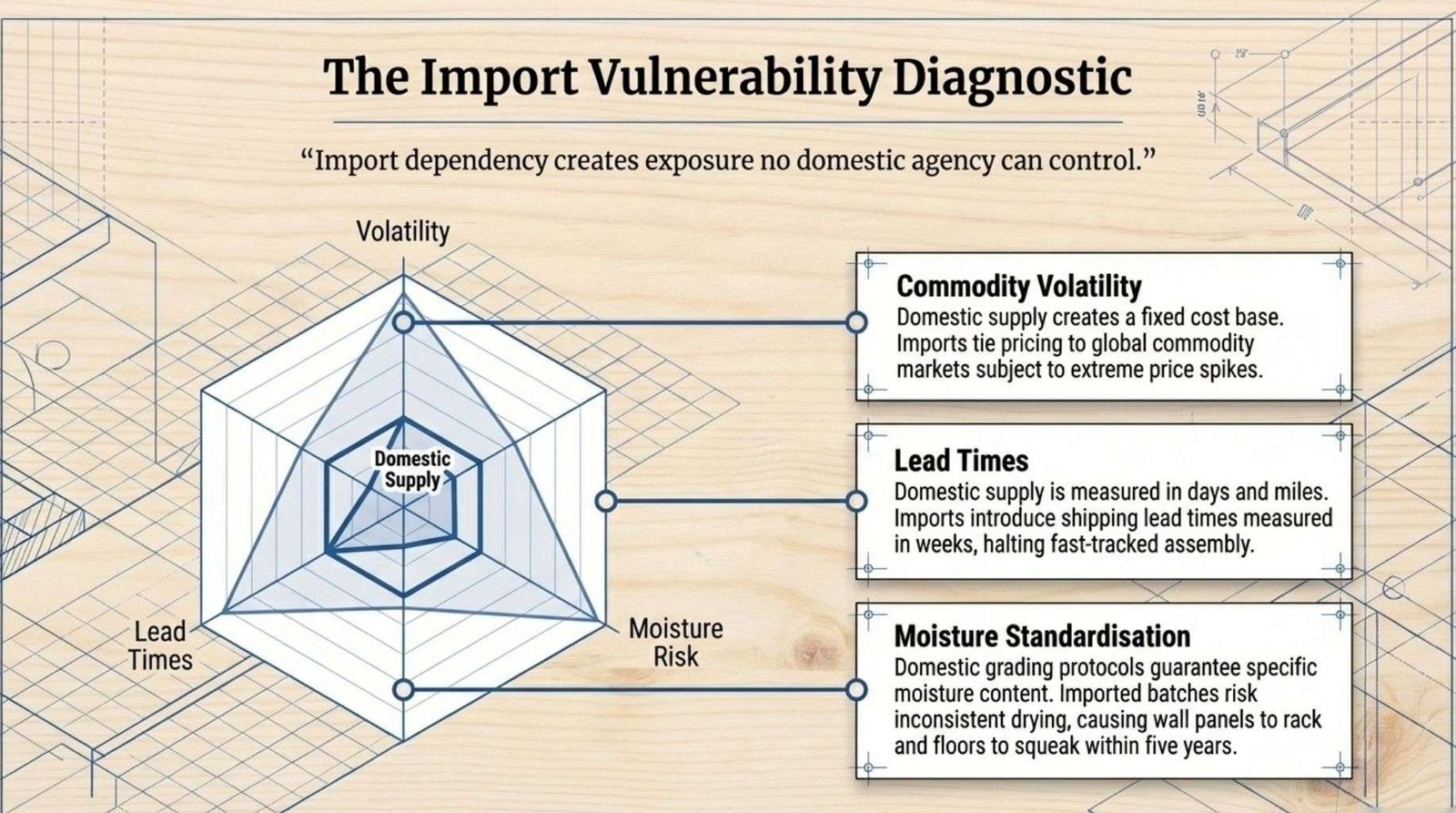
If it was not, the program becomes dependent on imports and import dependency brings its own complications: shipping lead times measured in weeks, pricing tied to global commodity markets and exposure to disruptions in distant supply chains that no domestic agency can control.
There is a secondary consideration that woodworkers who work with reclaimed timber will recognise immediately.
Not all wood is the same. Structural framing requires consistent species, grading and moisture content.
A poorly specified or inconsistently dried batch of framing timber causes wall panels to rack, floors to squeak and joinery to bind in its frames within five years of installation. At residential scale, that is an inconvenience.
At the scale of 1.2 million homes, it is a systemic quality failure that creates a maintenance burden lasting decades.
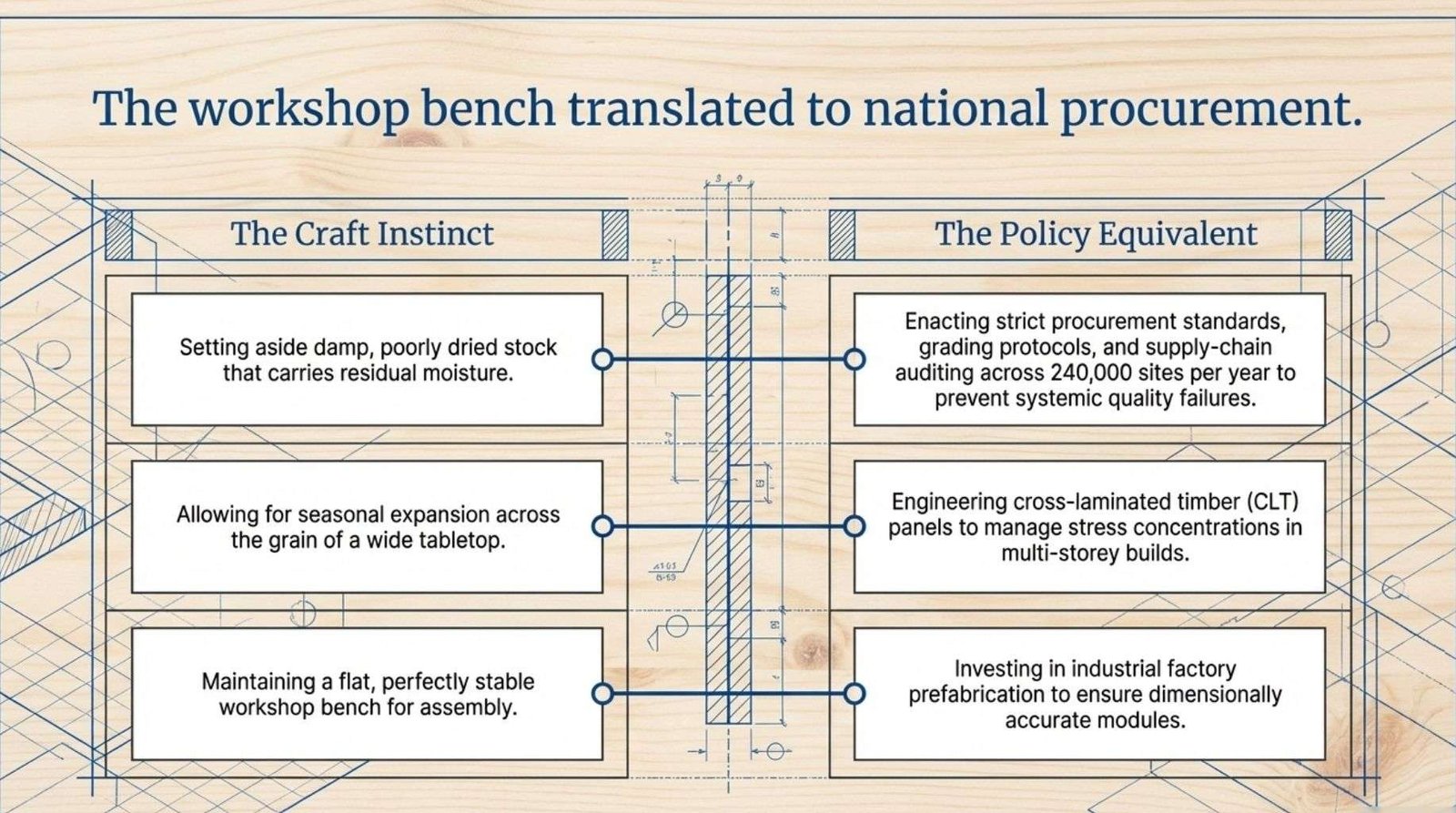
The sensory baseline matters here. When a carpenter runs a hand along a piece of framing timber and finds it slightly soft at one end, still carrying moisture the kiln did not fully remove, that carpenter knows to set it aside.
At program scale, that judgment has to be encoded into procurement standards, grading protocols and supply-chain auditing, because no individual carpenter can inspect every piece of timber arriving at 240,000 sites per year.
Domestic forestry policy is, therefore, housing policy. The two cannot be treated as separate portfolios.
The Timber Processing Ecosystem.
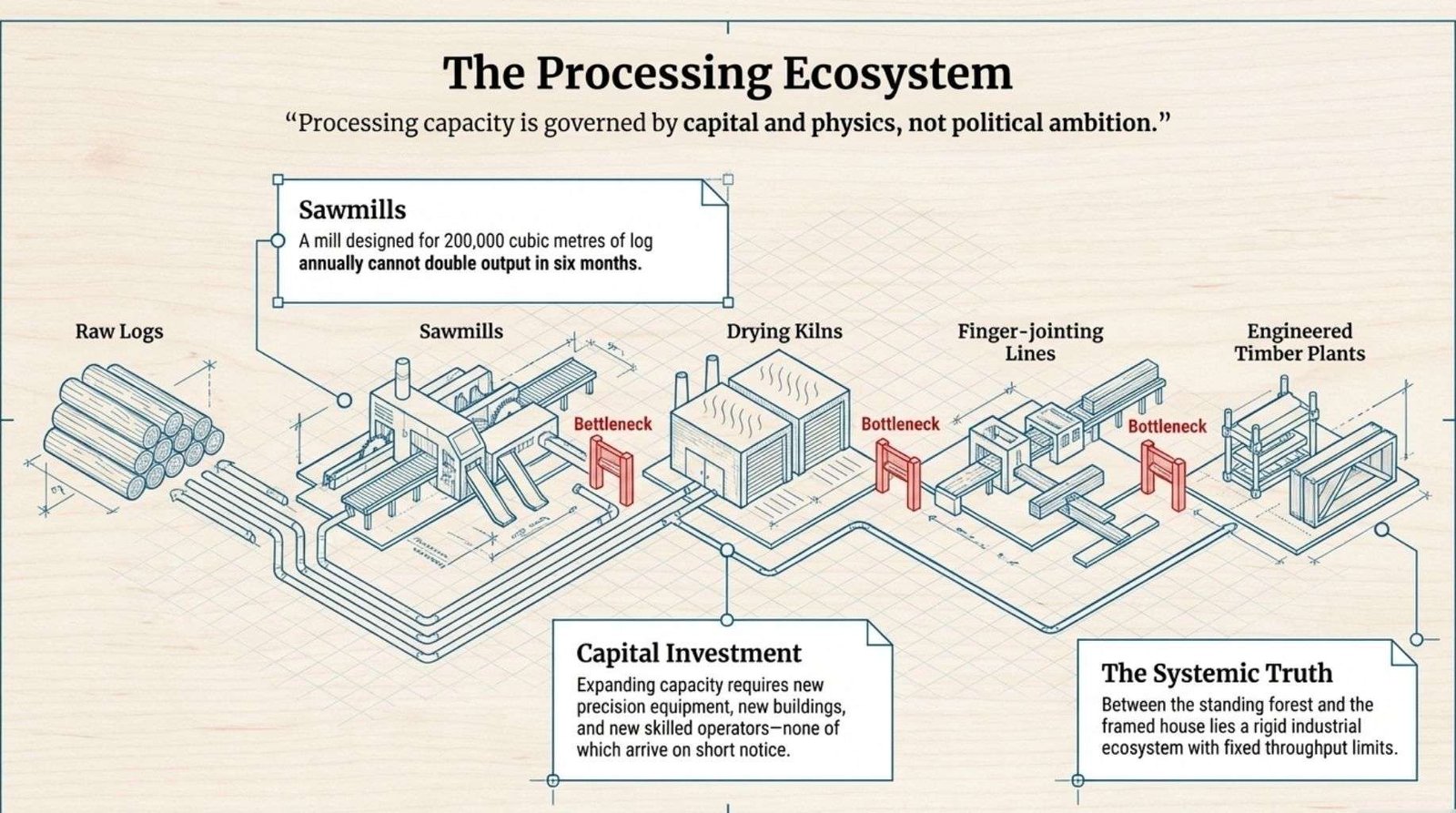
Raw trees do not become wall frames. Between the standing forest and the framed house lies an entire industrial ecosystem: sawmills, drying kilns, treatment facilities, finger-jointing lines and engineered timber plants producing the laminated veneer lumber and cross-laminated timber panels that modern residential construction increasingly depends on.
Each of these facilities represents a significant capital investment with a fixed throughput capacity.
A sawmill designed to process 200,000 cubic metres of log per year cannot double its output in six months because a housing minister announces an ambitious target.
Expanding milling capacity requires new equipment, new buildings and new skilled operators, none of which arrives on short notice.
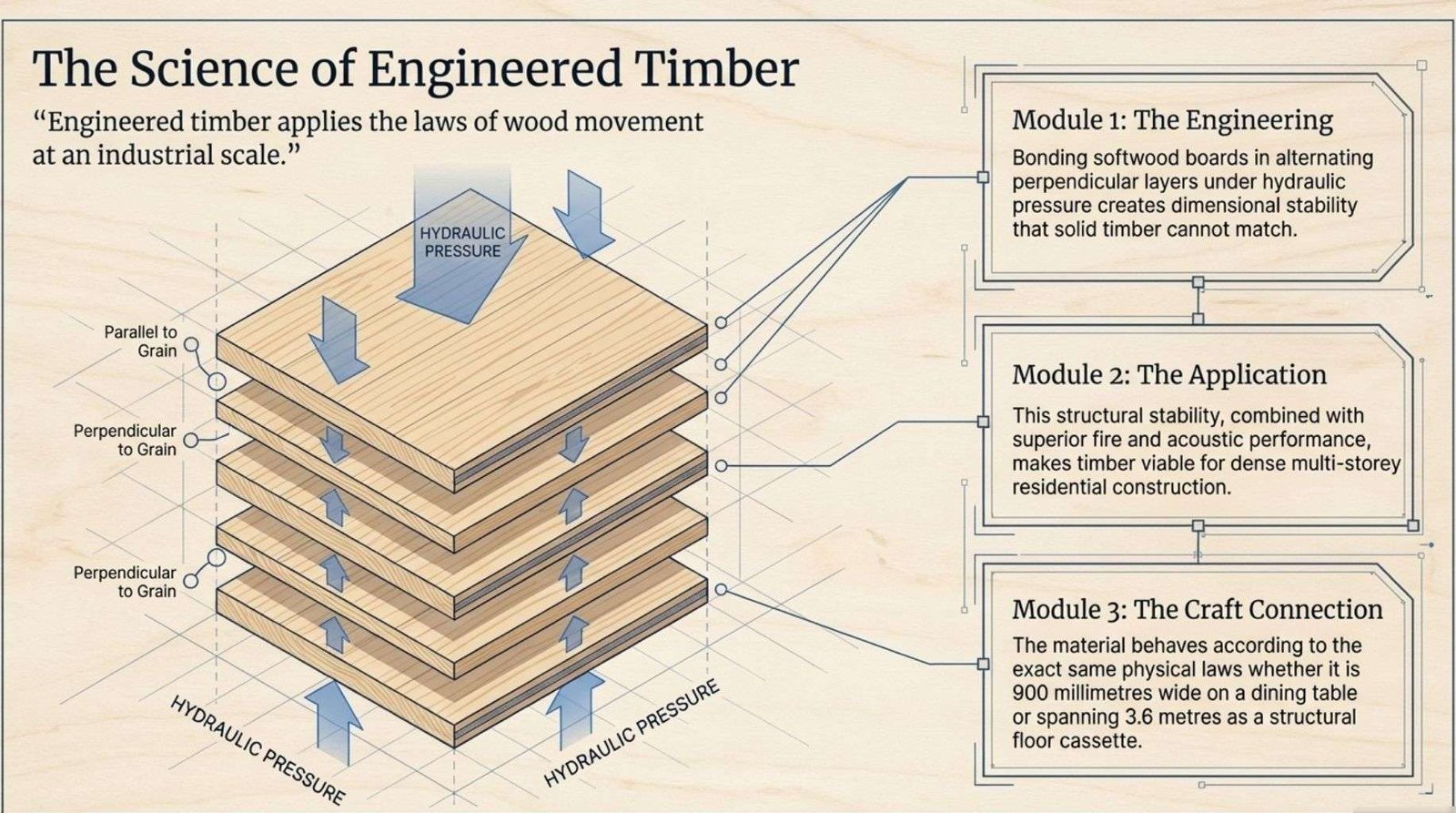
The engineered timber dimension is worth particular attention. Cross-laminated timber, known in the industry as CLT, is manufactured by bonding softwood boards in alternating perpendicular layers under hydraulic pressure.
The result is a structural panel with dimensional stability that solid timber cannot match and with fire and acoustic performance that makes it suitable for multi-storey residential construction. CLT plants are expensive to establish.
They require precision manufacturing environments, large hydraulic presses and sophisticated CNC cutting equipment. However, once operating at scale, they can produce structural floor and wall panels at a rate that dramatically accelerates on-site assembly.
The connection to craft woodworking is direct, not metaphorical. The same understanding of wood movement that guides a furniture maker when designing a wide tabletop, allowing for seasonal expansion across the grain, predicting where stress will concentrate, informs the engineering decisions in a CLT panel.
The material behaves according to the same physical laws whether it is 900 millimetres wide on a dining table or 3.6 metres wide in a structural floor cassette.
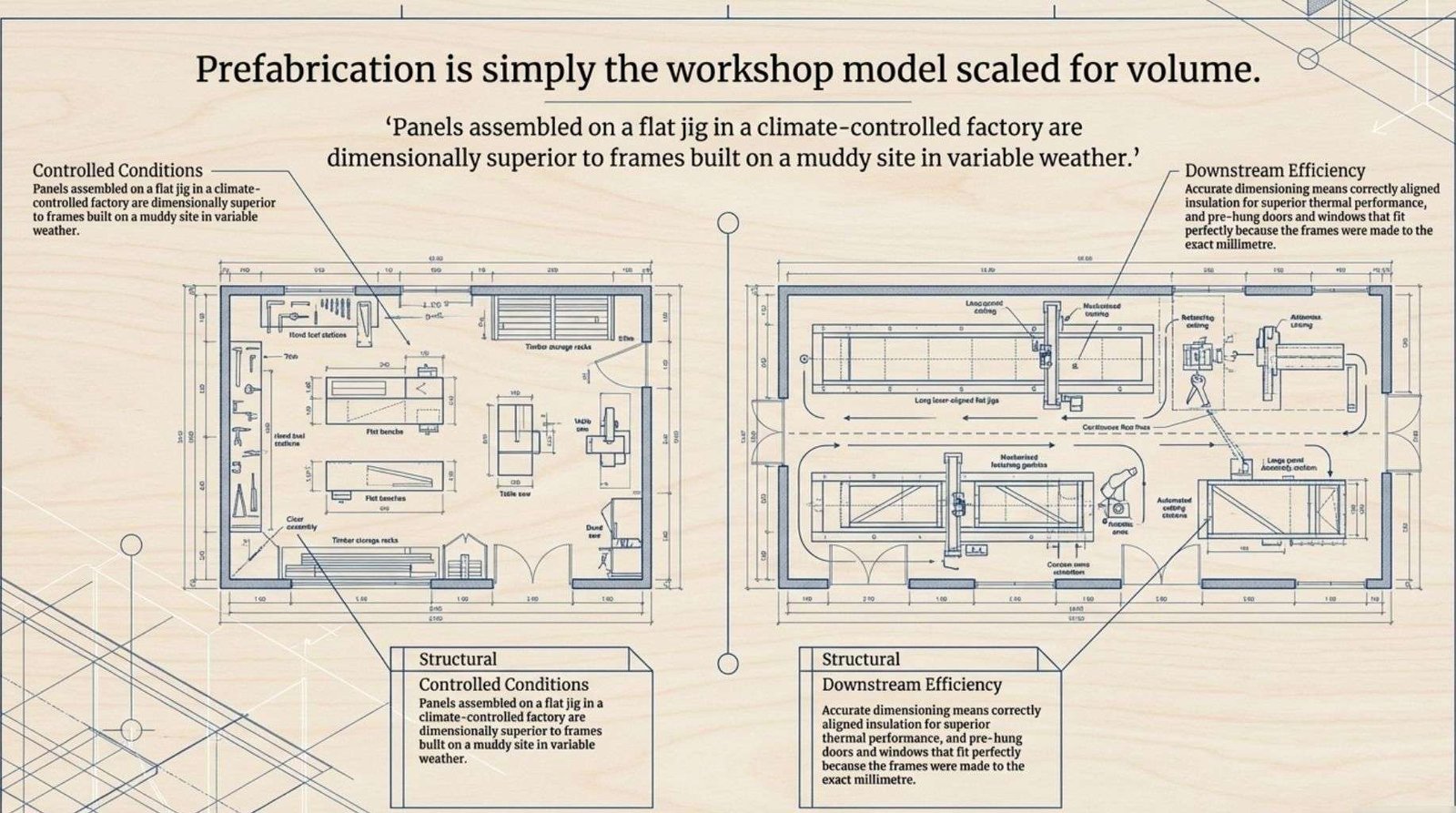
Prefabrication, which the housing industry often presents as a modern innovation, is in fact a scaling of the workshop model.
A furniture maker who produces multiple identical components and assembles them efficiently is practicing the same logic as a wall panel factory producing standardised framing modules.
The difference is volume and the degree to which the process is mechanised. The underlying principle, accurate dimensioning, consistent jointing, dry and stable material, is identical.
The Trades Pipeline: Skills That Cannot Be Rushed.
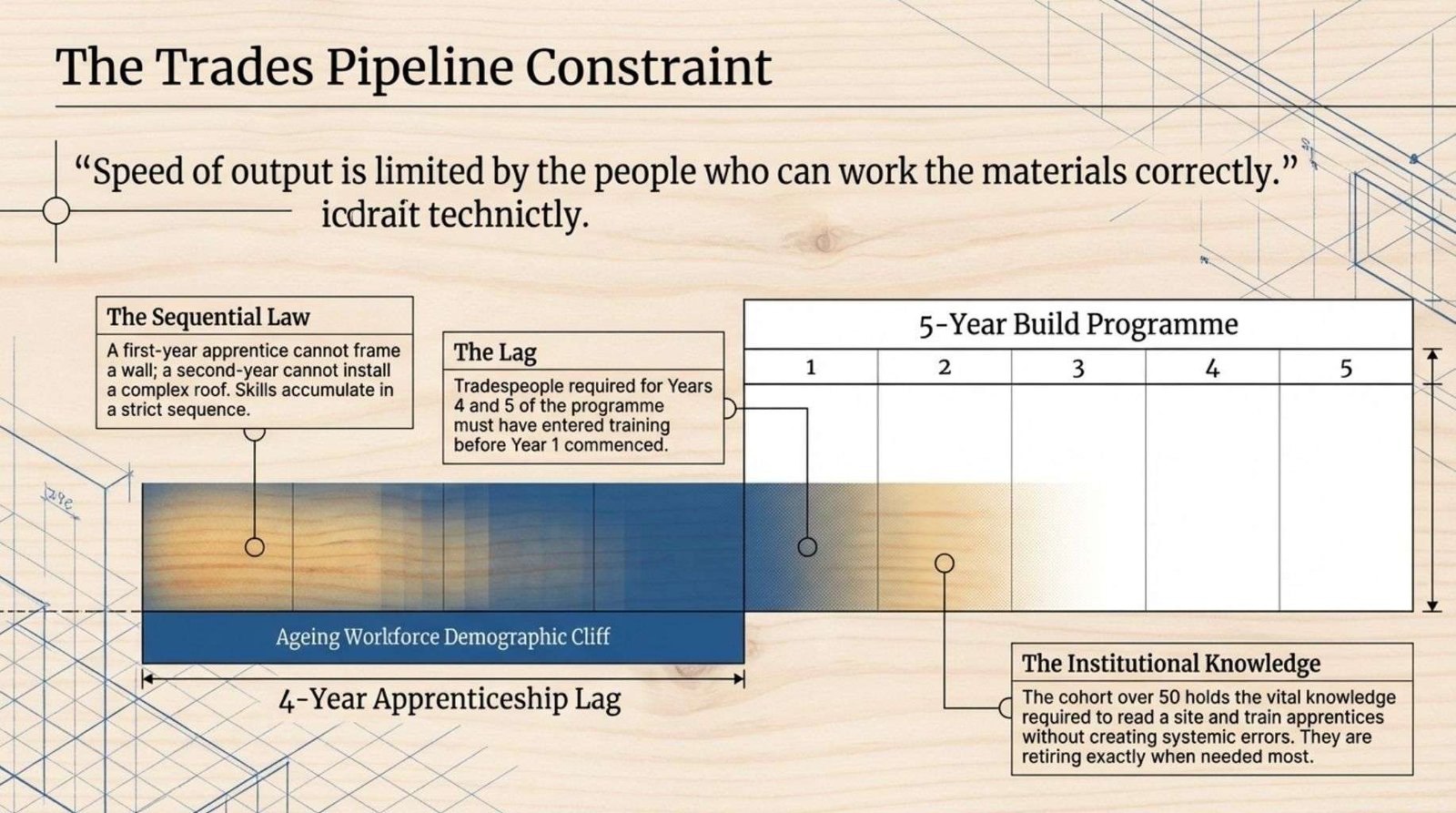
There is a counter-intuitive truth at the centre of the skilled trades question. In a construction program of this scale, speed of output is not primarily limited by materials. It is limited by the people who can work them correctly.
Most planning documents treat tradespeople as a variable that can be adjusted by increasing training program enrolments. That assumption is wrong in a way that is specific and measurable.
A carpentry apprenticeship in most jurisdictions runs for three to four years.
A first-year apprentice cannot frame a wall unsupervised.
A second-year apprentice cannot cut and install a complex roof system. The skills accumulate in sequence and no training shortcut eliminates the time required to develop genuine competency.
This means that for a five-year housing program, the tradespeople who will work years four and five need to have entered training by year one at the very latest and ideally before the program commenced.
The training system must be treated as part of the infrastructure, funded and scaled in parallel with land acquisition, planning reform and materials procurement, not as an afterthought addressed when site managers begin reporting that they cannot find enough qualified carpenters.
There is a demographic layer underneath this that compounds the problem.
In many developed economies, the median age of a fully qualified carpenter or joiner is above 30 and in some places, the tradies workforce is ageing and in some specialties a large share of qualified workers are now over 50.
The experienced cohort that carries institutional knowledge, the workers who know how to read a site, solve an unexpected structural problem, or train a first-year apprentice without creating more errors than they prevent, is approaching retirement at exactly the moment a large program needs it most.
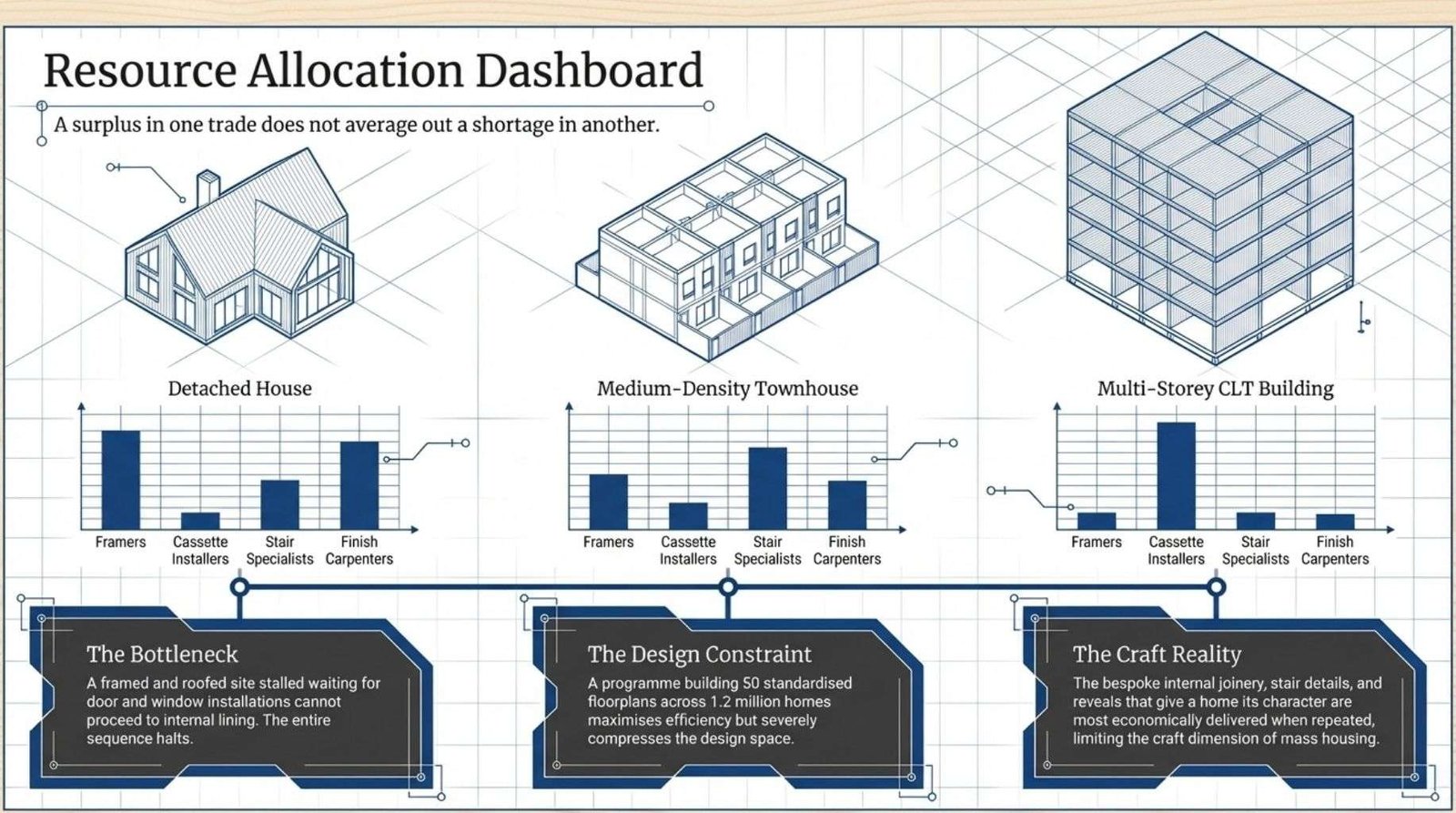
The skill mix question is also more granular than it appears. A housing program does not simply need carpenters.
It needs carpenters who can work in timber frame systems, floor cassette installation teams, prefab panel erection crews, stair installers and finish carpenters for internal joinery.
It needs joiners who can produce and fit door and window frames to tolerances that weather sealing requires.
It needs a different ratio of these skills depending on whether the program is building predominantly detached houses, medium-density townhouses, or multi-storey apartment buildings.
A surplus of one trade and a shortage of another does not average out. It creates bottlenecks. A site that is framed and roofed but cannot get its door and window installations completed cannot proceed to internal lining and service rough-ins. The whole sequence stalls.
The Cost Equation: What ‘Reasonable’ Actually Means.
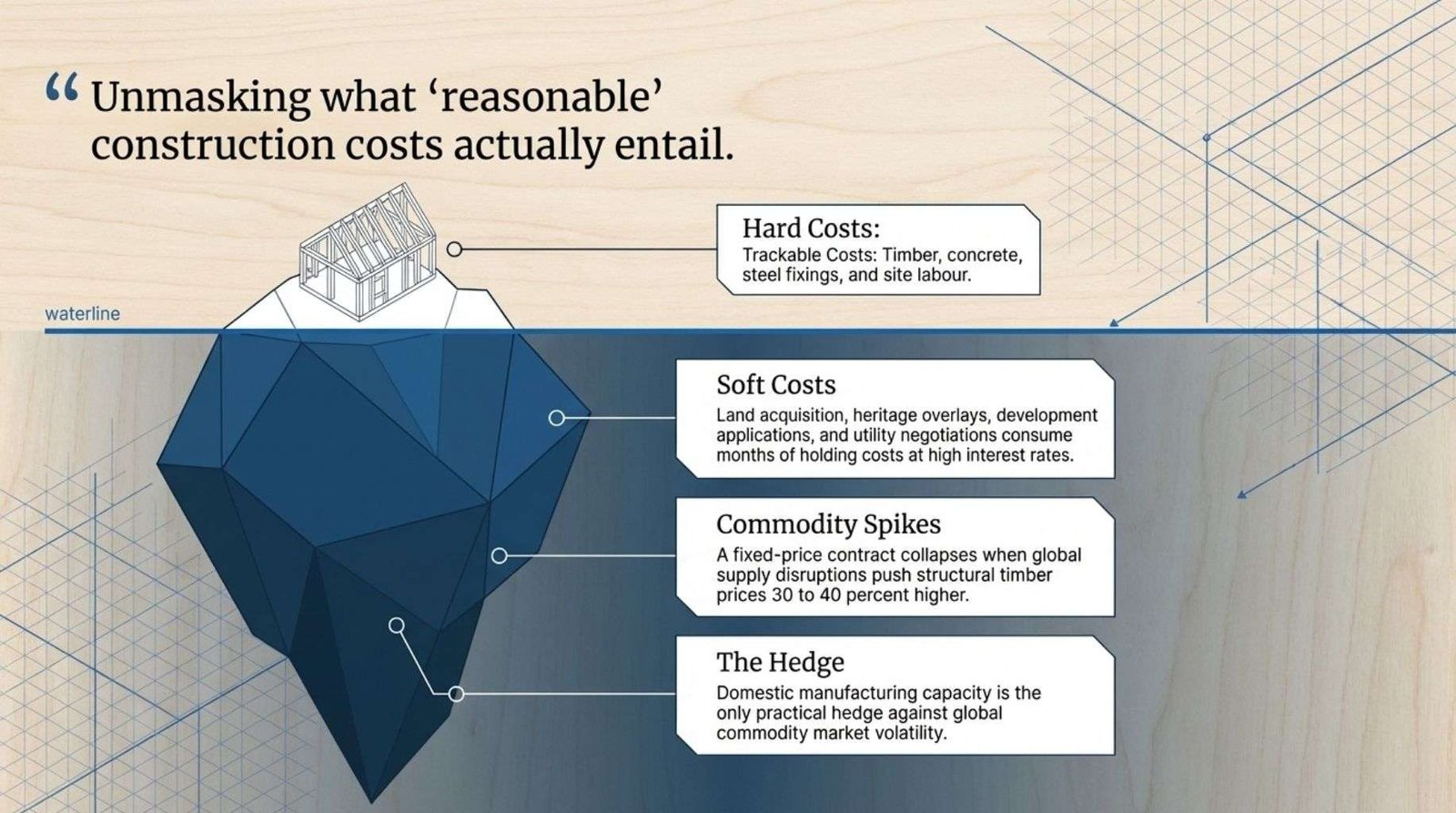
The word reasonable, when applied to construction costs, carries more weight than it appears to. Housing programs routinely underestimate cost because they account for hard costs accurately but mishandle soft costs and because they apply contingencies that do not adequately reflect commodity market volatility.
Hard costs are the visible elements: timber, concrete, steel fixings, plasterboard, roofing material, windows and doors and the labour to install them.
These are real and significant, but they are also the elements that procurement systems can most readily track and manage.
Soft costs are less visible and frequently more damaging to program budgets. Land acquisition in areas with sufficient infrastructure is expensive.
Development application processes, including environmental impact assessments, heritage overlays, utility service negotiations and community consultation requirements, consume months and sometimes years of holding costs at interest rates that can turn a viable project into an unviable one before a single piece of timber is cut.
The commodity volatility point is not abstract.
A fixed-price contract signed when structural timber is trading at one level becomes financially unworkable when global supply disruptions or increased demand push that price 30 to 40 percent higher within the contract period.
Developers and builders operating on the thin margins typical of residential construction cannot absorb that differential. Projects stop. Sites sit idle while contracts are renegotiated or abandoned.
Domestic manufacturing capacity for construction materials is the practical hedge against this volatility.
A country that produces its own framing timber, its own engineered timber panels, its own brick and concrete masonry and its own door and window systems has more control over its cost base than one that depends heavily on imports.
Building that manufacturing capacity takes time and capital, but it creates a structural resilience in the supply chain that no import purchasing strategy can replicate.
There is one specific trade-off here that deserves naming plainly. Standardising home designs to reduce costs and accelerate construction does work.
A program that builds 50 optimised floor plans across 1.2 million homes will produce those homes more efficiently than one that pursues architectural variety at every site.
Although it’s got to be said, standardisation compresses the design space in which skilled joiners and finish carpenters operate.
The internal joinery, the stair details, the window reveals, the built-in cabinetry, all of the elements that give a timber home its particular warmth and character, are most economically delivered when they are repeated and refined, not when they are individually designed for each project.
That is a real constraint on the craft dimension of a mass program and it is worth acknowledging rather than papering over.
Prefabrication as Scaled Craftsmanship.
The workshop has always been a place of controlled conditions. Flat benches. Stable temperature. Consistent lighting.
Tools within reach and materials stored correctly. The quality that a woodworker achieves in a well-ordered workshop is not accidental. It is the product of an environment designed to support precision work.
Factory prefabrication for residential construction applies exactly this logic at industrial scale. Wall panels assembled in a controlled factory environment, on a flat jig, with consistent material and reliable fastening equipment, are dimensionally more accurate than panels assembled on a muddy site in variable weather by a crew working under time pressure.
That accuracy has downstream consequences: faster erection, better thermal performance from correctly aligned insulation, doors and windows that fit their frames because the frames were made to the correct dimensions.
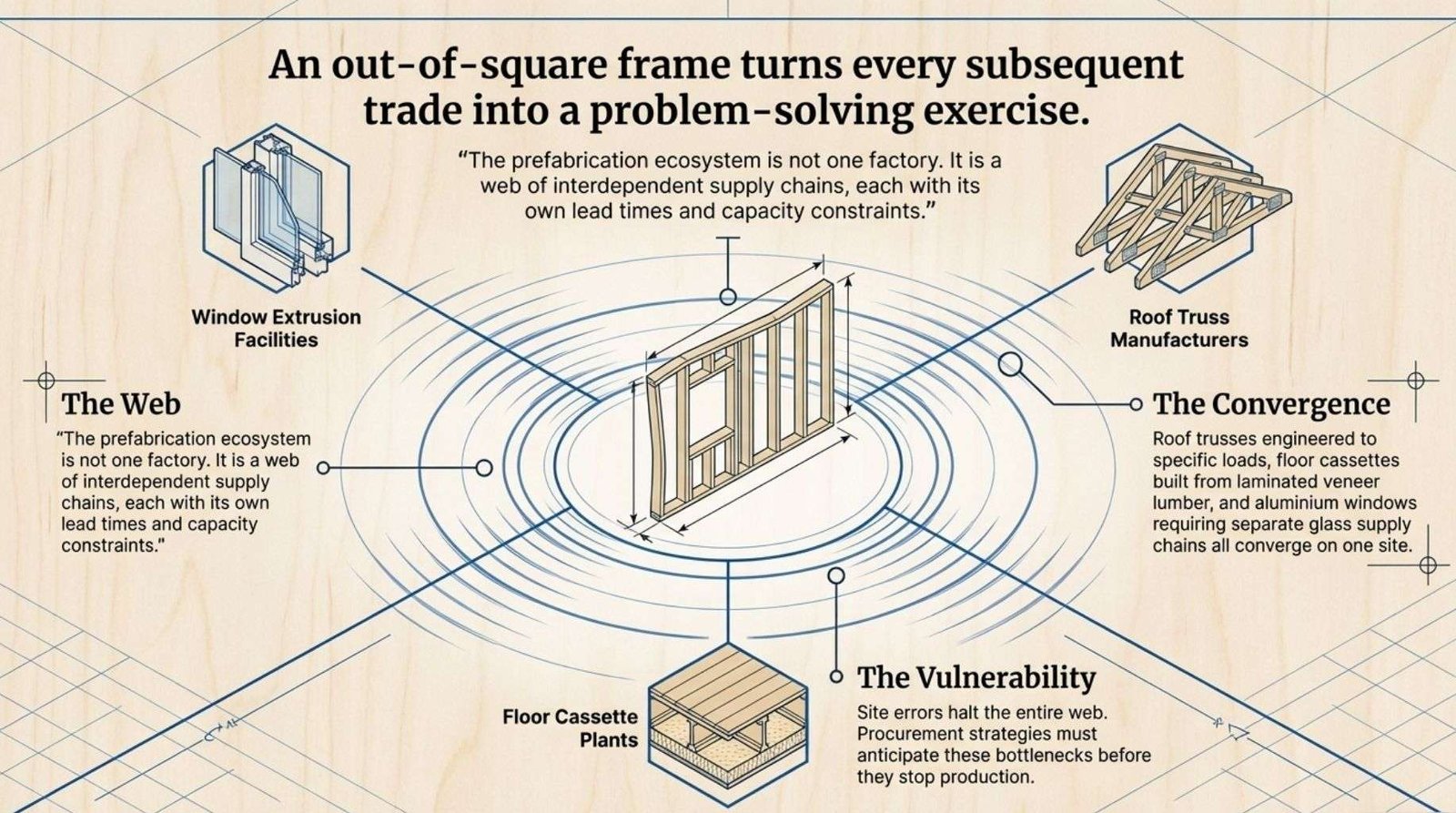
The prefabrication ecosystem that supports a major housing program is not a single factory. It is a network of specialist facilities, each contributing components that converge on-site for assembly.
Roof truss manufacturers produce engineered structural systems that arrive at the site ready to lift into position.
Floor cassette plants produce deck panels that are craned into place and fastened rather than built up from individual members one piece at a time. Window and door manufacturers produce pre-glazed, pre-hung units that install into pre-made openings without on-site glass cutting or hardware fitting.
Each of these elements requires a different kind of manufacturing expertise and each has its own supply chain dependencies.
Roof truss manufacturers depend on accurately graded framing timber and on the software systems that engineer each truss to the specific loads of the roof it will carry. Floor cassette manufacturers work with engineered timber products that require their own supply chains of laminated veneer lumber or I-joist components.
Window manufacturers work with aluminium extrusions, glass and weather seals that come from entirely separate industrial sources.
This is what an ecosystem actually means in practice. Not a single supply chain but a web of interdependent ones, each with its own lead times, its own capacity constraints and its own vulnerability to disruption.
Managing that web requires coordination between sectors that do not naturally communicate and it requires procurement strategies sophisticated enough to anticipate bottlenecks before they halt production rather than after.
There is a small but telling observation worth making here. The most experienced site carpenters tend to be the most enthusiastic adopters of prefabricated components.
Not because they are looking to reduce their own workload, but because they understand that accurate pre-made components are easier to work with than components assembled under site conditions.
A perfectly square, dimensionally stable wall panel makes the work of installing internal joinery straightforward. An out-of-square site-built frame turns every subsequent trade into a problem-solving exercise.
Utility Infrastructure and the Boundaries of the Build.
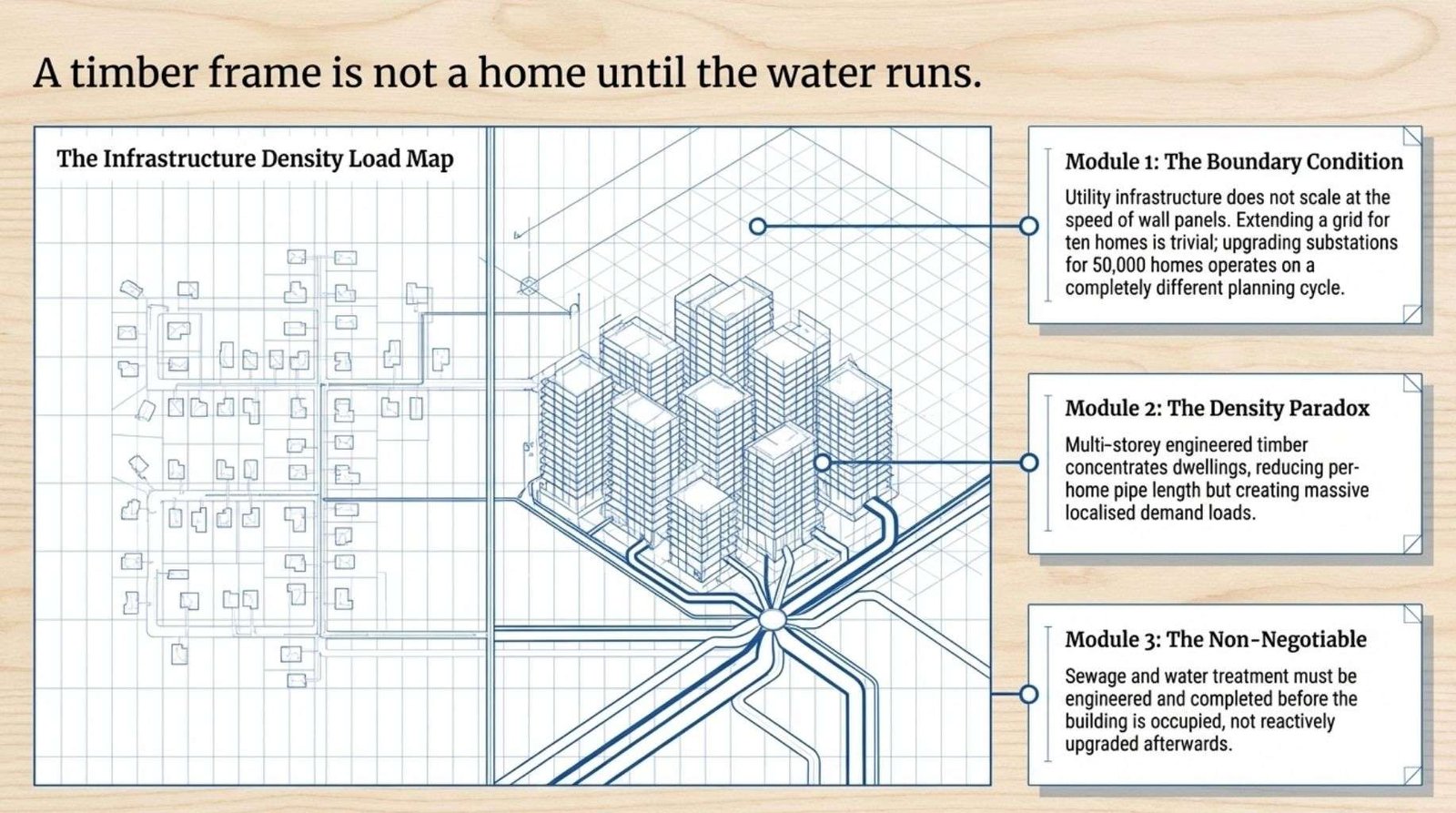
A timber frame does not become a home when the last stud is nailed.
It becomes a home when water runs from the tap, power reaches the outlet, sewage drains correctly and the structure is connected to roads and communication infrastructure that allow its occupants to live normally within it.
This boundary condition is one that residential construction programs consistently underestimate.
Utility infrastructure does not scale at the same speed as building construction. An electrical grid connection that serves ten homes on a suburban street can be extended with relatively modest investment.
An electrical grid connection that serves 50,000 new homes across a development zone of any scale requires substation upgrades, new transmission capacity and coordination with grid operators whose planning cycles operate on timescales that do not align neatly with a five-year housing target.
Water and sewage infrastructure is more constrained still. Water treatment and distribution systems are engineered to specific capacities.
Exceeding those capacities does not produce minor inefficiencies.
It produces failures: low pressure that renders upper storeys of multi-storey buildings unusable, sewage overflows that trigger public health responses and stormwater systems overwhelmed by the increased impervious surface area of a large development.
The timber connection here is less direct but still present. Engineered timber construction, particularly cross-laminated timber for multi-storey residential buildings, concentrates large numbers of dwellings on smaller land footprints than detached housing.
That density is efficient from a land-use perspective and it can reduce per-dwelling infrastructure costs by concentrating utility connections.
But it also concentrates demand loads and the utility infrastructure must be engineered for those loads before the building is occupied, not upgraded reactively after residents move in.
Waste, Circularity and the Second Life of Timber.
Construction generates more material waste per square metre of completed building than almost any other industry.
Offcuts, damaged panels, packaging and the residue of cutting, drilling and fastening operations accumulate on every site.
At the scale of 1.2 million homes, that waste stream becomes an environmental and logistical challenge of its own.
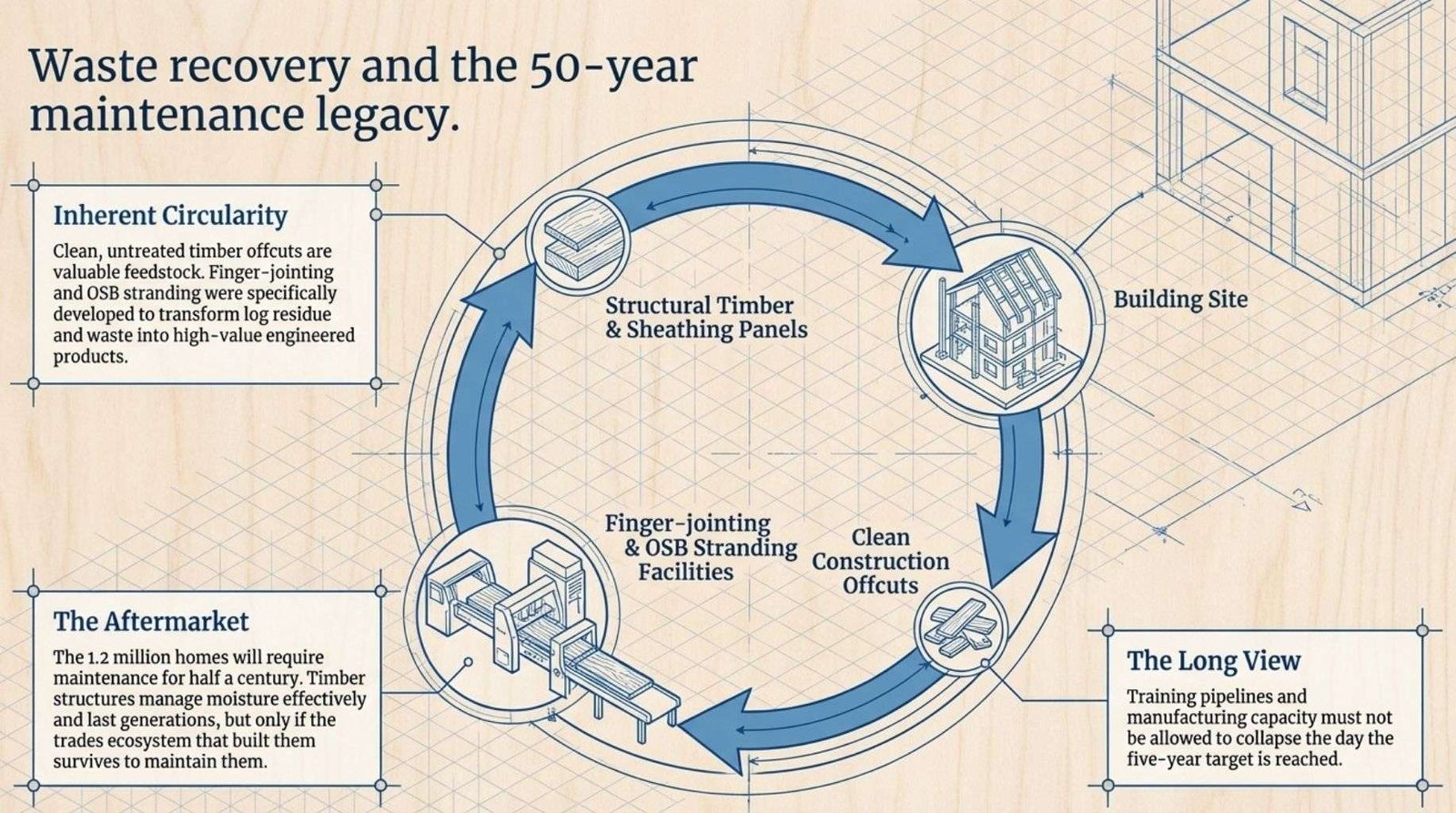
The timber dimension of this challenge is particularly worth examining. Wood waste from construction sites, clean untreated offcuts, end cuts from framing timber and panel products, has genuine value as either biomass energy or as feedstock for engineered wood products.
The finger-jointing process that produces long lengths of structural timber from shorter pieces was developed specifically to use material that would otherwise be waste.
Oriented strand board, the sheathing panel used extensively in timber-frame construction, is manufactured from wood strands that would otherwise be residue from log processing.
A construction program that takes material circularity seriously builds procurement and site management systems that separate recoverable timber waste from general construction debris, enable its return to processing facilities and account for its recovered value in the overall cost model.
This is not idealism. It is resource management of the kind that any serious woodworker practices instinctively, because the cost of material and the pleasure of using it well produce the same outcome.
The aftermarket reality is also worth acknowledging. The 1.2 million homes completed at the end of the program will require maintenance for the following 50 years.
Timber-framed structures, well built and properly detailed to manage moisture, last as long as any other construction method.
They’ll require periodic inspection, maintenance of weather seals and cladding systems and eventual replacement of joinery and finish elements that wear with use. The trades ecosystem that builds the program is also the trades ecosystem that maintains it.
Planning for that continuity, ensuring the training pipeline and manufacturing capacity do not collapse when the five-year target is reached, is as important as the program itself.
The Long View That Wood Has Always Required.
There is a discipline that woodworking imposes on the people who practise it seriously. It is the discipline of looking ahead.
A furniture maker choosing timber for a piece that will last a generation thinks about how the wood will move across the seasons, how the joints will behave as the material responds to humidity, how the finish will age.
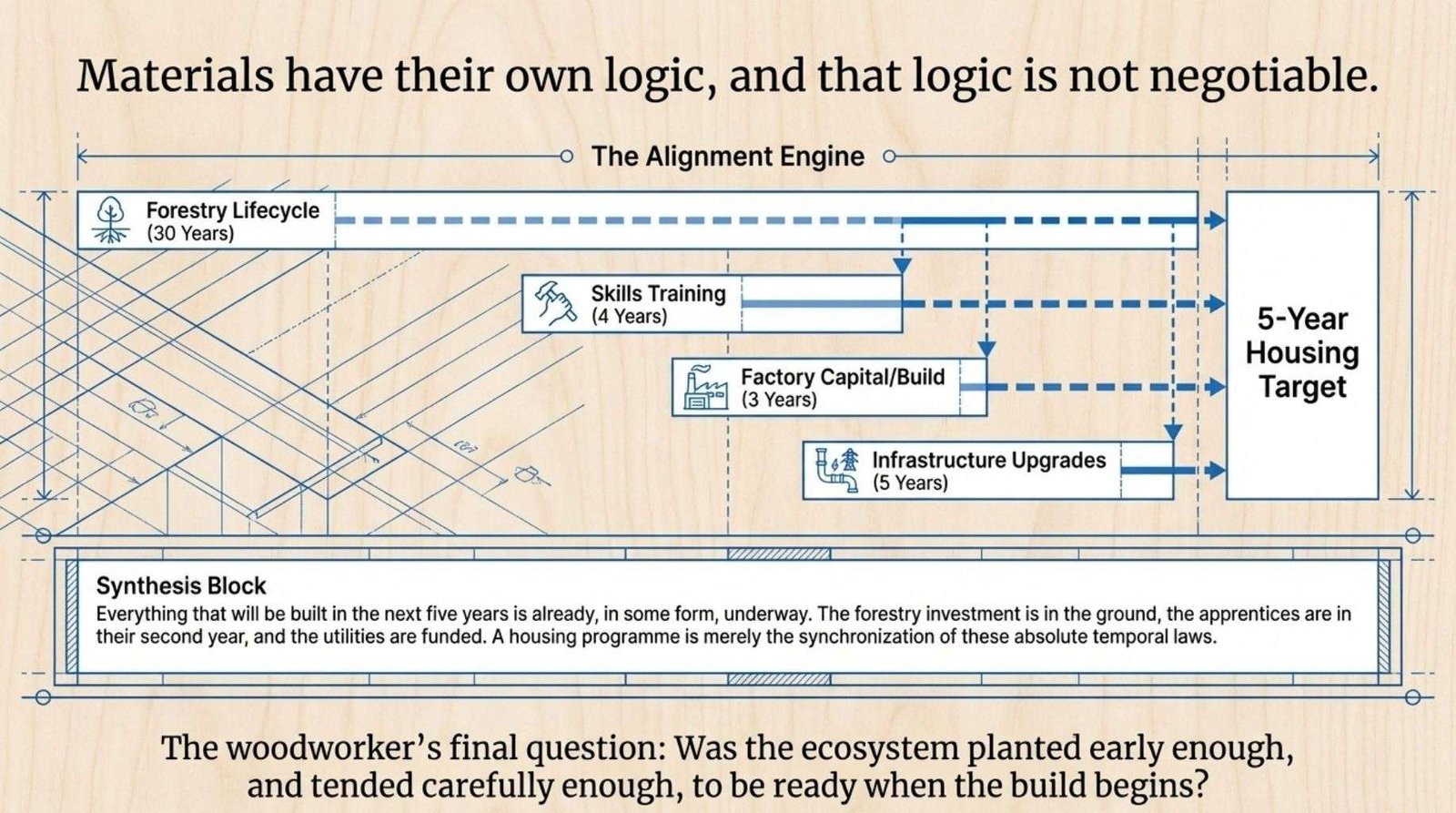
The calculations are not made once and then forgotten. They are built into every decision. A housing program worthy of the ambition it represents operates on the same principle. The timber supply chain requires forest investment made decades before the houses are built.
The trades pipeline requires training investment made years before the workers are needed on-site.
The utility infrastructure requires planning and capital commitment that must precede construction, not follow it. The manufacturing capacity for prefabricated components must be established before the order volumes arrive, not scaled up in response to a backlog.
What wood teaches, across every scale from a dovetailed drawer to a cross-laminated wall panel, is that materials have their own logic.
That logic is not negotiable. Timber dried to the wrong moisture content will move. Joints cut without adequate tolerance will bind. A forest harvested without replanting will not regrow on a five-year schedule.
The most durable things made from wood, the things that outlast their makers by generations, are built by people who understood that the material was already doing something before the first tool touched it.
It was growing. It was storing energy and structure in its rings. It was responding to its environment.
Working with that, rather than against it, is not a philosophy, it’s a method.
At 1.2 million homes, the method is the same.
The forestry investment already in the ground, the apprentices already in their second year, the prefabrication plants already engineering their first panels, the utility upgrades already approved and funded.
Everything that will be built in five years is already, in some form, underway.
The question is whether the ecosystem was planted early enough and tended carefully enough to be ready when the build begins.
To me, that’s the woodworker’s question and it always has been.