Woodwork Clothing - Function And Business
Clothing in a woodworking environment is not a uniform choice or a branding exercise. It’s a form of PPE. A loose, flapping sleeve cuff flopping around near a lathe chuck, or a hoodie drawstring dangling toward a router table are just a couple of things that would lead to a problematic situation.
Clothing that is sensible for woodworking is a layer of protection that sits between your body and the machinery, the timber, the finishes and the floor.
Getting it right, from the hair on your head to the sole of your boot, is a practical discipline that deserves the same attention as sharpening a plane iron or setting up a table saw fence.
This extends further than personal safety. For woodworkers who sell their work, offer custom commissions, or operate a workshop that clients visit, clothing is also a visible signal of professionalism.
The two functions overlap more than most people expect.
Understanding the Entanglement Problem.
Before looking at individual garments, it is worth understanding the single most common clothing-related hazard in a woodworking shop: entanglement.
Rotary machinery is not sentient, it isn’t thinking about what it’s doing, it will simply do what it is designed for when it’s turned on.
As such, it will not distinguish between a workpiece and a sleeve. A drill press, a lathe, a jointer, a router spinning at 24,000 rpm, each creates a rotating surface that will catch fabric, hair or cordage instantly and without warning.
The physics are unforgiving. A cuff that brushes a lathe mandrel does not give you time to react. By the time you register contact, the machine has already committed. This is why the foundational principle of woodworking attire is not comfort or appearance.
It is the elimination of anything that can be grabbed, snagged or wound into a rotating component. Every clothing decision flows from that principle outward.
The sensory reality of this is easy to underestimate until you have stood next to a lathe turning a wet bowl blank and felt the fine mist of wood and water against your forearm. That mist carries enough force to tell you exactly how quickly something pliable could be pulled in.
Once that register is in your body, you stop treating loose clothing as a minor inconvenience and start treating it as an active hazard.
From the Head Down: Hair, Neck and Upper Body.
Hair is the first item on the anatomy checklist and it is one that is still treated casually in hobbyist shops. Long hair is a severe entanglement risk around any rotary tool. A single loose strand near a drill press is enough.
The solution is to tie hair back fully and secure it so that strands cannot escape. A low ponytail alone is often insufficient. A bun, a braid pinned flat, or a ponytail tucked under a cap is the standard in production environments.
Cap selection matters more than most woodworkers realise. A mesh-back baseball cap with a plastic snap closure looks harmless, but if that closure is drawn toward a spinning chuck, it will not break away. It will catch.
Cotton twill caps or waxed canvas caps sit flat, have no protruding fasteners and do not carry the same entanglement profile.
The neck and upper body present a related set of concerns. Dangling necklaces should not be worn in any shop where rotary tools are in use.
This includes chains worn inside a shirt, which can shift during movement and appear outside the collar at the wrong moment.
Shirt choice comes down to sleeve fit. Short sleeves are the cleaner option around spinning machinery.
If long sleeves are preferred for warmth or skin protection, they must be close-fitting through the forearm, either a snug base layer or a cuffed shirt with the cuff buttoned tightly at the wrist. The loose flared cuff of a casual flannel shirt is not appropriate around a jointer or table saw.
Hoodies occupy an interesting position in workshop culture. They are comfortable, they are warm during the cold months when an unheated shop drops below ten degrees, and they are enormously popular as branded merchandise for woodworking businesses.
In the shop itself, the primary hazard is the drawstring. A hoodie worn with the drawstrings removed is meaningfully safer than one worn with cords hanging loose. Many experienced woodworkers carry a cheap seam ripper specifically to strip drawstrings from new hoodies before wearing them in the shop.
The Apron: The Most Functional Garment in the Workshop.
The woodworking apron is undervalued. It is not decorative and it is not purely traditional. A well-chosen apron serves three distinct functions simultaneously and does them in a way no other single garment can match.
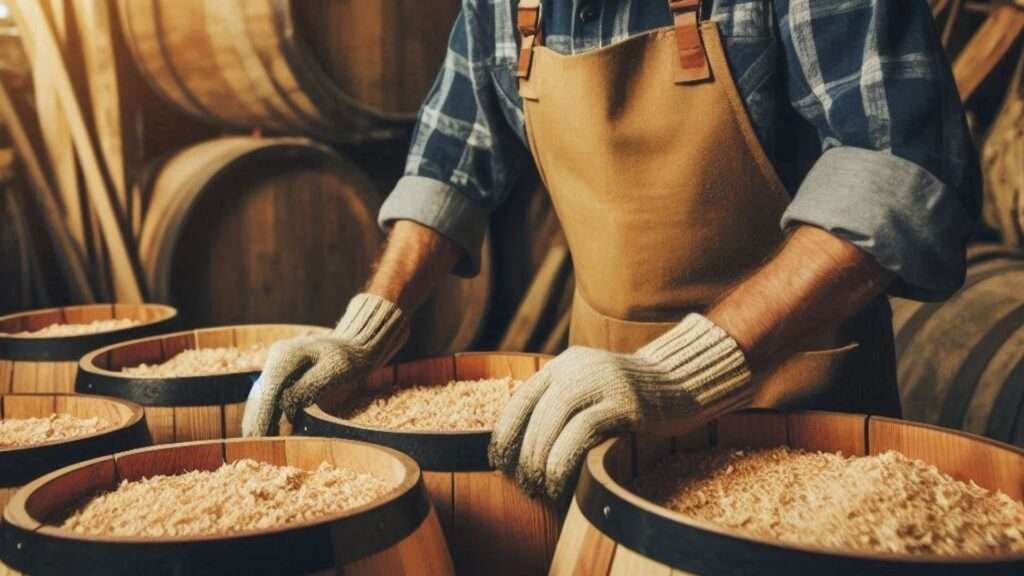
The first function is physical protection. Heavy duck canvas or full-grain leather deflects wood chips, absorbs splinter contact and creates a barrier between your torso and any glue or finish that drips, flicks or splashes.
A hand-cut dovetail sprays fine shavings; a freshly brushed coat of danish oil leaves a drip trail. The apron takes both without complaint.
The second function is organisation. A good apron keeps a pencil, a combination square, a marking knife and a pair of safety glasses within reach at all times. This sounds minor until you consider how much time in a woodworking session is spent walking back to a bench to retrieve a tool that should have been on your person. That walking is also when most trips and slips occur.
The third function is deflection. A stiff leather apron bib will not stop a full table-saw kickback, and no reasonable claim should be made that it will.
What it does do is absorb a fraction of the impact from a piece of timber returning at speed. That fraction matters. A cotton t-shirt offers nothing.
For material, the choice sits between leather and heavy canvas. Leather is the more durable option and handles prolonged finishing work well because it does not absorb water-based products as readily as canvas.
Canvas is lighter and easier to wash. A split-leather apron with canvas straps is a reasonable middle ground for a woodworker who does both bench work and finishing in the same session.
Gloves: The Most Misunderstood Item in the Shop.
Here is the counter-intuitive point that surprises even experienced hobbyists: gloves are not universally safer than bare hands in a woodworking shop. Around rotary machinery, gloves are a liability, not a protection.
A glove that catches a spinning table-saw blade or jointer cutterhead does not simply tear. It pulls the hand toward the machine.
The glove adds surface area for the machine to grip. The result is worse than bare-hand contact, not because the glove provides less padding, but because it provides more purchase for the rotating component.
The rule is specific and absolute: no gloves with rotating machinery. This includes table saws, jointers, lathes, drill presses, band saws, routers and any other tool that has a spinning component near which a hand might pass.
Gloves are appropriate in a smaller set of circumstances. Handling rough-sawn green lumber by hand generates significant splinter risk, particularly with species like black locust or white oak that produce hard, needle-like fibres.
Moving a large slab of hard maple across a concrete floor carries the same risk. For this kind of material handling, a pair of nitrile-grip or tight leather rigger gloves is the correct choice.
Chemical finishing is the other clear use case. Solvent-based finishes, oil-based stains and lacquer thinners penetrate skin with repeated exposure.
Nitrile gloves rated for solvent resistance create the appropriate barrier. Cotton gloves are not adequate for this task; they absorb the chemical and hold it against the skin longer than bare hands would.
The specific trade-off here is this: a woodworker who keeps a single pair of gloves on the bench and uses them for both finishing and general shop tasks will eventually wear them during a moment of machine operation.
The safer discipline is to keep chemical-protection gloves separate from any other shop consumable and to treat their presence as a signal that a machine should not be running.
Leg and Foot Protection.
The lower body receives less attention in most woodworking safety conversations than the upper body and hands.
This is partly because the most visually dramatic accidents tend to involve hand and arm contact with machinery, and partly because leg and foot hazards develop more slowly and are easier to underestimate.
Trouser fit follows the same logic as sleeve fit. Baggy, wide-leg trousers can catch on bench corners, jig components or tool handles resting against a leg.
Functional work trousers with a straight or slightly tapered leg offer better clearance. Carpenter-style trousers with tool loops and hammer holders are an entirely reasonable choice for a woodworker who uses a lot of hand tools, provided the loops are not left dangling when walking past stationary machinery.
Shorts are generally not appropriate for woodworking. This is a practical assessment rather than a rule for its own sake.
A chisel dropped from bench height strikes a bare thigh at the same velocity it would strike a piece of oak. Fine metal shavings from a router bit on a hardwood surface accumulate quickly on the floor and embed in skin at ankle and calf height. Neither scenario is trivial.
Footwear is where the most consequential decisions are made and where the most consistent compromises occur.
A full 8/4 slab of walnut, dressed and ready for the saw, can weigh forty kilograms or more when pulled from a rack. Dropping that across a foot wearing canvas sneakers is not a recoverable situation without medical attention.
Steel-capped or composite-capped work boots are the appropriate standard for any woodworker handling significant timber volumes.
The sole matters as much as the toe. Sawdust on a sealed concrete floor is frictionless in a way that is genuinely startling until you have experienced it.
An oil-resistant, lug-patterned sole that grips that surface is not a comfort feature. It is a stability feature that affects whether you remain standing while carrying an awkward panel to the saw.
Leather boots with full ankle coverage also provide protection against the puncture risk from dropped chisels and gouges, which land point-down more often than intuition suggests.
Choosing the Right Fabrics.
Not all materials wear the same way in a working shop. The fabric selection for woodworking clothing is guided by a simple test: what does this material do when it encounters heat or friction?
Material | Key Strengths | Key Limitations | Best Application |
100% Cotton | Breathable, chars rather than melts, comfortable for long sessions. | Absorbs moisture, less abrasion-resistant than canvas or leather. | Shirts, base layers, jeans. |
Denim or Duck Canvas | High abrasion resistance, long wear life, handles rough lumber contact well. | Heavy in summer, slow to dry. | Work trousers, aprons, jackets. |
Full-Grain Leather | Excellent protection from sparks, splinters and sharp contact. | Hot in warm conditions, expensive, requires maintenance. | Aprons, cuff guards for turning. |
Wool | Naturally fire-resistant, insulates when damp, durable fibre. | Higher cost, some individuals find it irritating against skin. | Socks, cold-weather base layers. |
Synthetics (Nylon, Polyester) | Lightweight, moisture-wicking, inexpensive. | Melts under friction or heat, adheres to skin. | Outer rain shells worn over cotton only. Avoid as primary layers. |
The distinction between charring and melting is not a minor technical point.
A cotton shirt that contacts a spinning bit chars, smells, and potentially ignites, but the burn is localised and the material does not adhere to skin.
A polyester fleece under the same conditions melts into the skin and bonds with the wound. This makes a clear case for natural primary layers: cotton, wool, leather.
Synthetics belong on the exterior in rain conditions only, over a full cotton underlayer. Polyester fleece and nylon puffer jackets are the two garments most frequently worn in hobby workshops that should not be.
They are comfortable and inexpensive and they look identical to safe garments from a distance. The difference only becomes apparent under friction or direct heat, at which point the damage is already underway.
Branded Workwear as a Business Strategy.
The woodworking business that grows beyond a solo operation eventually arrives at a question about identity.
What does it look like to the outside world? Branded clothing is one of the most cost-effective answers available, but only if the approach separates shop-floor utility from customer-facing presentation.
Two distinct wardrobes serve different purposes. The shop wardrobe is built for punishment. Old jeans, inexpensive cotton t-shirts and a canvas apron that has seen glue, oil and sawdust without being replaced.
This is the clothing that gets destroyed so that the good clothing does not. There is no logic in wearing a forty-five dollar embroidered hoodie while jointing rough white oak on a damp morning.
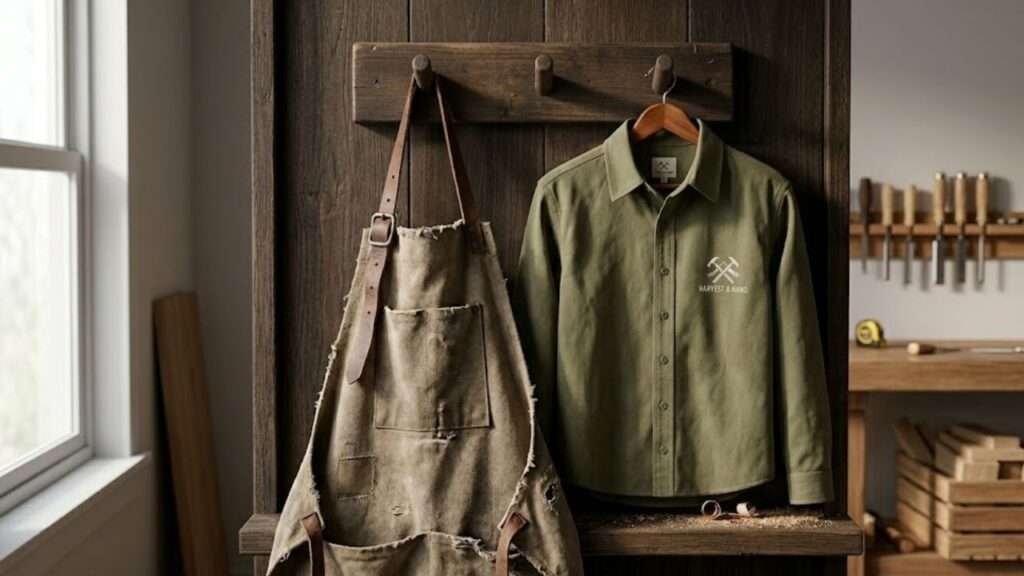
The client-facing wardrobe is where branding investment pays off. A clean, well-fitted cotton shirt with an embroidered logo, worn during a client consultation, a trade show, or an installation day, communicates competence before a word is spoken. Embroidery is the right finishing method for this application.
Screen printing and vinyl transfers crack and peel within a year of regular washing. Embroidered thread holds its structure, sits flat against the fabric and reads as higher quality at close range.
For businesses that sell merchandise directly to customers, the calculation is different again. Customers buying branded merchandise are not wearing it in a shop. They are wearing it in daily life, which means the safety constraints around drawstrings and sleeve fit do not apply in the same way.
A heavyweight cotton hoodie with the shop logo, sold from a shelf near the entry of a showroom, is entirely appropriate as retail merchandise.
The practical stock list for customer-facing merchandise is short. Heavyweight cotton t-shirts in dark or neutral colours hide sawdust and workshop contact best. Navy, charcoal and black are the proven choices.
White shows everything. Long-sleeve shirts extend the product offering for cooler months. Hoodies are consistently the highest-selling branded item across trade businesses of all kinds.
A denim or waxed canvas jacket with an embroidered chest logo sits at the premium end of the range and positions a business as established and considered. A small tangential observation: the physical placement of merchandise in a workshop showroom matters more than most people think.
Items stored behind a counter or in boxes register as inventory. Items displayed on a simple wall-mounted shelf or a clean mannequin near the exit register as desirable.
he context of the craft space itself, the smell of wood, the sound of hand tools, the grain of a displayed piece, gives the merchandise a provenance that a retail clothing store cannot replicate. The woodworker who wears a clean branded shirt to a client meeting and then removes it before entering the shop to begin work has understood both purposes clearly.
Closing.
Clothing in the woodworking shop is a system, not a collection of individual choices. Each garment relates to the others, and each interacts with the tools, the materials and the environment in ways that either reduce or compound risk.
The principle that holds the system together is simple: eliminate anything that can be caught, melted, or swept into a machine, and build the rest of the wardrobe around natural fibres that tolerate the physical demands of the work.
For woodworkers with a business to run, the same deliberateness that applies to shop clothing applies to how that clothing is used to represent the brand.
A recognisable, consistent visual identity built around well-made basics is more durable than any marketing effort that does not have a physical presence in the world. It is also an honest expression of what good craft looks like: considered, material-appropriate and built to last.