Your Backyard Shed
A backyard shed often begins as a simple shelter for tools
and seasonal items.
Over time it can shift into a place where work settles into
a rhythm.
The change is rarely announced. It appears in the way light
falls across a bench or in the familiar sound of a plane shaving a strip of
softwood.
A shed that once stored objects begins to support a craft.
Defining a Woodshop: Key Characteristics and Essentials.
A woodshop is defined by intention. A shed becomes a
woodshop when the space supports repeatable processes rather than occasional
tasks.
The distinction is practical. A shed can hold tools. A
woodshop enables work.
A stable work surface is often the first sign. A bench that
stays in place and carries the marks of repeated use changes the atmosphere of
the space.
The scent of freshly cut pine or the fine dust that settles
on a cast iron surface signals that the shed is no longer passive storage.
Dedicated lighting reinforces this shift. A bright task lamp
over a bench allows accurate layout work.
Shadows become predictable which improves precision during
joinery.
Even a small upgrade in lighting can alter how confidently a
person approaches a project. A counter-intuitive observation emerges here. A shed can contain more tools than a modest
woodshop yet still not function as one. The difference lies in how those tools
are used and how the space supports movement.
The Transition from Casual Workspace to Dedicated Woodshop.
The transition usually begins with repetition. A person
returns to the same corner of the shed to cut dovetails or shape a table leg.
The hands learn where tools sit. The body moves without
hesitation.
This familiarity encourages refinement. A row of hooks
appears on the wall.
A small cabinet is built to hold chisels. The shed becomes
easier to work in because the layout reflects actual habits.
Tool collection growth often accelerates the shift. A single
cordless drill becomes a drill and driver pair. A circular saw is joined by a
track saw.
Each addition demands storage and clear access. The shed
evolves to accommodate these needs.
There is a trade-off. As the space becomes more specialised
it becomes less suitable for general storage.
Garden equipment may no longer fit comfortably. This
limitation is practical and signals that the shed is now serving a defined
craft.
A small tangential observation arises when looking at older
sheds. Many contain remnants of past hobbies. A rusted clamp or a forgotten
marking gauge can reveal how a space once functioned. These traces show how
easily a shed can shift identities over time.
Essential Tools and Equipment That Elevate a Shed to a True
Woodshop.
Certain tools mark the transition from casual woodworking to
a dedicated shop. They introduce capability and consistency.
They also require stable placement which encourages a more
structured layout.
·
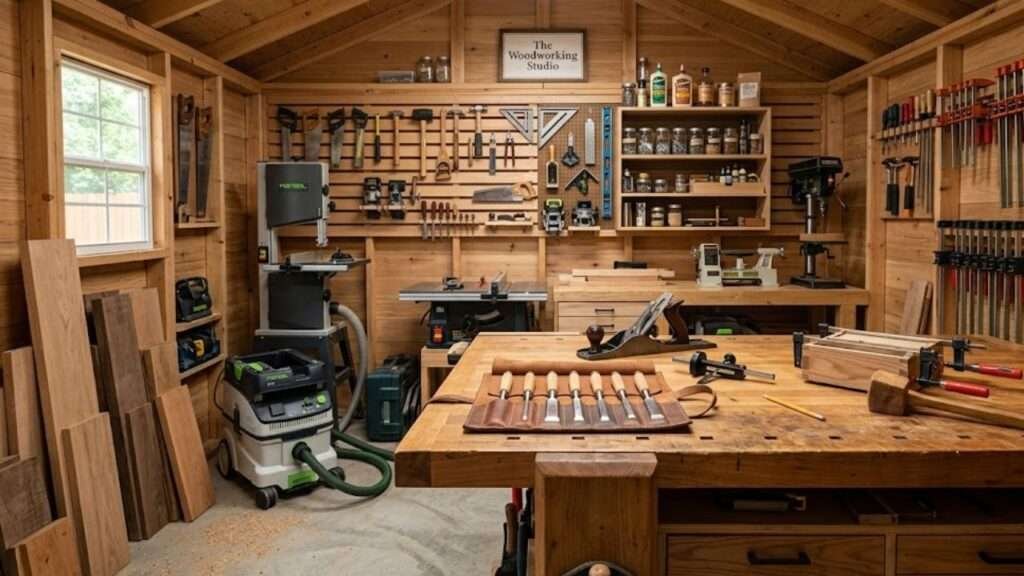
A solid workbench with a reliable vise that holds timber
securely.
·
A set of sharp hand tools including chisels, block plane and
marking tools.
·
A primary power tool such as a table saw or bandsaw that
remains in position.
·
A dust collection system that manages fine particles and
keeps the air clear.
·
Storage solutions that protect tools from moisture and allow
quick access.
The texture of oiled hardwood handles on chisels or the
smooth surface of a cast iron table saw top reinforces the sense of a working
environment. These tactile elements matter because they influence how
confidently tasks are performed.
A shed becomes a woodshop when these tools are not only
present but integrated into a workflow. A benchtop sander sitting on the floor
does not elevate a space. A sander with a dedicated stand and dust hose does.
The Importance of Layout and Workflow in Defining a
Functional Woodshop.
Layout determines efficiency. A shed with a thoughtful
arrangement supports safe and predictable movement.
Timber enters the space, moves through cutting and shaping
then leaves as a finished component. This sequence is easier to maintain when
tools are placed according to task order.
Good lighting is essential. Natural light from a window can
reveal grain direction during hand planing. Overhead LED panels provide
consistent brightness for assembly work. Shadows are reduced which improves
accuracy.
Workflow also depends on clear floor space. Offcuts stacked
near the bench can interrupt movement. A narrow path between tools can slow
progress.
Even in a small shed a simple rule helps. Tools used daily
stay within arm’s reach. Tools used monthly can sit higher or further back.
A limitation appears when the shed footprint is small. Large
stationary machines may not fit without compromising movement.
A mobile base can help but it introduces its own constraint
because repositioning machines takes time and interrupts workflow.
Legal and Safety Standards: When Your Shed May Need
Professional Input.
As a shed evolves into a functional woodshop there may come
a point where professional guidance becomes necessary.
This is not because every woodshop must follow the same
rules. It is because requirements vary widely depending on the town, city,
state, territory or county in which the shed sits.
Electrical capacity is a common area where local
expectations differ.
A licensed electrician can assess whether the existing
wiring can support tools such as dust extractors or stationary saws. The steady
hum of a properly installed circuit is a sign that the space is prepared for
long-term use.
Ventilation needs also vary. Some regions expect mechanical
extraction.
Others rely on natural airflow. The scent of freshly sanded
timber is pleasant but it should not linger in still air for extended periods.
Local building authorities or trade professionals can
clarify when a shed used for regular woodworking crosses into a category that
requires formal compliance. These conversations are often straightforward.
They help ensure that the woodshop imagined for the future
aligns with local codes and long-term plans.
Comparing Sheds and Woodshops Through Practical Criteria.
A table can clarify the distinctions between a
general-purpose shed and a functional woodshop. The criteria reflect how the
space is used rather than how it looks.
|
Criteria |
Typical Shed |
Functional Woodshop |
|
Primary
Purpose |
Storage |
Craft
and production |
|
Workbench |
Portable
or absent |
Permanent
and stable |
|
Tool
Storage |
Mixed
with household items |
Organised
by task |
|
Lighting |
Basic
overhead |
Task
lighting and natural light |
|
Dust
Management |
Minimal |
Dedicated
extraction |
|
Electrical
Capacity |
Standard
outlet |
Upgraded
circuits |
|
Workflow |
Unstructured |
Defined
sequence |
The table highlights how a woodshop supports continuous
work. The presence of a stable bench and organised tools changes the rhythm of
the space. Even the sound of a plane stroke or the feel of sawdust underfoot
reflects that shift.
When the Identity of the Space Becomes Clear.
A shed becomes a woodshop when the craft shapes the
environment.
The change is visible in the way timber is stored, how tools
are arranged and how the space feels during use. It is also visible in the
small details such as a pencil resting in the same spot each day or the smooth
wear on a bench edge.
The identity of the space emerges through consistent
practice.
It becomes a place where ideas take form and where the
atmosphere supports concentration. The shed no longer waits for tasks. It
invites them.
Closing Section.
A backyard shed can evolve into a woodshop through steady
refinement and purposeful arrangement. The shift is gradual yet unmistakable.
When the space supports clear workflow, reliable tools and a sense of craft it becomes more than storage. It becomes a place where woodworking is lived rather than visited.