Making Arts And Crafts Your Niche
The Arts and Crafts woodworking niche has a way of drawing makers
towards some deeper and fascinating work.
It tends to reward patience and precision and will highlight
your weaknesses when you don’t take this type of work seriously enough.
It has the potential to reward those who choose it as a professional full time niche.
The combination of solid timber, visible joinery, and a design language that has remained stable for more than a century creates a field where skill is recognised and valued. Many woodworkers discover that this niche offers both creative satisfaction and a reliable commercial foundation.
Understanding the Appeal of Arts and Crafts Furniture.
The Arts and Crafts Movement grew from a belief that honest
materials and visible craftsmanship matter. That belief still resonates.
A piece built in quarter sawn white oak catches light in a
way that feels grounded. The ray fleck shifts as the viewer moves.
The joinery is not hidden. It is part of the design. This
clarity of structure gives the style a directness that suits modern homes. It
also creates a niche where makers can build a recognisable identity.
Tools That Shape the Work.
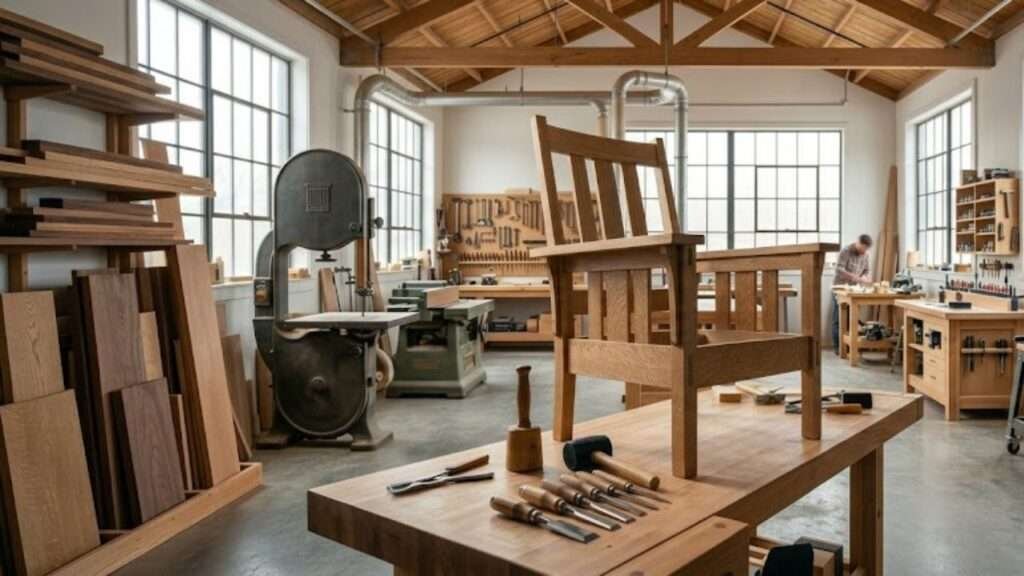
A standard workshop provides the foundation for this niche.
A table saw, jointer, planer, and bandsaw handle the bulk of the stock
preparation.
The difference comes from the tools that support the
joinery. A hollow chisel mortiser allows consistent through mortises in thick
oak.
A set of sharp chisels refines the shoulders. A shoulder
plane brings the tenon cheeks into alignment. These tools do not replace skill.
They support it.
The sensory experience of this work is distinct. Cutting a
long mortise in dense oak produces a fine, warm dust that settles quickly.
The sound of a chisel paring end grain is muted and steady.
These details shape the rhythm of the shop. They also shape the expectations of
the craft. Arts and Crafts furniture rewards accuracy more than speed.
One practical limitation appears early. Quarter sawn oak is
expensive and heavy. Moving wide boards across a jointer requires space and
safe handling.
This is not a niche for a cramped corner of a garage. It
asks for room to work and room to assemble.
Joinery as a Signature.
The joinery defines the style. Through tenons, keyed tenons,
and exposed dovetails are not decorative additions.
They are structural. A Morris chair arm with a proud tenon
at the front leg shows the maker’s intent. The joint is visible from across the
room. It becomes part of the furniture’s identity.
A counter intuitive observation emerges here. Many
woodworkers assume that visible joinery increases the difficulty of the work.
In practice it often simplifies it. A through tenon can be
adjusted from both sides. A keyed tenon allows controlled tightening during
assembly.
These joints demand accuracy but they also provide clarity.
The structure is honest. The work is easier to assess as it progresses.
The tactile qualities of these joints matter. A flush planed
tenon has a different feel from a sanded one.
The plane leaves a crisp surface that reflects light evenly.
This detail is small but it is part of what customers notice even if they
cannot articulate it.
Materials That Define the Aesthetic.
Arts and Crafts furniture relies on specific timbers.
Quarter sawn white oak is the most recognised. Its stability and ray fleck
pattern create the familiar look of the period. Cherry and mahogany appear in
Greene and Greene work.
These woods behave differently under the plane. Cherry
produces a sweet, warm scent when cut. Mahogany feels almost waxy under a sharp
blade.
The choice of timber influences the workflow. Oak requires
sharp tools and steady pressure. Cherry burns easily under a router bit.
Mahogany accepts detail work with less resistance. These
differences shape the maker’s approach. They also shape the final appearance of
the piece.
A small tangential observation arises when selecting boards.
Many woodworkers notice that quarter sawn oak offcuts often
become small trays or tool holders in the shop. The straight grain and
stability make them useful long after the main project is complete.
Workflow and Shop Rhythm.
Arts and Crafts furniture is built through a sequence of
predictable steps.
Stock preparation, joinery, dry fitting, shaping, and
finishing form a cycle that becomes familiar. The work is steady rather than
rushed.
A long afternoon spent refining tenons at the bench can be
satisfying. The sound of a plane on oak becomes part of the shop’s atmosphere.
Batch processing is less common in this niche. Each piece
has its own proportions and joinery layout.
Templates help with curves and repeated elements but the
work remains individual. This is one of the reasons the niche supports higher
pricing. Customers understand that each piece is built with intention.
A trade off appears in the finishing stage. Traditional
fumed finishes require an enclosed space and careful handling of ammonia.
Many makers choose oil and wax finishes instead. These
finishes highlight the grain and create a warm surface but they require periodic
maintenance by the owner. This is a practical consideration that should be
communicated clearly.
Economic Realities of the Niche.
Arts and Crafts furniture attracts buyers who value
craftsmanship. They are not comparing prices with mass produced furniture.
They are comparing the quality of your work with the quality
of other makers. This creates a stable market for well executed pieces.
The table below outlines the economic differences between
small wooden crafts and Arts and Crafts furniture.
|
Category |
Small Wooden Crafts |
Arts and Crafts Furniture |
|
Typical
Price Range |
Low
to moderate |
High
to premium |
|
Buyer
Type |
Gift
shoppers |
Collectors
and homeowners |
|
Production
Model |
High
volume |
Low
volume |
|
Skill
Requirement |
Moderate |
High |
|
Market
Saturation |
High |
Low |
|
Material
Cost |
Low |
High |
|
Workshop
Space |
Minimal |
Significant |
The financial advantage of the furniture niche becomes clear
when comparing the time invested with the revenue generated.
A single chair or side table can exceed the income from
dozens of small craft items. This does not diminish the value of small crafts.
It simply reflects the economics of the two fields.
Developing a Personal Style.
The Arts and Crafts Movement provides a strong foundation
but it also allows variation. Greene and Greene details introduce soft edges
and cloud lifts.
Stickley designs emphasise straight lines and structural
clarity. Makers often blend elements from both traditions. A chamfered leg with
a subtle ebony plug can become a signature detail.
The development of a personal style takes time. It emerges
through repeated work with the same materials and joinery. The feel of a hand
planed surface becomes part of the identity. The proportions of rails and
stiles become consistent. Customers begin to recognise the work even without a
maker’s mark.
The sensory qualities of the shop support this development.
The smell of freshly cut oak, the weight of a long board on the bench, and the
sound of a plane stroke all contribute to the maker’s understanding of the
material.
These details shape the craft as much as the tools do.
Building a Sustainable Practice.
A sustainable woodworking practice requires more than skill.
It requires a workflow that supports consistent output.
It also requires a clear understanding of the market. Arts and Crafts furniture provides both. The designs are stable.
The demand is
steady. The materials are predictable.
One limitation remains. The work is physically demanding.
Moving large panels, clamping heavy assemblies, and planing dense timber require
strength and endurance. Many makers develop jigs and supports to manage the
workload. These solutions become part of the shop’s infrastructure.
The long term benefit of this niche is the ability to build
a portfolio that grows in value. Each piece becomes a demonstration of skill.
Customers who purchase one piece often return for another.
This creates a stable foundation for a woodworking career.
Where to Begin.
A woodworker considering this niche does not need to rebuild
the workshop overnight. The transition begins with a single piece that
introduces the language of the style without demanding a full investment in
unfamiliar tools.
A small side table makes a suitable starting point. The
scale keeps material costs manageable and allows for mistakes without
significant waste.
Quarter sawn white oak is the natural choice. Its stability
and distinctive ray fleck reward careful work while teaching the behaviour of a
timber that behaves differently from the construction lumber found in many
shops.
The joinery can be limited to through mortises and tenons.
These joints can be cut with a table saw, a drill press fitted with a mortising
attachment, and a set of sharp chisels. This is equipment many woodworkers
already own.
The first piece will reveal the gaps. A tenon that fits too
loosely. A shoulder that leaves a visible gap. These are not failures. They are
the shape of experience forming. The second piece closes those gaps. The third
begins to feel natural.
Choose a design that emphasises one signature detail. A
through tenon that extends past the rail. A chamfer worked along the leg with a
hand plane. A single ebony plug set into the joinery intersection.
These details teach more than any survey of the style ever
could. They force decisions about grain orientation, fit, and proportion that
generic furniture does not. The work
proceeds at a steady pace.
A morning spent refining tenons at the bench becomes its own
reward. The sound of a plane on oak becomes familiar. The weight of the
assembled piece, lifted onto the bench for final fitting, confirms that the
work is solid.
By the time the table is finished and finished, the maker
understands something that cannot be conveyed in a list of tools or a summary
of the style. The joinery is not hidden. The materials are honest. The work
stands on its own.
That first piece becomes the foundation for the next. And
the next becomes the beginning of a body of work that builds steadily over
time.
A Path That Rewards Commitment.
The Arts and Crafts Movement offers a clear path for
woodworkers who want to build meaningful work. It rewards accuracy, patience,
and a steady hand.
It also rewards those who choose it as a professional niche. The combination of honest materials and visible joinery creates a field where craftsmanship is recognised and valued.
For many woodworkers this becomes not only a style but a long term direction.