Just For Laughs
Welcome to ‘Just For Laughs’, the corner of the woodworking world where sawdust meets sarcasm and chisels collide with chuckles.
This is a space that celebrates the lighter side of the craft because not every dovetail joint is perfect and neither is every punchline.
You’re going to make mistakes, so it’s worthwhile knowing with absolute certainty, having to do something twice:
- Costs money (extra materials) but it is not the end of the world.
- It’s only a job.
The aim is to enjoy the mishaps, poke fun at the pretentious and remind ourselves that woodworking is as much about the laughs as it is about the lumber.
Whether you are a seasoned woodworker, cabinetmaker, carpenter or a newcomer with more hopeful thoughts than skills, this is a place for reflections riffs and moments that keep the woodshop atmosphere light.
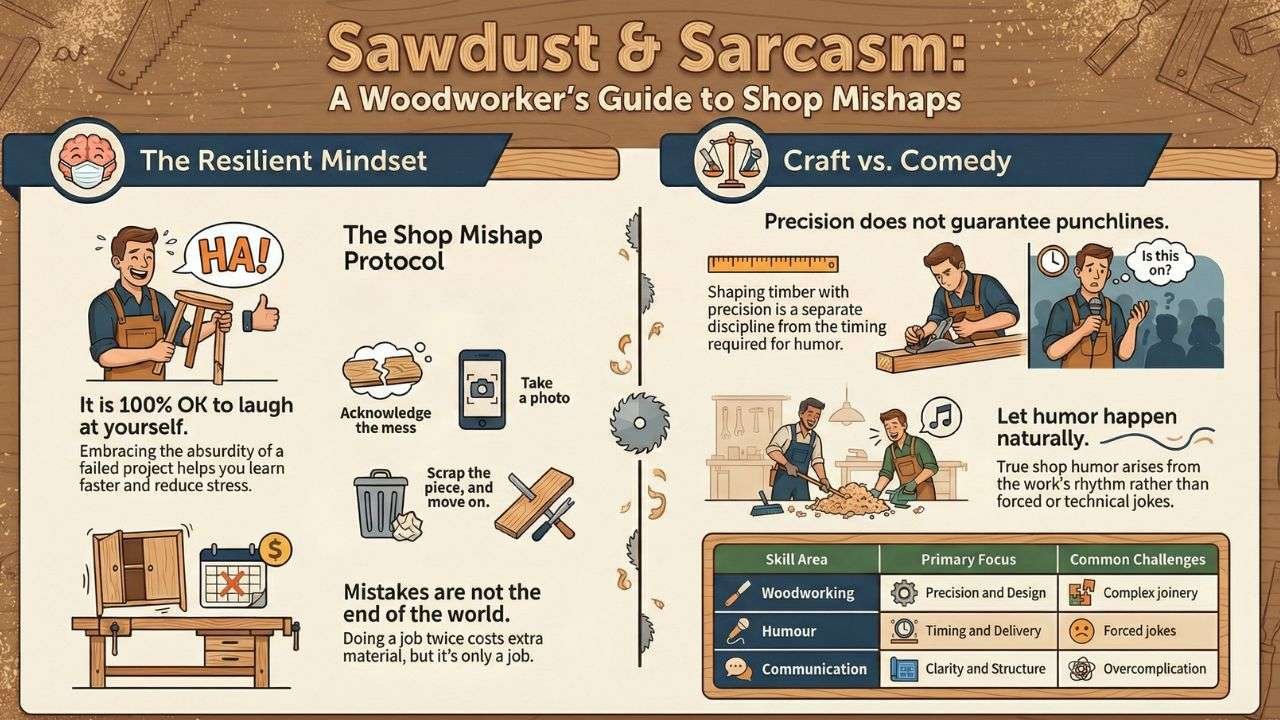
You Need To Know It Is 100% Ok To Laugh At Yourself.
In the theatre of woodworking you are the star, the stagehand and occasionally the clown who zigs when they should have zagged.
Self help advice may encourage you to embrace your inner woodworker with lofty affirmations although the reality is often less poetic.
Sometimes the project you’re working on resists every intention and the final result resembles a thing that is so abstract, even the strangest amongst us would not take it on as some type of abstract art.
This is part of the journey and it is entirely acceptable to laugh at it.
A sense of humour becomes a practical tool that’s well worth having handy on the shelf. When a carefully measured job ends up shorter, less square, made from the wrong lumber and a little too different to the design template than expected. Instead of dwelling on the mess you’ve made, acknowledge the moment, take a picture of it, make a youtube short of it, chuck it in the scrap bin, have a good laugh and then move on.
This mindset builds resilience and turns small to medium sized failures into memorable stories, plenty of likes on instagram and some good reminders of what not to do. This matters because woodworking and imperfections sit side by side, deal with it.
Embracing the absurdity helps you learn faster, live a less stressful life and enjoy the work without the pressure of perfection. If 100% happens that’s great, move on to the next job.
Even the most experienced makers have moments that go sideways.
They simply turn them into anecdotes or use them as the basis for a 20 minute youtube video that explains what happened, how to avoid that and tips for achieving better quality most of the time etc.
When varnish bubbles or a joint refuses to align a quick laugh can reset the mood and keep the overall project moving, fix what needs fixing and keep the momentum, have a laugh about it with your mates later on.
Understanding the Limits of Craft Based Humour.
Woodworkers will naturally gain confidence as their skills develop.
This can create the impression that proficiency in one area naturally extends to another however, humour does not follow this pattern.
The ability to shape timber with precision does not guarantee the ability to land a joke with equal success.
Recognising this distinction supports a balanced understanding of personal strengths.
Attempts at woodworking themed humour can fall short when timing structure and delivery are not well developed and you’re probably trying too hard to be funny. The outcome may not match the intention and awareness of this helps maintain perspective.
The Role of Humility in Creative Expression.
Humility supports growth in any creative or complex field of work.
It allows room for experimentation without the expectation of perfection.
When humour does not land as intended it becomes a reminder that every discipline has its own learning curve.
This approach encourages calm expression and reinforces the value of focusing on areas where skill is strongest while still appreciating moments of lightness.
Learning From Missteps in Humour.
Missteps in humour can usually be be constructive as they reveal gaps in understanding and highlight the complexity of comedic structure.
They also show that enthusiasm and a good story alone does not produce effective woodshop humour.
- Attempts at humorous poems that lack rhythm or clarity.
- Jokes that rely too heavily on technical references.
- Wordplay that does not connect with the intended audience.
- Situations where humour distracts from the craft itself.
These experiences support a grounded approach to communication within the woodworking community.
Focusing on Craftsmanship Instead of Forced Comedy.
Woodworking offers many opportunities to share knowledge and inspire others.
These contributions hold greater value when they focus on craftsmanship rather than forced humour.
Clear explanations thoughtful insights and practical guidance strengthen the community and encourage learning.
A focus on quality work creates a welcoming environment. Humour can appear naturally although it does not need to dominate the conversation.
Natural Moments of Lightness in the Woodshop.
Humour often appears without planning. It could be a small mistake, a surprising outcome or an unexpected detail, any of these and other various situations can create a moment of shared amusement.
These moments feel genuine and make good jokes or popular videos on social media because they arise from the natural rhythm of the work. They contribute to the atmosphere of the shop and reinforce the enjoyment of the craft.
Balancing Confidence With Realistic Expectations.
Confidence supports the willingness to take on new projects and refine techniques. Realistic expectations help maintain perspective.
Recognising that humour is a separate discipline prevents overextension and encourages thoughtful communication.
The table below outlines the contrast between woodworking skills and humour related skills.
| Skill Area |
Primary Focus |
Typical Strengths |
Common Challenges |
| Woodworking |
Precision and design |
Measured progress |
Complex joinery |
| Humour |
Timing and delivery |
Natural spontaneity |
Forced jokes |
| Communication |
Clarity and structure |
Sharing knowledge |
Overcomplication |
| Creative Expression |
Personal style |
Unique ideas |
Misaligned tone |
This comparison highlights the importance of treating each skill with respect and patience.
Supporting a Positive Woodworking Community.
A woodworking community thrives when members share experiences with honesty and openness.
Acknowledging limitations in humour encourages authenticity and reduces pressure to perform in areas unrelated to the craft.
This strengthens the sense of belonging and allows woodworkers to appreciate each other for their dedication and willingness to learn.
Woodworking for Aliens: Declassified Edition.
If aliens ever join the woodworking community they may need a primer on Earth based craft. With popular culture filled with speculation about reptilians in boardrooms and greys in supermarkets, it’s interesting to imagine non-human tradies applying for visas paying taxes, getting a drivers license, registering their ships/vehicles and working at the local bottle shop 5 days per week.
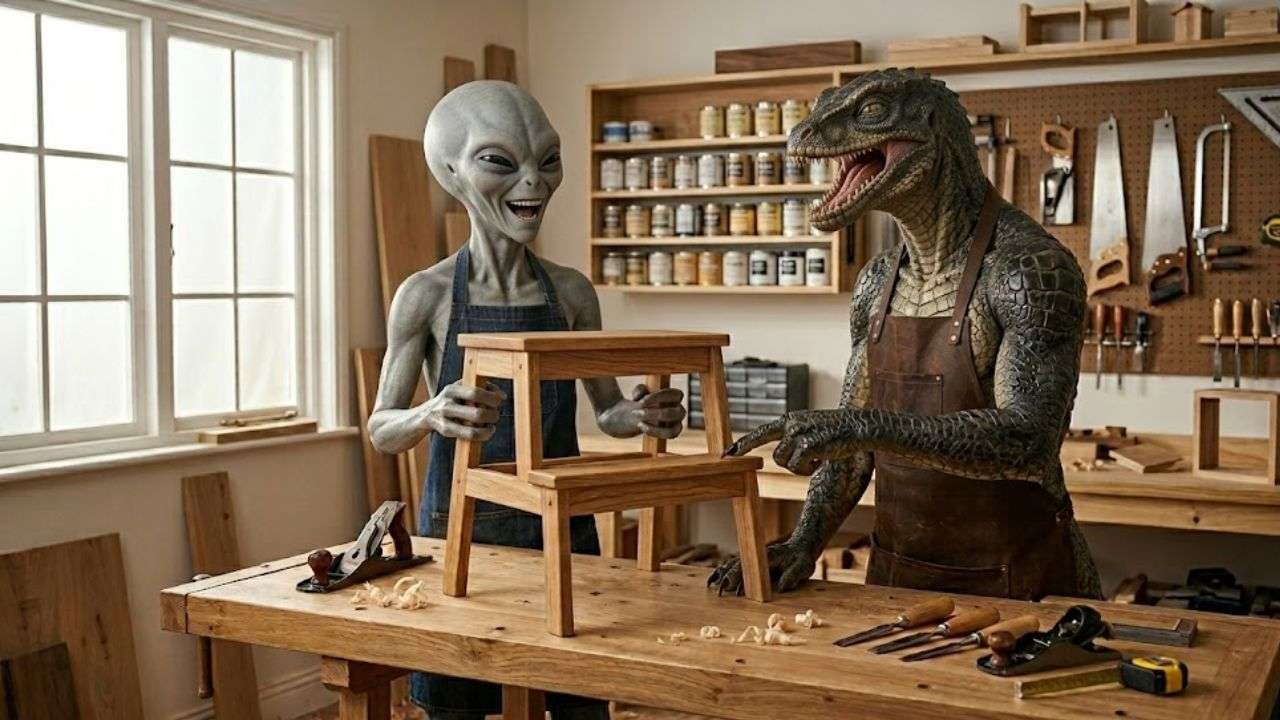
Picture a reptilian woodworker with scales shimmering under workshop lights planing a board with claws that double as chisels.
They might question the need for a bandsaw when they’ve been working with personal lasers for over 30 years but then might enjoy discovering the satisfaction of hand sanding.
A grey alien with large eyes and a huge brain will have no trouble spotting grain patterns but with only 4 dangly fingers, they’ll probably struggle with dovetails and remark that they can assemble most of our joints quite easily via telekinesis.
Earth tools would seem quaint yet charming but if they are a tradie at heart (or in one of their 4 hearts) they might give it a go.
This scenario highlights the idea of NHDEI, Non Human Diversity, Equity And Inclusion and how that might play out in the woodshop and the lunch room.
If extraterrestrial and inter-dimensional tradies select to settle into rural life perhaps they might bring new perspectives to the DIY.
Hand held directional anti gravity beams could make light work of building a new barn on the farm and make it very easy to change a tyre on the truck.
Their version of humour might catch on and become the standard in the woodshop as well as the pub after work. A funny alien woodworker is well liked alien woodworker I suppose.
Conclusion.
Woodworking provides satisfaction through steady improvement and thoughtful craftsmanship. Humour can complement this experience when it arises naturally although it does not need to be forced.
Respecting the boundaries between creative skills supports a calm and grounded approach to the craft and creates a more connected community whether human, alien, hybrid or something yet to be discovered.