Abstract Woodwork
Wood in its most elemental form invites a different kind of attention.
When grain becomes pattern and structure becomes expression the workshop shifts from a place of production to a place of interpretation.
Abstract woodwork grows from this shift. It asks the maker to notice shape texture and proportion with the same care usually reserved for joinery.
The result is a practice that feels both grounded and exploratory.
It rewards patience. It rewards curiosity. It rewards the willingness to see familiar material through a new lens.
The Nature of Abstraction in Woodwork.
Abstraction in woodwork begins with restraint. Instead of carving toward a recognisable figure the maker works toward a distilled idea.
A curve becomes a gesture. A surface becomes a field of light. A joint becomes a point of tension between two planes.
The workshop feels different when the focus moves from representation to interpretation. The sound of a hand plane on a wide board becomes part of the process because the rhythm influences how the surface develops.
The scent of freshly cut cedar or the cool weight of a slab of ash reminds the maker that abstraction still depends on physical reality.
The counter intuitive aspect is that abstraction often reveals more about the material than representational work. When the form is simplified the grain becomes the subject.
A single knot can shift the balance of a piece. A faint ripple in the fibres can guide the entire composition. This is why abstract work demands slow observation before any tool touches the timber.
Working With Form and Proportion.
Form drives abstract woodwork more than detail. A single block of hardwood can become a study in proportion when its edges are softened or its mass is redistributed. Makers often begin with cardboard mockups or small offcuts to test relationships between height width and depth.
These experiments help clarify how the eye moves across a piece.
A tall narrow form draws attention upward while a low wide form encourages the viewer to read the surface horizontally.
In the workshop the tactile qualities of the material influence these decisions. The slight drag of a rasp on dense jarrah encourages gentle curves rather than sharp transitions.
The crisp response of beech under a chisel supports more geometric forms. These sensations guide the maker toward shapes that feel honest to the timber.
A practical limitation appears when working with large forms.
Timber movement becomes more noticeable because abstract pieces often rely on uninterrupted surfaces. A wide panel of solid wood may cup or twist over time which can alter the intended proportions.
Makers who work in this style learn to anticipate seasonal changes and select boards with stable grain patterns.
Surface as Expression.
Surface treatment plays a central role in abstract woodwork. A smooth plane polished with a cabinet scraper reflects light in a continuous sweep.
A textured surface created with a gouge or toothing plane scatters light and creates a sense of depth. The choice between these approaches shapes the emotional tone of the piece.
The workshop environment influences these decisions. Morning light falling across a half finished surface can reveal subtle irregularities that would remain hidden under artificial lighting.
The warmth of the timber under the hand after sanding with fine grit paper creates a sense of completion that is difficult to describe yet unmistakable to the maker. Some makers introduce controlled irregularities.
A shallow undulation left by a carving tool can create a rhythm across the surface. This approach challenges the assumption that perfection requires uniformity. Instead the surface becomes a record of the maker’s interaction with the material.
Exploring Negative Space.
Negative space becomes a structural element in abstract woodwork.
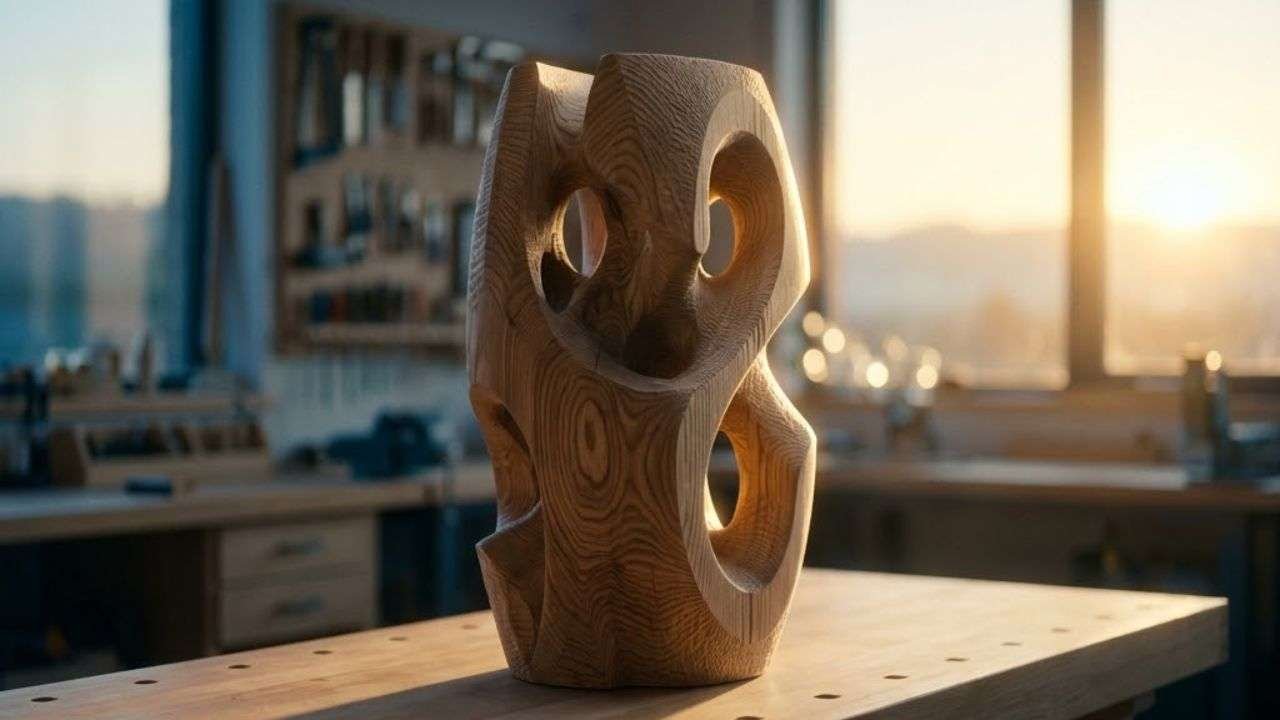
A void carved into a block of timber can feel as substantial as the surrounding mass. The contrast between solid and empty shapes how the viewer experiences the piece. This is especially noticeable when the interior surfaces catch light differently from the exterior.
In the workshop this exploration often begins with chalk lines or pencil marks on the timber. The maker studies how the grain flows around the intended void.
A knot or change in colour can shift the placement of the opening. The sound of the chisel as it enters the wood provides feedback about density and direction which influences how the void develops.
A small tangential observation arises here. When shaping negative space the offcuts often become interesting objects in their own right.
Their irregular shapes and exposed grain patterns can inspire future pieces or serve as reference forms.
Material Selection and Its Influence.
Abstract woodwork depends heavily on the character of the chosen timber. Dense species like ironbark or spotted gum support crisp edges and strong geometric forms.
Softer species like pine or poplar encourage broader gestures because they respond differently to carving tools.
The colour of the timber also influences the final composition. Pale woods highlight shadow while darker woods emphasise silhouette.
The tactile qualities of each species guide the maker. The waxy feel of oiled walnut or the dry texture of unfinished oak creates different expectations for the final piece. Even the sound of tapping a board on the bench can reveal information about internal tension or hidden defects.
A useful comparison appears when considering how different species behave under similar tools.
| Timber Species | Typical Density | Best Suited Forms | Surface Qualities | Notes |
| Walnut | Medium | Soft curves and balanced proportions | Smooth reflective finish | Responds well to hand tools. |
| Oak | Medium high | Strong geometric shapes | Visible grain texture | Movement requires planning. |
| Pine | Low | Broad expressive forms | Soft matte finish | Easy to carve but dents easily. |
| Jarrah | High | Precise edges and defined planes | Deep colour variation | Hard on edge tools. |
| Ash | Medium | Tall slender forms | Even grain pattern | Stable for large surfaces. |
This table highlights how material choice shapes the direction of the work.
It also shows why abstract woodwork often begins with a close reading of the timber before any design decisions are made.
Tools and Techniques for Abstract Forms.
The tools used in abstract woodwork are familiar yet applied with different intent. A spokeshave becomes a way to explore curvature rather than refine a chair leg.
A block plane becomes a tool for shaping light across a surface. Carving gouges allow the maker to introduce texture that feels deliberate rather than decorative.
The workshop atmosphere influences technique. The fine dust from sanding a large surface settles on the bench and softens the edges of nearby tools.
The vibration of a mallet strike on a carving chisel travels through the timber and into the maker’s hand which helps gauge the depth of each cut.
Some makers incorporate power tools for rough shaping then return to hand tools for refinement. This combination allows for efficient material removal without losing the tactile connection that defines abstract work.
The trade off is that power tools can introduce marks that require careful removal to preserve the intended form.
Integrating Abstract Pieces Into the Home.
Abstract woodwork fits naturally into domestic spaces because it emphasises material presence rather than function.
A sculpted form placed near a window interacts with changing light throughout the day. A wall mounted piece with subtle texture can shift the atmosphere of a room without dominating it.
The warmth of natural timber supports a calm environment which aligns with the broader lifestyle of woodworking.
A lived in example appears in homes where a single abstract piece sits on a sideboard near everyday objects.
The contrast between the sculpted form and the practical items around it creates a quiet dialogue. The piece becomes part of the rhythm of the home rather than a standalone statement.
The limitation is that large abstract pieces require space to breathe. Placing them too close to furniture or walls can diminish their impact.
Makers who design with domestic settings in mind often create smaller works that maintain presence without overwhelming the room.
Closing Reflections.
Abstract woodwork invites a slower way of seeing. It encourages the maker to notice grain direction light movement and the subtle weight of form.
It also encourages the viewer to engage with timber in a more contemplative way. The practice rewards patience and curiosity which makes it a natural extension of a woodworking centred life. It offers a path where craftsmanship and expression meet without competing for attention.