Best Woodwork Machine

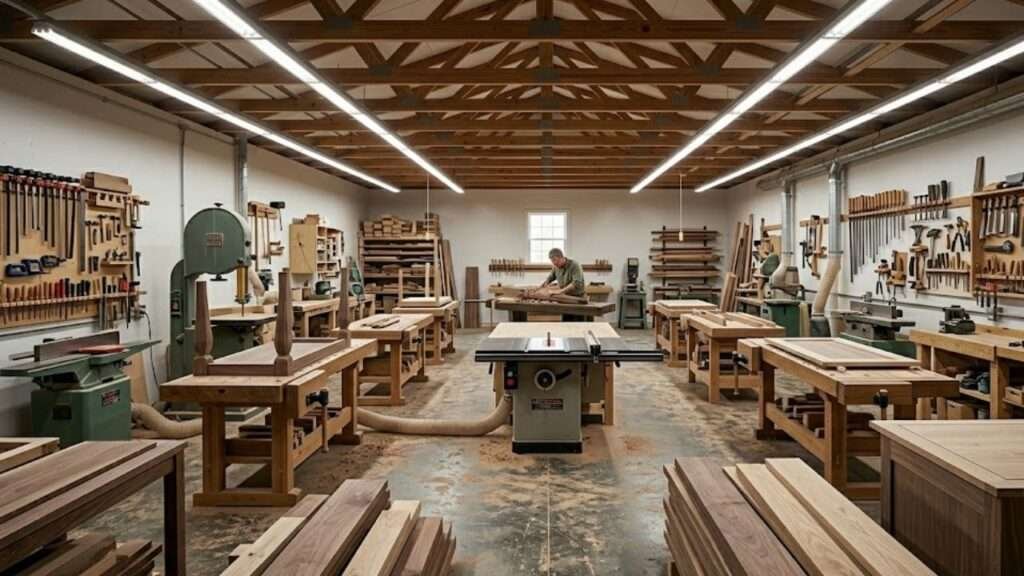
A workshop often reveals its character through the tools that see the most use.
Some machines gather dust while others become extensions of the hands that guide them. Comfort and skill shape these choices more than specifications or trends, and they influence the atmosphere of a woodworking life as much as the finished pieces themselves.
Understanding Personal Fit In The Workshop.
Every woodworker develops a relationship with certain machines.
The feel of a cast iron table under the palm, the steady hum of a motor at a familiar pitch, or the way a fence locks into place with a reassuring click all contribute to a sense of ease. This comfort is not sentimental.
It affects accuracy, pace and confidence. A machine that feels intuitive encourages steady work and reduces hesitation. The opposite is also true. A tool that feels awkward can interrupt flow even when it is technically capable.
This sense of fit often emerges gradually. A woodworker might notice that a particular machine becomes the default choice for tasks that could be completed in several ways.
The decision is not always logical. It may come from the way the machine handles a specific species of timber or how it behaves when the workshop is warm and the air carries the scent of freshly planed pine.
Skill As A Practical Foundation.
Comfort alone is not enough. Skill determines how effectively a machine can be used. A well tuned bandsaw can produce clean curves and straight resaws, but only when the operator understands blade tension, feed rate and the subtle vibration that signals a dull edge.
Skill transforms a machine from a static object into a responsive partner.
This relationship deepens through repetition. A woodworker who has spent years adjusting a particular jointer learns to recognise the faint change in sound when the knives begin to lose their edge. That awareness cannot be purchased. It is earned through hours of contact with timber, steel and dust.
A counter intuitive truth emerges here. The most advanced machine is not always the most productive choice.
A simpler tool that aligns with a woodworker’s habits can outperform a complex one that demands constant adjustment. This surprises many newcomers who assume that capability alone determines value.
The Role Of Workshop Rhythm.
Every workshop has a rhythm shaped by the sequence of tasks, the layout of benches and the natural light that shifts across the space during the day.
Machines that support this rhythm become central to the workflow. A table saw positioned near a window might feel more inviting in the morning when the grain of a board is easier to read in soft light.
A planer near the back wall might be preferred in the afternoon when the air is cooler and the machine’s steady output feels grounding.
These small environmental details influence comfort more than many woodworkers realise.
The warmth of a motor after a long session, the scent of cedar lingering near the dust port or the smoothness of a freshly waxed table surface all contribute to a sense of belonging. When a machine fits naturally into the rhythm of the space, it becomes easier to use with precision.
Balancing Capability With Familiarity.
Choosing machines often involves a trade off between capability and familiarity. A new machine may offer improved accuracy or efficiency, but it also introduces a learning curve. During this period, productivity can dip.
A woodworker must decide whether the long term benefits outweigh the temporary disruption. This trade off becomes clear when comparing two machines that perform the same task.
One might have a more powerful motor or a larger capacity, but the other might feel more predictable.
Predictability matters. It reduces the mental load of constant adjustment and allows attention to remain on the timber rather than the tool.
A lived in example illustrates this well. A woodworker might keep an older drill press because its quill return feels smooth and its depth stop locks with a familiar firmness.
A newer model could offer digital readouts and improved accuracy, yet the older machine remains the preferred choice because it responds exactly as expected.
How Comfort Influences Safety.
Comfort and skill also influence safety in practical ways. A machine that feels natural to use encourages steady posture, controlled feed pressure and consistent hand placement.
These habits reduce the likelihood of mistakes. When a woodworker understands the behaviour of a machine under load, they can anticipate movement and adjust accordingly.
This does not eliminate the need for safety gear or careful technique.
It simply means that familiarity supports safer decisions. A machine that feels unpredictable can lead to rushed adjustments or awkward body positions.
Over time, these small stresses accumulate.
A tangential observation arises here. Many woodworkers notice that they work more safely when the workshop is tidy, even though tidiness has no direct mechanical effect on a machine.
The clarity of the space influences the clarity of the mind, and comfort with tools often grows in parallel with comfort in the environment.
Matching Machines To Project Style.
Different woodworking styles favour different machines. A furniture maker who works with fine joinery may rely heavily on a well tuned table saw and a precise router table.
A craftsperson who shapes organic forms may feel more at home with a bandsaw and a spindle sander. Comfort develops where the machine aligns with the type of work being done.
This alignment becomes more noticeable when switching between projects. A woodworker who spends several weeks building cabinets may find that the table saw becomes the centre of activity.
When shifting to small decorative boxes, the scroll saw or disc sander might take on that role. The machine that feels best is often the one that matches the scale and intention of the work.
A practical limitation appears here. No single machine excels at every task. Even the most versatile tools have boundaries. Recognising these boundaries prevents frustration and encourages thoughtful planning.
A Table Of Machine Characteristics And Comfort Factors.
The following table outlines how comfort and skill interact with common machine characteristics. It is not a ranking. It is a way to understand how personal fit influences performance.
| Machine Type |
Key Strength |
Comfort Factor |
Skill Requirement |
Typical Use Case |
| Table Saw |
Accurate ripping and joinery |
Fence feel and table smoothness |
High |
Furniture and cabinetry |
| Bandsaw |
Curves and resawing |
Blade tracking behaviour |
Medium |
Organic shapes and veneers |
| Planer |
Thickness consistency |
Feed roller predictability |
Medium |
Dimensioning stock |
| Jointer |
Flat reference surfaces |
Knife alignment feel |
High |
Edge and face jointing |
| Drill Press |
Controlled drilling |
Quill movement smoothness |
Low |
Joinery and hardware installation |
Evolving Preferences Over Time.
A woodworker’s preferred machines often change as skills deepen.
Early in a woodworking journey, a machine may feel intimidating. With practice, that same machine becomes a source of confidence.
This evolution is natural. It reflects the growing understanding of timber behaviour, tool mechanics and personal working style.
Some preferences shift due to physical comfort. A machine that once felt effortless may become tiring after long sessions.
Adjusting bench height, improving dust extraction or repositioning machines can restore ease. These adjustments highlight how comfort is not fixed. It responds to the body, the space and the work being done.
There is also a quiet satisfaction in rediscovering a machine that has been underused. A woodworker might return to a spindle sander after months of hand shaping and find that its steady rhythm suits the current project. These moments remind us that comfort is not always predictable.
Closing Reflections.
The best woodwork machine is not defined by price, power or reputation. It is the one that supports steady work, aligns with personal skill and fits naturally into the rhythm of the workshop. Comfort and familiarity shape this choice more than any specification sheet.
When a machine feels right, it becomes part of the craft rather than an obstacle to it.