Our Very Long Association With Tools
There is something particular about picking up a well-worn chisel.
The handle has darkened where thousands of palms have gripped it before yours. The steel holds an edge that someone else ground.
The tool arrives already inhabited. That feeling is not nostalgia. It is the residue of an unbroken line of human intention stretching back further than any written record, further even than the genus we call our own.
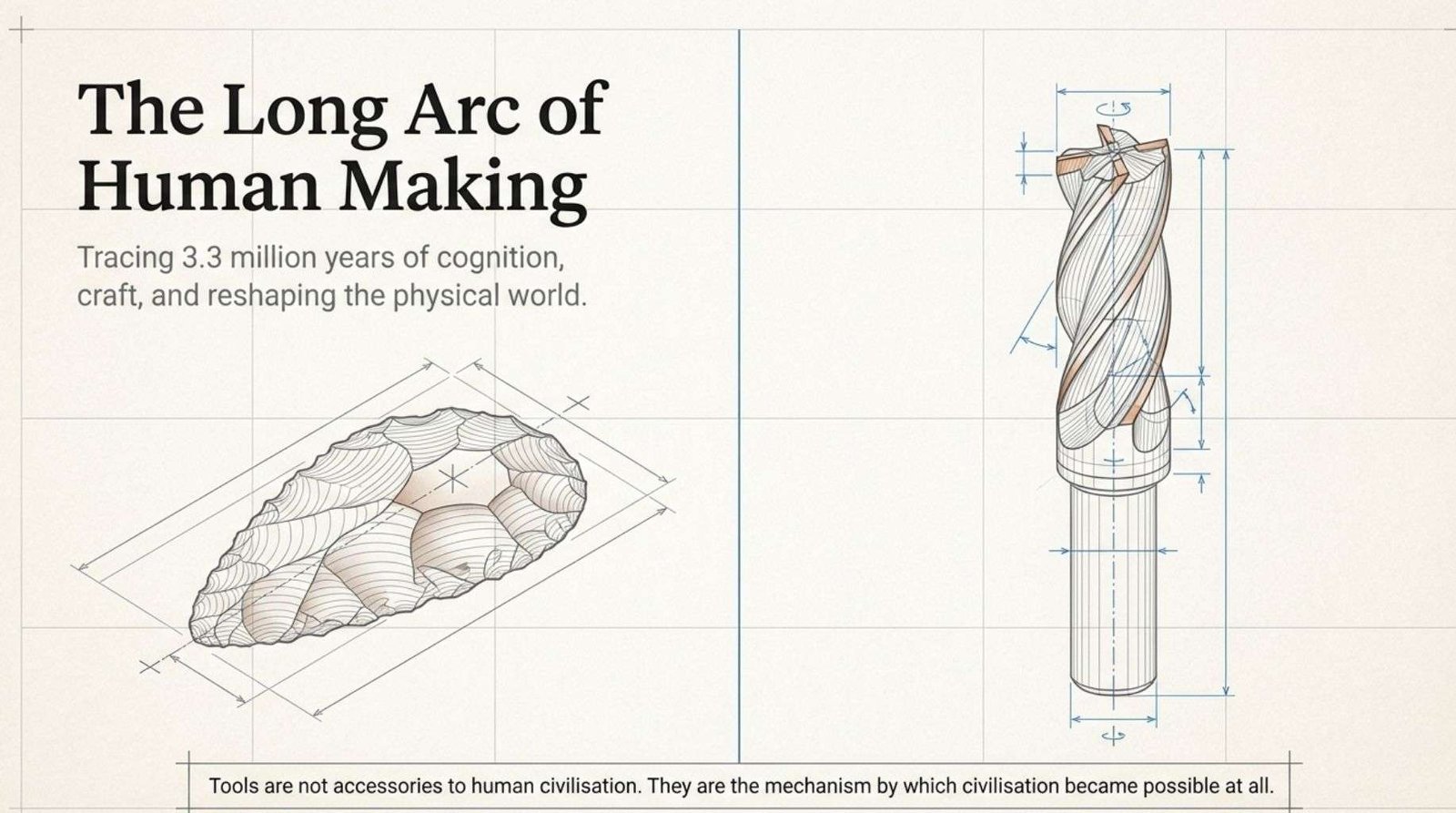
Tools are not accessories to human civilisation. They are the mechanism by which civilisation became possible at all.
What a Tool Actually Is.
The word is used loosely enough that it deserves precision.
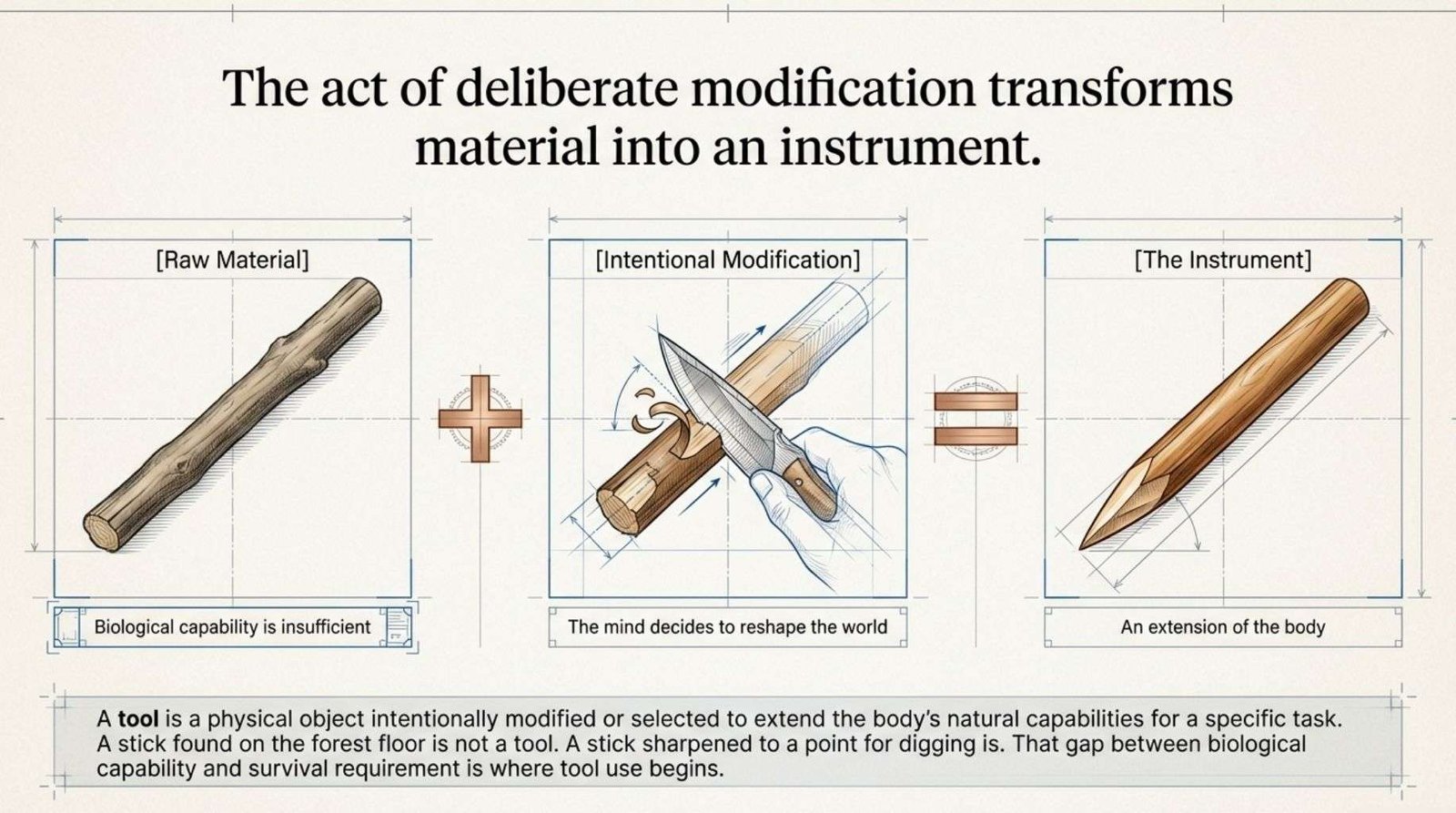
A tool is a physical object intentionally modified or selected to extend the body’s natural capabilities for a specific task.
That last part matters as a stick found on the forest floor is not a tool but a stick sharpened to a point for digging is. The act of deliberate modification is what transforms material into instrument.
This distinction is not merely philosophical. It marks the moment when a mind decided that what the body could do was insufficient and that the world could be reshaped to remedy that.
The hand is strong and versatile, but it cannot cut hardwood, prise marrow from bone or shave a timber face to tolerance.
Something harder, sharper and more specific was needed. That gap between biological capability and survival requirement is where tool use begins.
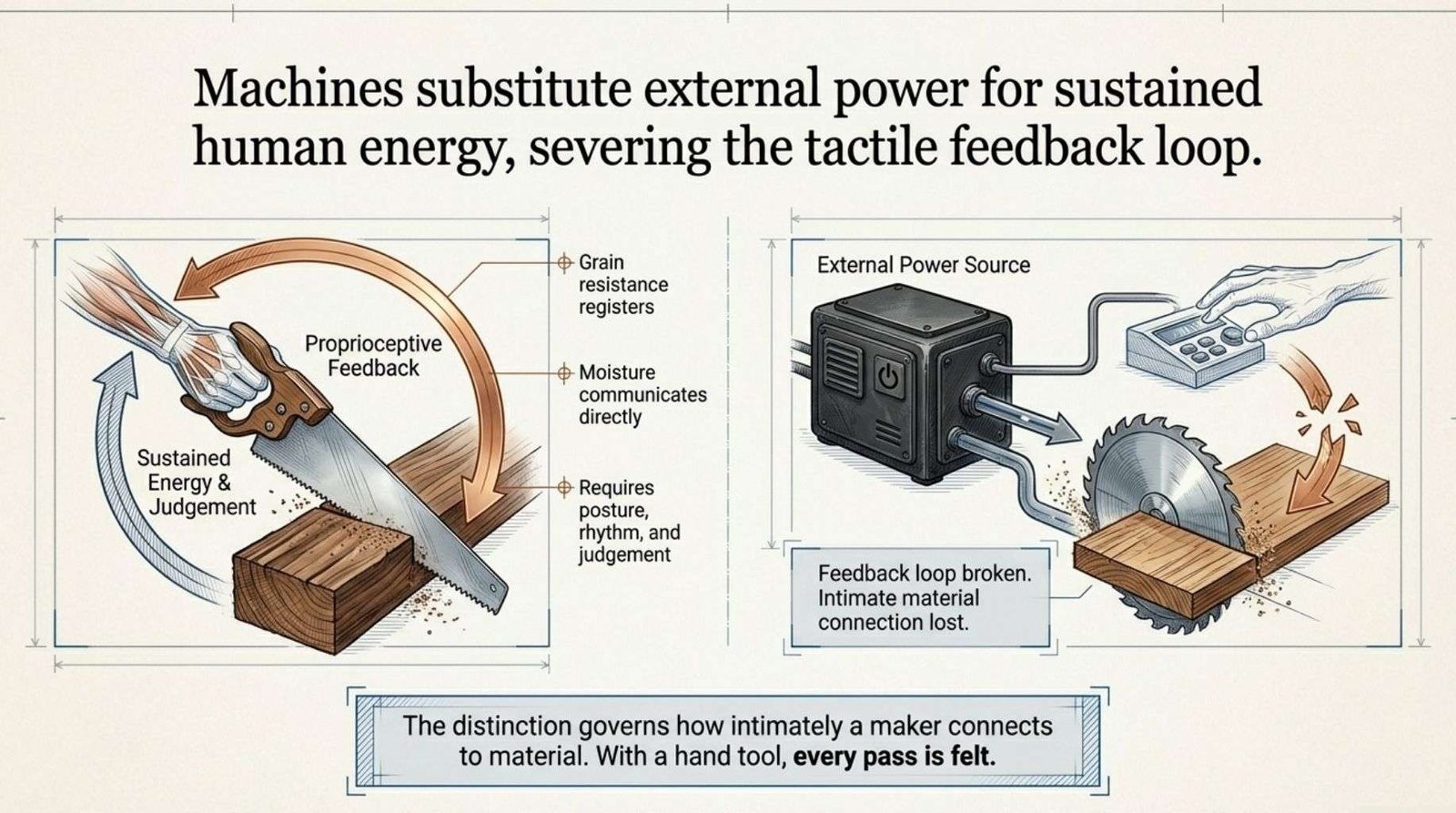
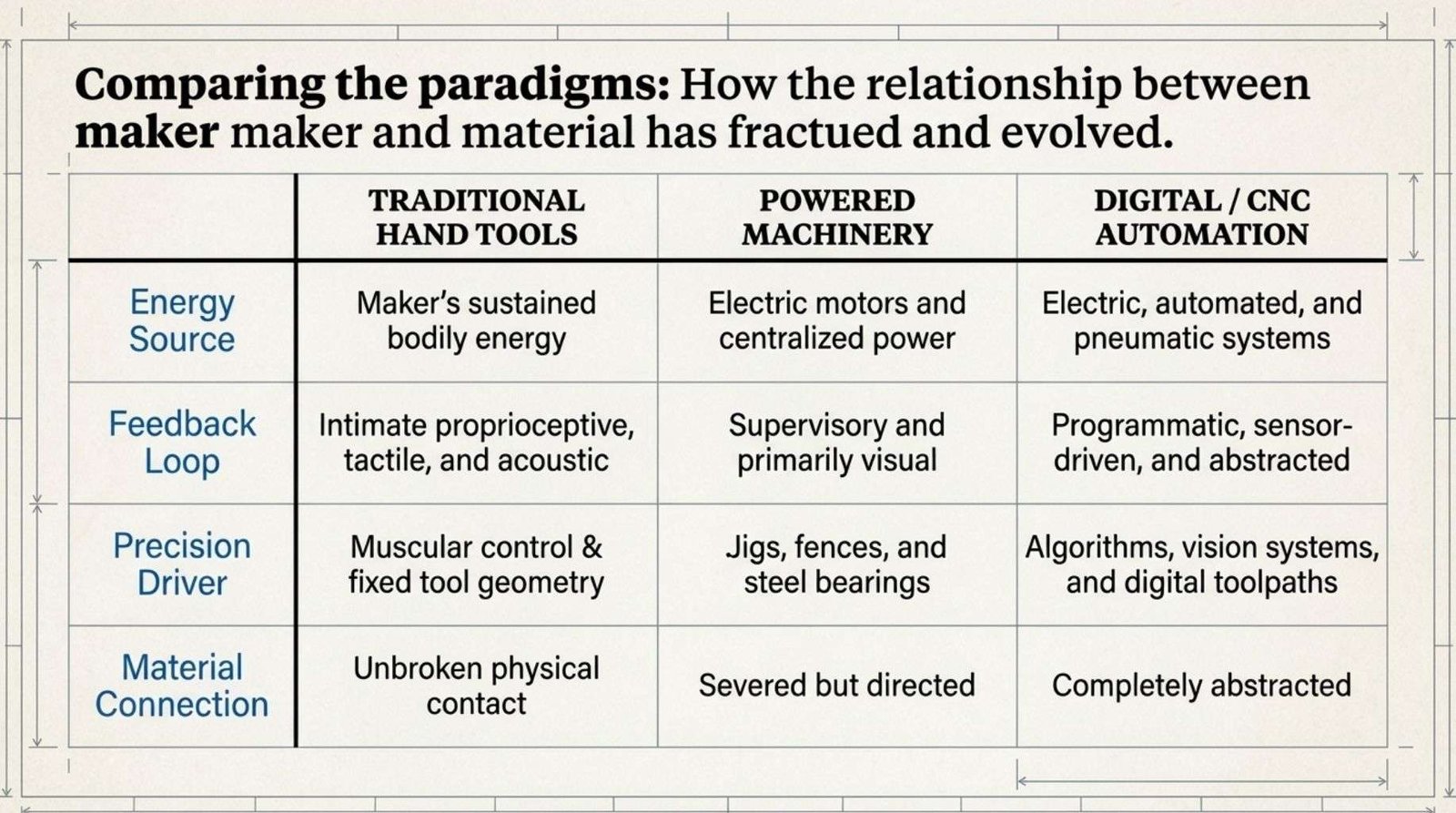
Tools are also categorically different from machines. A hand saw requires the woodworker’s sustained energy, posture, rhythm and judgement.
A panel saw with a motorised carriage substitutes an external power source for most of that. The distinction matters in a workshop context because it governs how intimately a maker is connected to the material.
With a hand tool, every pass is felt. Grain resistance registers through the wrist. Hardness or moisture in the timber communicates itself directly.
That feedback loop between hand, tool and wood is one of the defining pleasures of traditional woodworking, and it is not replicated by a machine, however sophisticated.
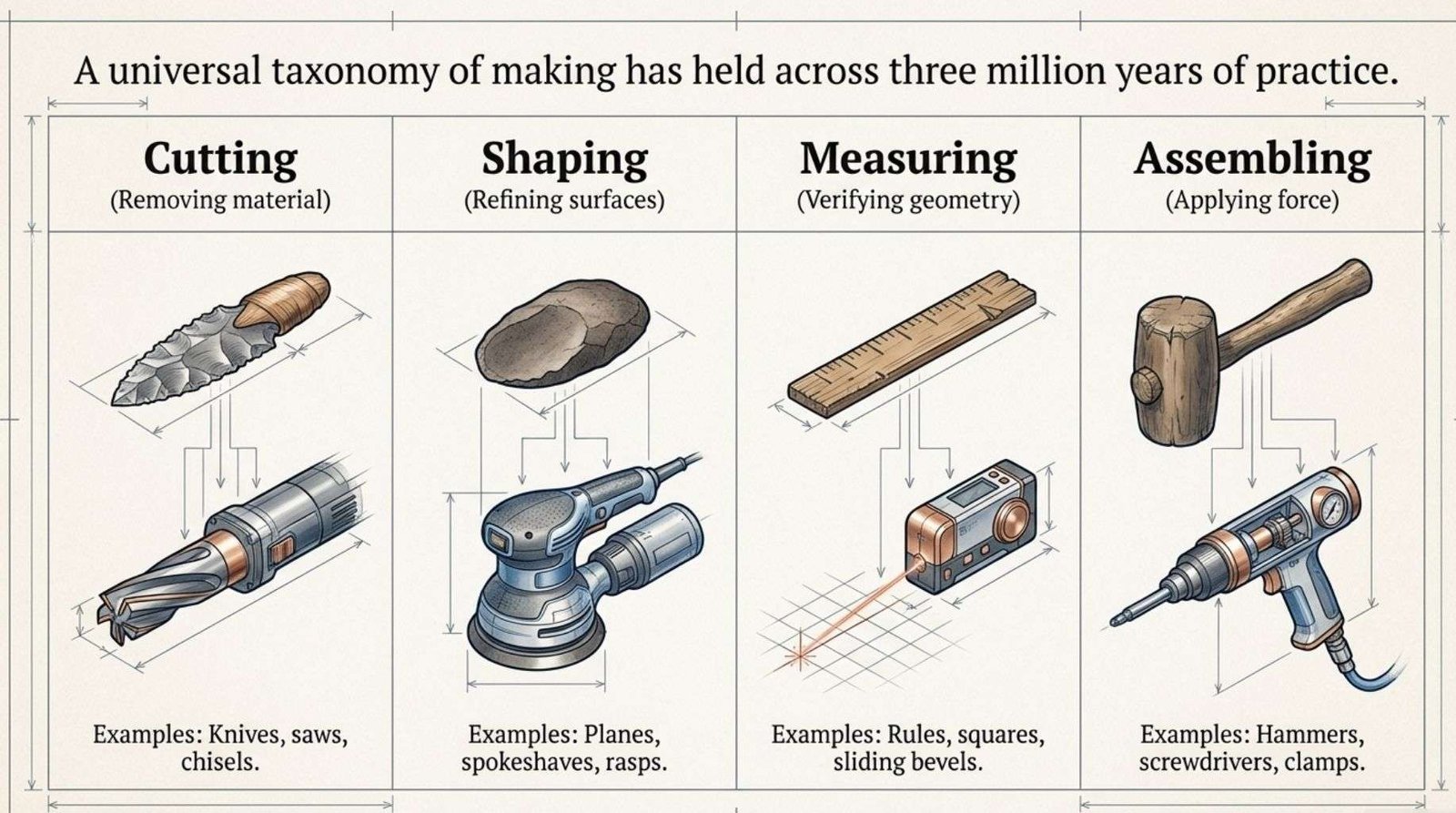
Tools can be sorted by function. Cutting tools remove material: knives, saws, chisels, and gouges. Shaping tools refine surfaces: planes, spokeshaves, rasps and files. Measuring tools verify dimension and geometry: rules, squares, sliding bevels and gauges.
Assembling tools drive fixings or apply force: hammers, mallets, screwdrivers, and clamps. This taxonomy holds across three million years of making, from a fractured flint to a carbide-tipped router bit spinning at 24,000 RPM.
Before Homo Sapiens: The First Three Million Years.
The oldest confirmed tools yet found were not made by modern humans. They were not made by any species we would recognise as human at all.
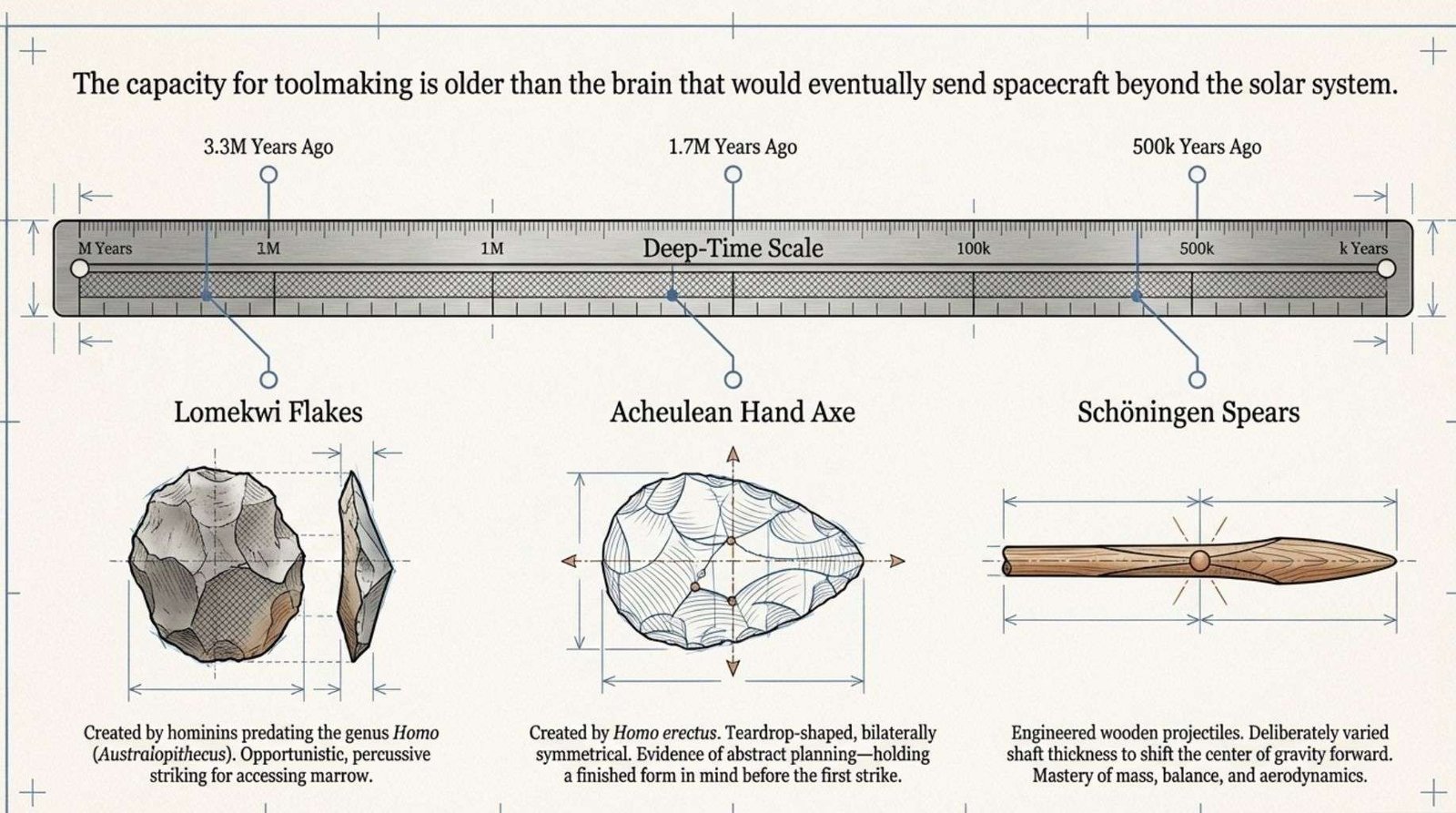
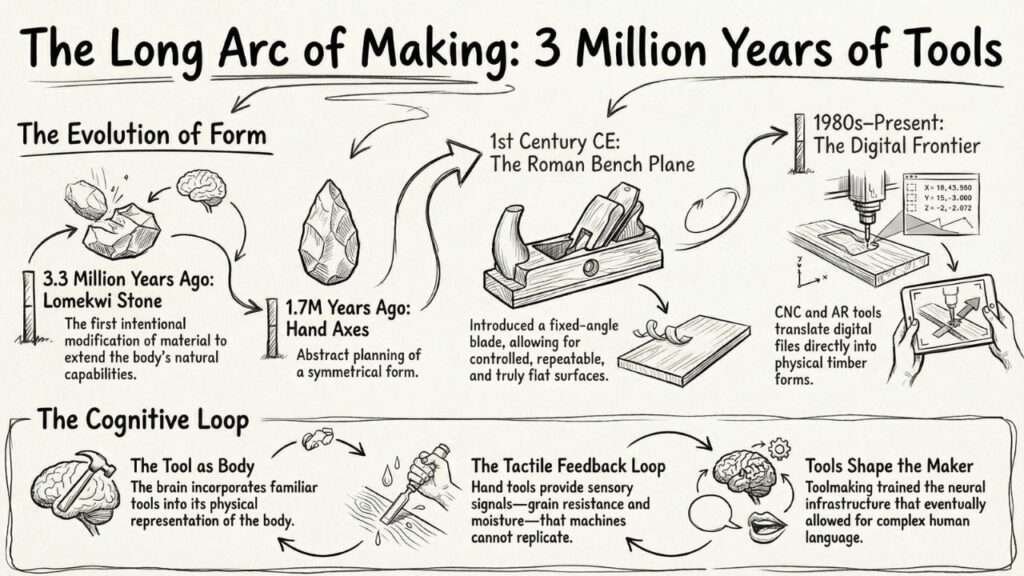
The Lomekwi stone tools from Kenya, dated to approximately 3.3 million years ago, were produced by hominins who predated the genus Homo entirely.
Australopithecus or Kenyanthropus, species closer in form to apes than to us, were knapping stone into functional instruments.
The capacity for toolmaking, it turns out, is older than the brain that would eventually send spacecraft beyond the solar system.
Those earliest implements were percussive and opportunistic. Hammerstones and sharp flakes, produced by striking one rock against another, were sufficient to butcher animal carcasses and split long bones to access the marrow inside. Bone marrow is dense with fat and protein.
Accessing it represented a significant caloric advantage and may have directly supported the metabolic demands of encephalisation, the gradual growth of the hominin brain over successive generations.
By 1.7 million years ago, the tool tradition had changed fundamentally.
Homo erectus produced Acheulean hand axes: teardrop-shaped, bilaterally symmetrical, refined on both faces. These are not opportunistic objects.
They required the maker to hold a finished form in mind before the first strike and then work toward that form through a sequence of controlled decisions.
The hand axe is evidence of abstract planning in a species that left no other written or constructed record of its inner life.
Wood was certainly worked throughout this period, but the evidence has largely rotted away. Stone preserves; timber does not.
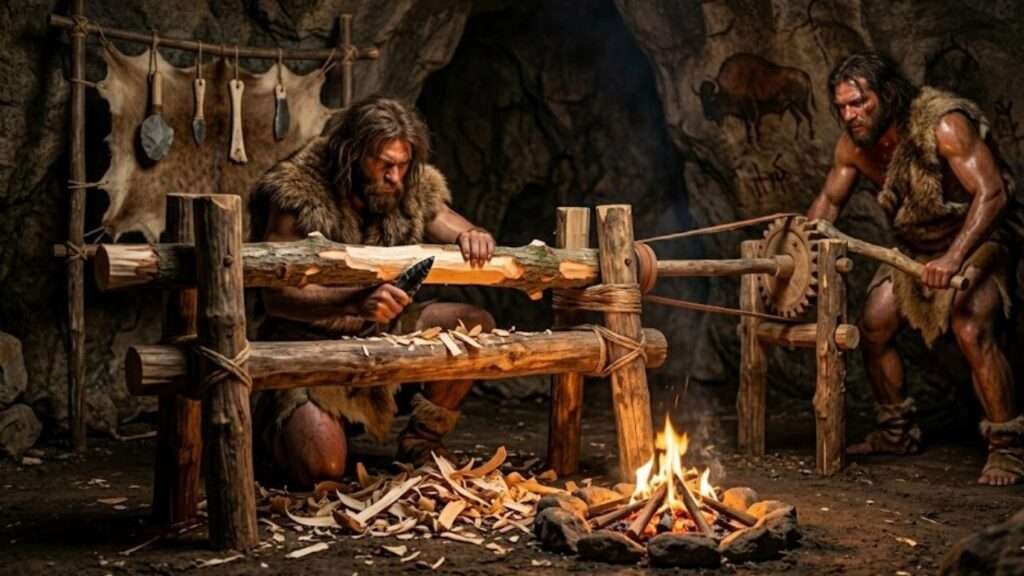
The oldest surviving wooden tool is a digging stick from Clacton-on-Sea in England, dated to approximately 400,000 years ago and shaped by Neanderthals or their immediate predecessors.
It is a reminder that the fossil record of early tools is heavily biased toward the durable and away from the perishable, which means the woodworking tradition is certainly older than anything we can currently prove.
By 500,000 years ago, hominins at Schöningen in northern Germany had produced complete wooden spears with shaped, balanced tips and deliberately varied shaft thickness to shift the centre of gravity forward.
These are not primitive objects. They are engineered projectiles made by creatures who understood mass, balance and aerodynamics through accumulated practice if not formal analysis.
The Cognitive Loop: How Tools Shaped the Makers.
Tool use did not simply reflect human intelligence. It contributed to creating it.
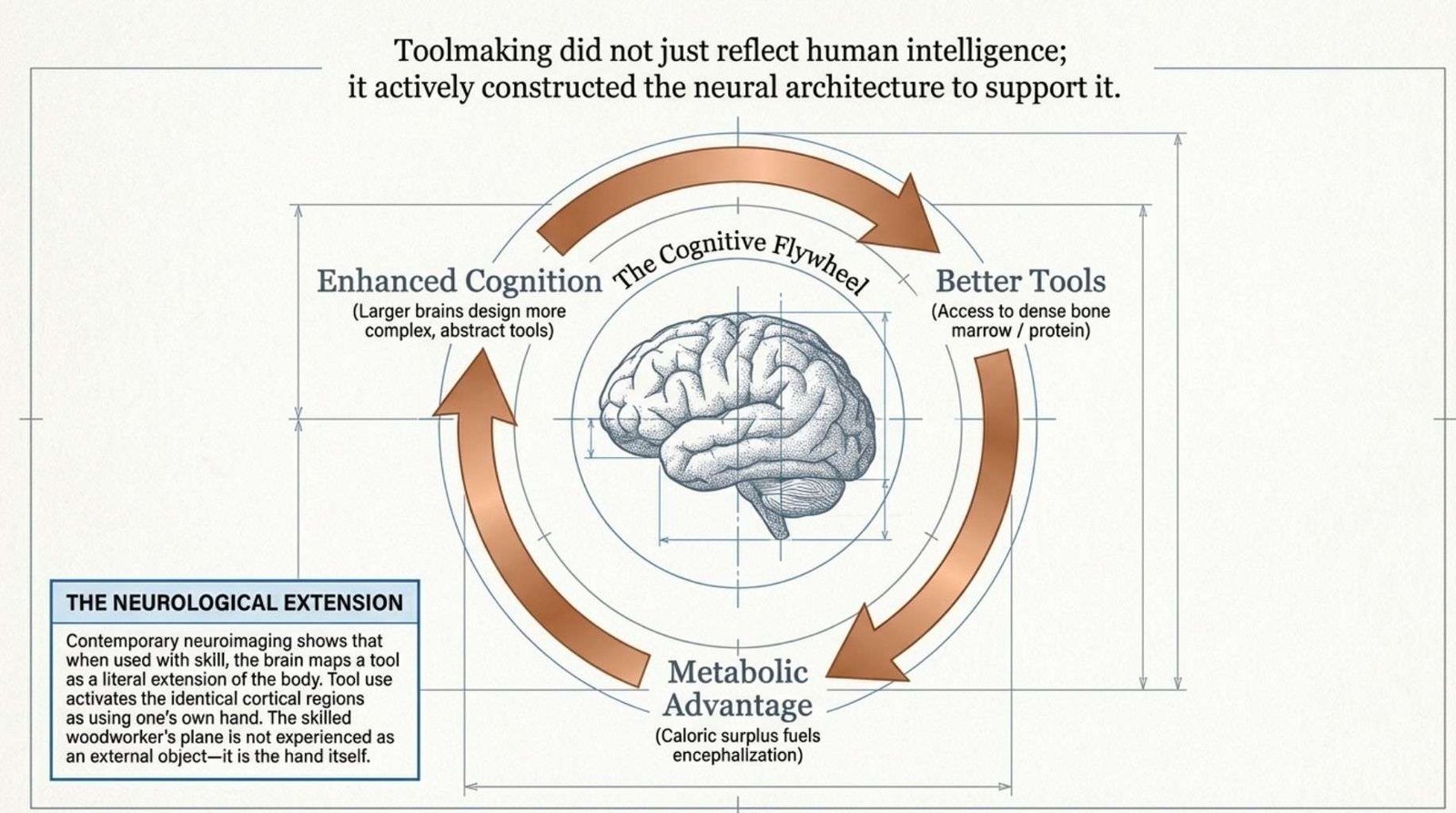
The relationship between making and thinking is reciprocal, and that feedback loop is one of the most consequential dynamics in the entire history of our species. Better tools allowed access to richer food sources.
Richer food supported larger brains. Larger brains generated better tools. This cycle repeated across hundreds of thousands of years.
However, the effect was not only metabolic. Toolmaking is also a social and communicative act. Teaching another person to knap a flint or to recognise the right tree for a spear shaft requires shared attention, demonstration and the transfer of embodied knowledge that cannot easily be expressed in words.
Long before language was sophisticated enough to describe abstract ideas, toolmaking was training the neural infrastructure that language would eventually use. Contemporary neuroscience has confirmed something that craftspeople have known intuitively for generations.
When a person uses a tool with sufficient skill and familiarity, the brain incorporates it into its representation of the body. Neuroimaging studies show that tool use activates the same cortical regions as using one’s own hand.
The skilled woodworker’s plane is not experienced as an external object held at arm’s length. It is experienced as an extension of the hand itself.
This is why a craftsperson can feel the difference between working with and against the grain through the handle of a smoothing plane, even when the visual feedback is minimal.
There is something worth pausing on here. The same neural mechanism that allows a brain surgeon to feel the resistance of tissue through a scalpel, or a sculptor to read the surface of clay through a wire loop, or a cabinetmaker to sense the onset of tearout through a bench plane, is not a specialist skill developed through years of training.
It is a general feature of human cognition that evolution installed when survival depended on reading the world through the medium of held objects.
Modern toolmakers are not doing something new. They are exercising one of humanity’s oldest cognitive faculties.
The Neolithic Shift and the First Woodworking Toolkit.
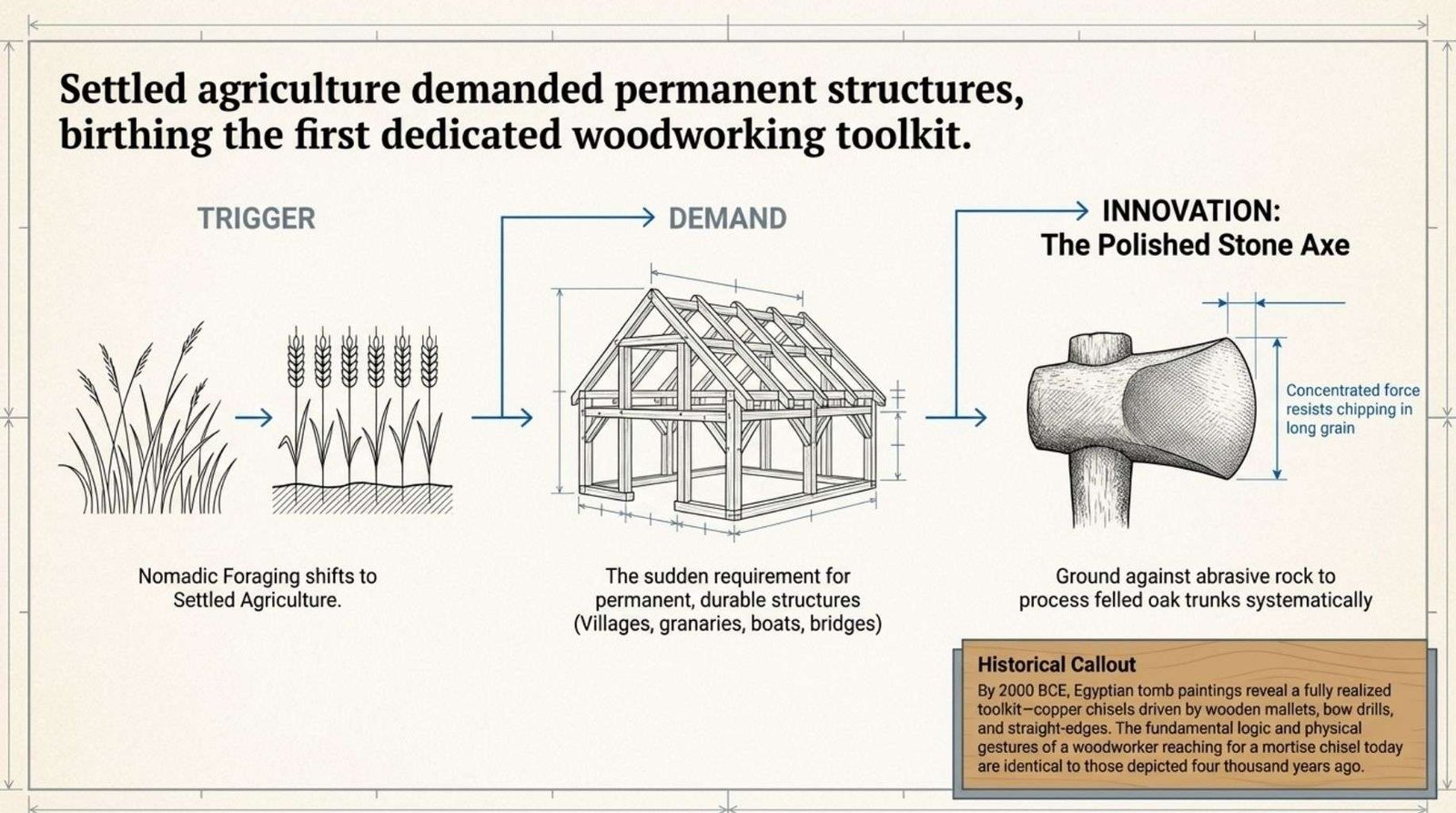
The Neolithic Revolution, beginning approximately 12,000 years ago, changed the relationship between humans and wood in ways that still define how we build today. The transition from nomadic foraging to settled agriculture created a demand for permanent structures that temporary shelters made from branches and hides could not meet.
Wood became a primary construction material, and that created demand for tools that could shape it with greater precision and at greater scale.
The polished stone axe is the signature tool of this period. Unlike the earlier flaked stone tools, polished axes were ground against abrasive rock to produce a smooth, convex cutting edge that concentrated force more effectively and resisted chipping in the long grain of a felled trunk.
A skilled Neolithic woodworker with a polished stone axe could fell a mature oak and dress its trunk into usable timber.
It was slow work, measured in hours per log, but it was systematic and repeatable. Villages, granaries, boats, and bridges followed.
The early woodworking toolkit expanded during the Bronze Age, when metal first became available for tool edges. Copper chisels appeared in Egypt and Mesopotamia around 3000 BCE.
Bronze, harder than copper and capable of holding a finer edge, followed. Egyptian tomb paintings dated to around 2000 BCE show carpenters using wooden mallets to drive copper chisels, bow drills to bore holes, and straight-edges to check their work. The basic logic of those tools has not changed.
A woodworker today reaching for a mortise chisel and a wooden mallet is making the same fundamental gestures as those depicted on tomb walls four thousand years ago.
The Roman contribution was the wooden-bodied bench plane, which appeared around the first century CE.
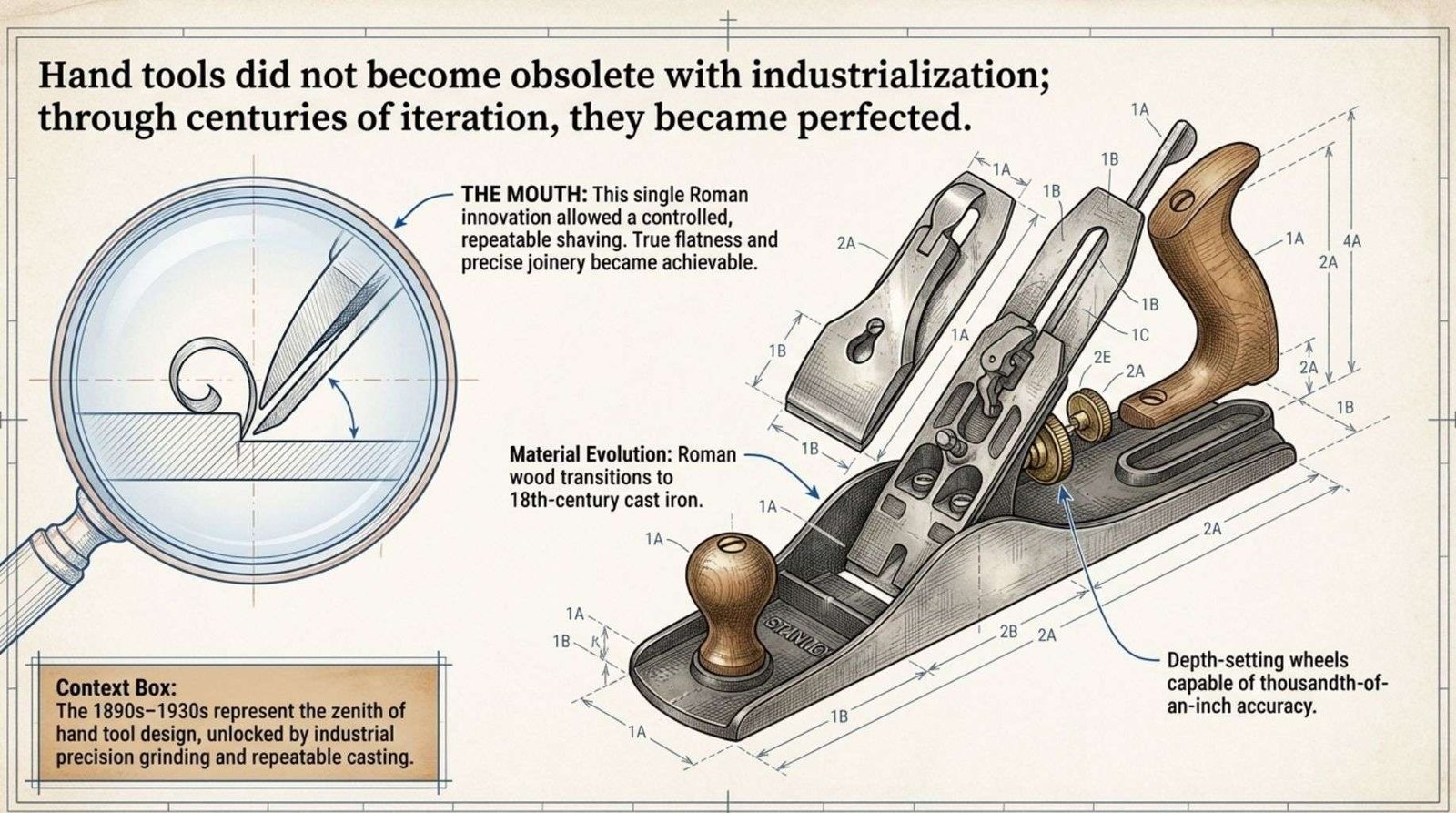
Its innovation was the mouth, a narrow gap through which a blade protruded at a set angle, allowing the woodworker to take a controlled, repeatable shaving from a board face. True flatness became achievable.
Precise joinery became reliable. Furniture, architectural panelling, and fine cabinet work followed directly from this single tool development.
The Romans also standardised and distributed tools across an empire, which meant that a carpenter in Roman Britain was working with instruments nearly identical to those used in North Africa or the Levant.
Centuries of Refinement: The Hand Tool Tradition.
From Rome to the Industrial Revolution, the woodworking toolkit evolved through accumulated refinement rather than radical invention.
Each generation of craftspeople made small improvements: better steel, improved geometry, more ergonomic handle profiles, finer tooth patterns on saws. The changes were incremental, but over a thousand years of iteration they produced instruments of remarkable sophistication.
The frame saw, developed in medieval Europe, used a narrow blade held in tension by a twisted cord at the top of a wooden frame.
The tension kept the blade rigid enough to cut accurately despite its thinness. A thin blade wastes less material per cut, which mattered when timber was expensive and hand-ripping a plank was a full day’s labour.
The tension principle persists in modern hacksaw frames and in the Japanese bow saw, both of which use the same fundamental geometry.
The 18th century brought the cast-iron bench plane, which replaced the wooden-bodied version for many applications. Stanley in America and Record in Britain eventually produced planes with adjustable frogs, lateral adjustment levers and depth-setting wheels.
A craftsperson could now set a cutting depth to a thousandth of an inch and maintain it consistently across a long board.
The feel of a well-set Stanley No. 4 moving across straight-grained Victorian ash, producing a continuous ribbon of translucent shaving, is one of the benchmarks against which all other woodworking experiences are measured.
The counter-intuitive truth about hand tools in this era is that they did not become obsolete with industrialisation.
They became more refined. The 19th and early 20th centuries were the golden age of hand tool design, precisely because industrial manufacturing made high-quality steel, precision grinding and repeatable casting commercially viable.
The best bench planes ever produced were made in the 1890s to 1930s, not before. The workshop that treats a 120-year-old Stanley as an antique curiosity is overlooking what is often a more capable instrument than its modern equivalent.
The Industrial Turn: Power, Speed and Separation.
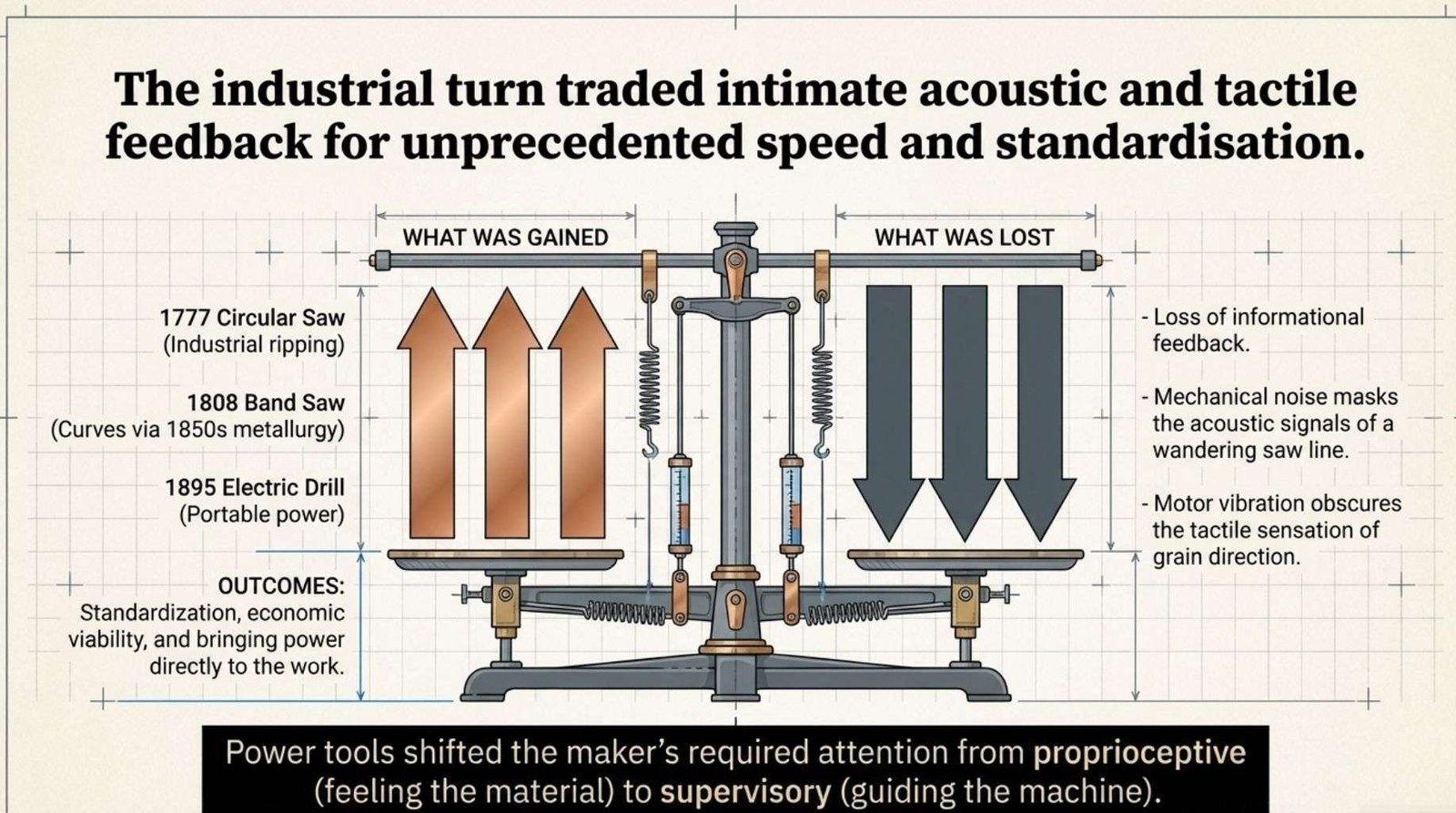
The first industrially significant woodworking machine was the circular saw, attributed to Samuel Miller in 1777 and initially powered by wind and water before steam made it more broadly practical.
The circular saw did not simply do what a handsaw did, faster. It changed the economics of timber processing entirely.
A water-powered circular saw could rip more timber in a single day than a team of pit sawyers could manage in a week.
Sawmill towns grew around that capability. Timber became cheaper, more standardised and more widely available.
The band saw followed in 1808, patented by William Newberry. It was theoretically superior to the circular saw for many cuts, producing less waste and allowing curves. But early band saw blades broke frequently at the weld joint and the tool did not become practically reliable until welded steel blade technology matured in the 1850s.
The gap between a good idea and a functional tool is sometimes not a design problem but a materials problem, and the band saw spent half a century waiting for metallurgy to catch up with the concept.
The portable electric hand drill, introduced by Wilhelm Fein in 1895, opened a different category of change. Where the large steam-powered machines had centralised woodworking into factories and mills, electric portability began returning capability to the individual workshop.
A craftsperson could now bring power to the work rather than bringing the work to the power. The portable electric circular saw in the 1920s and the electric planer in the 1950s extended that logic further.
By mid-century, a well-equipped home workshop could achieve surface quality and dimensional accuracy that would have required a small industrial operation thirty years earlier.
The specific trade-off introduced by power tools in this era was not about quality. A skilled woodworker with power tools could match and often exceed hand-tool results in flatness, consistency and speed.
The loss was informational. Power tools are louder, which masks the acoustic feedback that a hand saw provides when it wanders off line.
They vibrate, which obscures the tactile signals that register grain direction in a hand plane. Working with a router or an orbital sander requires a different kind of attention, more supervisory and less proprioceptive, than working with a chisel or a card scraper. Neither mode is superior.
They are different relationships with the material.
Digital Tools and the New Frontier.
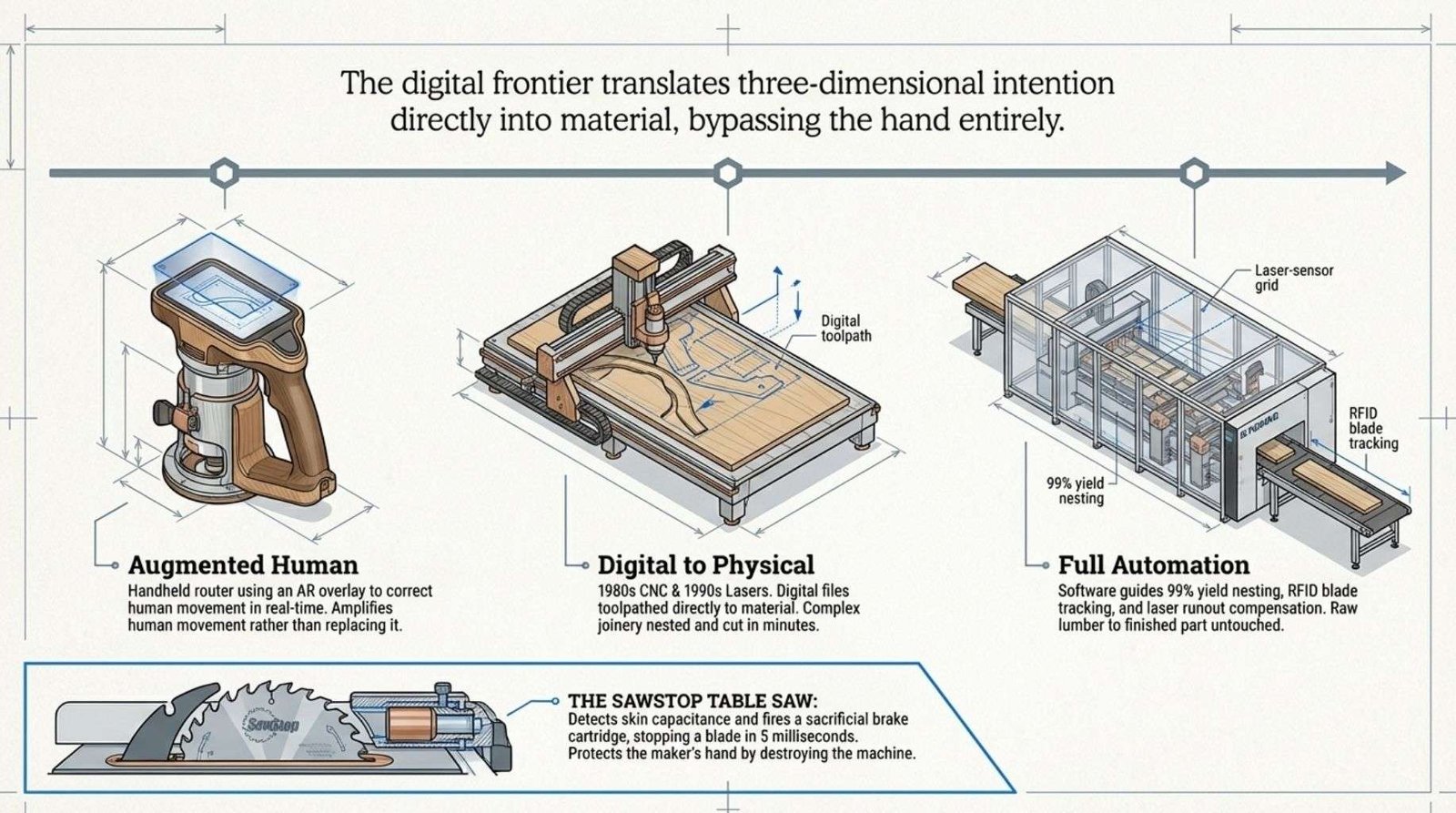
The CNC router entered woodworking shops commercially in the 1980s. Its introduction was not simply a faster way to cut wood.
It was a categorical change in what woodworking could mean. A digital file could now describe a complex three-dimensional form, and the machine would produce it from a sheet of timber with no hand tool contact at all.
Joinery that would take a skilled craftsperson hours of careful layout and cutting could be nested, toolpathed and cut in minutes. Furniture that was previously unaffordable because of the labour required became commercially viable.
Laser cutters arrived in woodworking applications in the 1990s, adding precision engraving and thin-section cutting to the digital toolkit.
The Shaper Origin, introduced more recently, took a different approach: a handheld router guided by an augmented reality overlay projected onto the workpiece, correcting for human error in real time so that a person using it can produce CNC-quality results without a fixed machine setup.
It is a tool that uses digital intelligence to amplify human movement rather than replacing it, which places it in an interesting conceptual position between traditional hand tools and full automation.
Contemporary industrial woodworking has extended these principles to a scale that is difficult to convey without specific numbers.
Automated nesting software now arranges complex part libraries across sheets of plywood with material utilisation approaching 99 percent, guided by vision systems that detect natural defects and route them away from critical zones.
RFID tags embedded in cutting tool holders track blade usage hours and trigger automatic sharpening notifications. Laser-based tool setters measure router bit runout and diameter while the spindle turns, compensating for thermal expansion during long production runs.
The most advanced automated lines, from manufacturers like Homag and Weinmann, can process raw lumber at one end and deliver finished furniture components at the other without a single hand touching the material.
Safety technology has developed in parallel. The SawStop table saw detects skin contact through a capacitance signal and stops its blade within five milliseconds, well within the window required to prevent a serious laceration.
The system uses a sacrificial brake cartridge that absorbs the blade’s kinetic energy, destroying itself and the blade to protect the hand.
It fires rarely, but when it does, the difference between losing a fingertip and walking away intact is measured in milliseconds and the price of a cartridge.
Portable tools have also transformed.
Brushless motor technology, combined with lithium-ion battery packs and Bluetooth monitoring, now delivers cordless tools that match corded performance across most practical applications. A mid-range cordless track saw in an Aussie woodshop today carries far more precision and consistent power than many corded saws available fifteen years ago.
Era | Representative Tool | Key Innovation |
3.3 million years ago | Lomekwi stone flakes | Intentional modification of material |
1.7 million years ago | Acheulean hand axe | Planned form and bilateral symmetry |
400,000 years ago | Clacton digging stick | Shaped wood for specific function |
500,000 years ago | Schöningen spears | Engineered balance and weighted tips |
10,000 years ago | Polished stone axe | Ground edge for sustained timber work |
2000 BCE | Copper chisel and mallet | Metal edge, first illustrated toolkit |
1st century CE | Roman wooden plane | Controlled, repeatable board surfacing |
18th century | Cast-iron bench plane | Micrometer adjustment, sustained accuracy |
1777 | Circular saw | Industrial-scale ripping under power |
1895 | Electric hand drill | Portable power, decentralised capability |
1980s | CNC router | Digital file to finished part, no hand contact |
Present | Shaper Origin | AR-guided handheld CNC |
The Hand Plane’s Long Persistence.
Of everything the long tool record contains, the persistence of the hand plane deserves particular attention.
The Roman plane of the first century CE operated on a blade bedded at a fixed angle, protruding through a narrow mouth in a wooden sole, driven by hand pressure. The contemporary hand plane available from a premium manufacturer today operates on exactly the same principle.
The body may be precision-ground cast iron, or ductile iron, or in some current versions carbon-fibre composite.
The blade may be A2 tool steel or powdered metallurgy steel or ceramic-coated high-speed steel. The adjustments are finer, the tolerances tighter, the flatness of the sole more reliable.
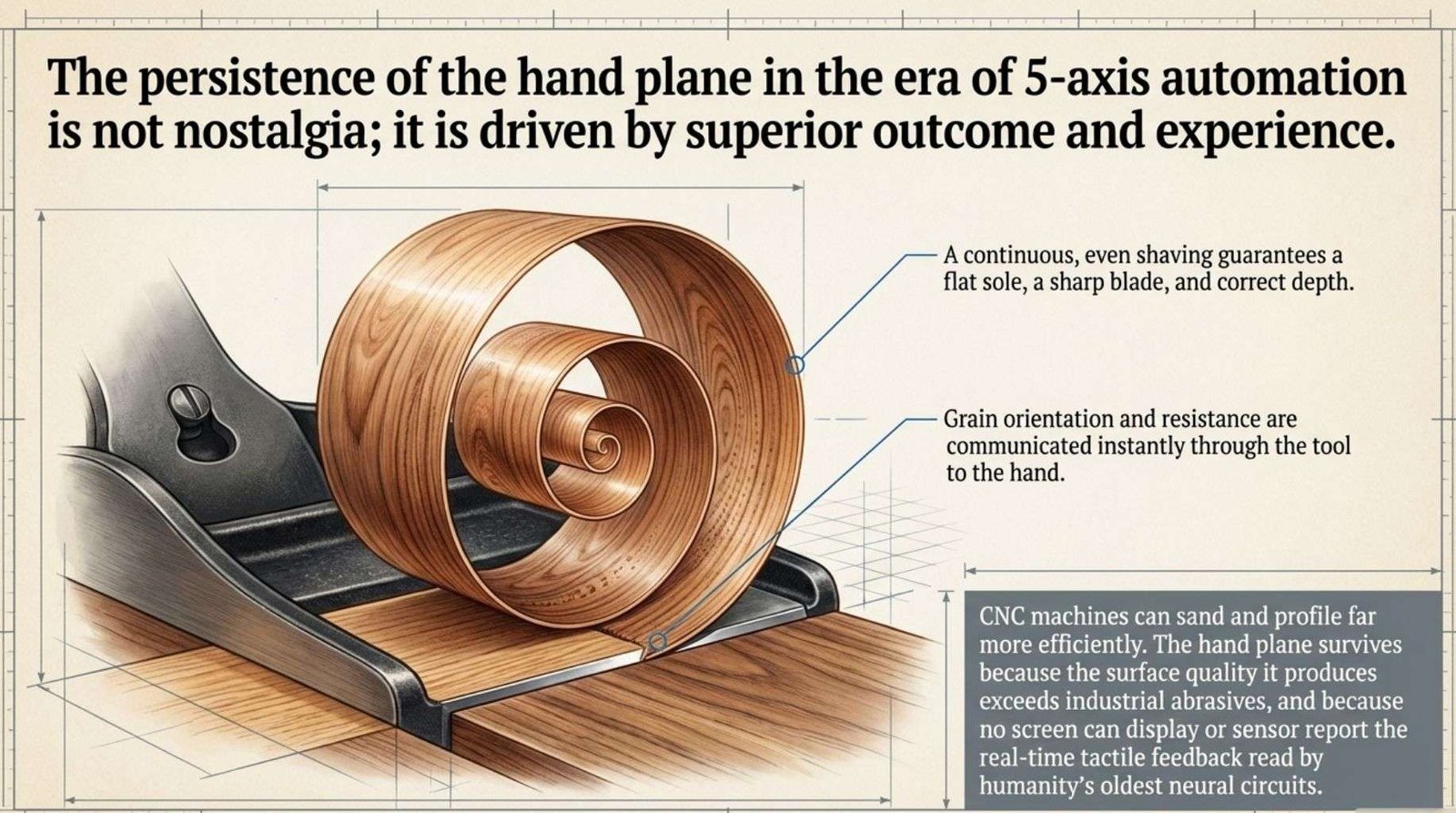
But the act of use is the same. A person stands at a bench, takes a grip, leans into the cut, and reads the shaving. The curl of a well-set shaving rising from a fine-grained hardboard is still one of the most reliable indicators of how a surface will finish. A continuous, even shaving means a flat sole, a sharp blade, correct depth, appropriate grain orientation and sufficient downward pressure.
Each of those variables is communicated through the tool to the hand in real time. No screen displays this. No sensor reports it.
The craftsperson reads it directly, through the same neural circuits that were being used to make tools before the human species existed in its current form.
There is also something worth noting about the bench plane specifically: it is not used in industrial production. CNC machines sand, drum-plane and profile timber far more efficiently than any hand tool.
The hand plane has persisted not because it is the most efficient surface preparation tool, but because the quality of surface it produces at its best exceeds what abrasives achieve, and because the connection it creates between maker and material is not duplicable by machine.
It has earned its survival through two things the machines have not replaced: the quality of the outcome and the quality of the experience.
From Stone to Algorithm: The Constant Thread.
Three million years of tool development can appear, from a distance, as a simple progression from simple to complex, from crude to precise.
That reading misses something important. The Acheulean hand axe is not a primitive object waiting to become a CNC router.
It is a complete and sophisticated response to the specific demands of its time, produced by a mind that was solving real problems with available materials.
The same is true of the Roman plane, the medieval frame saw, the Victorian bench plane, and the brushless cordless drill sitting on a charger in a Sydney workshop right now.
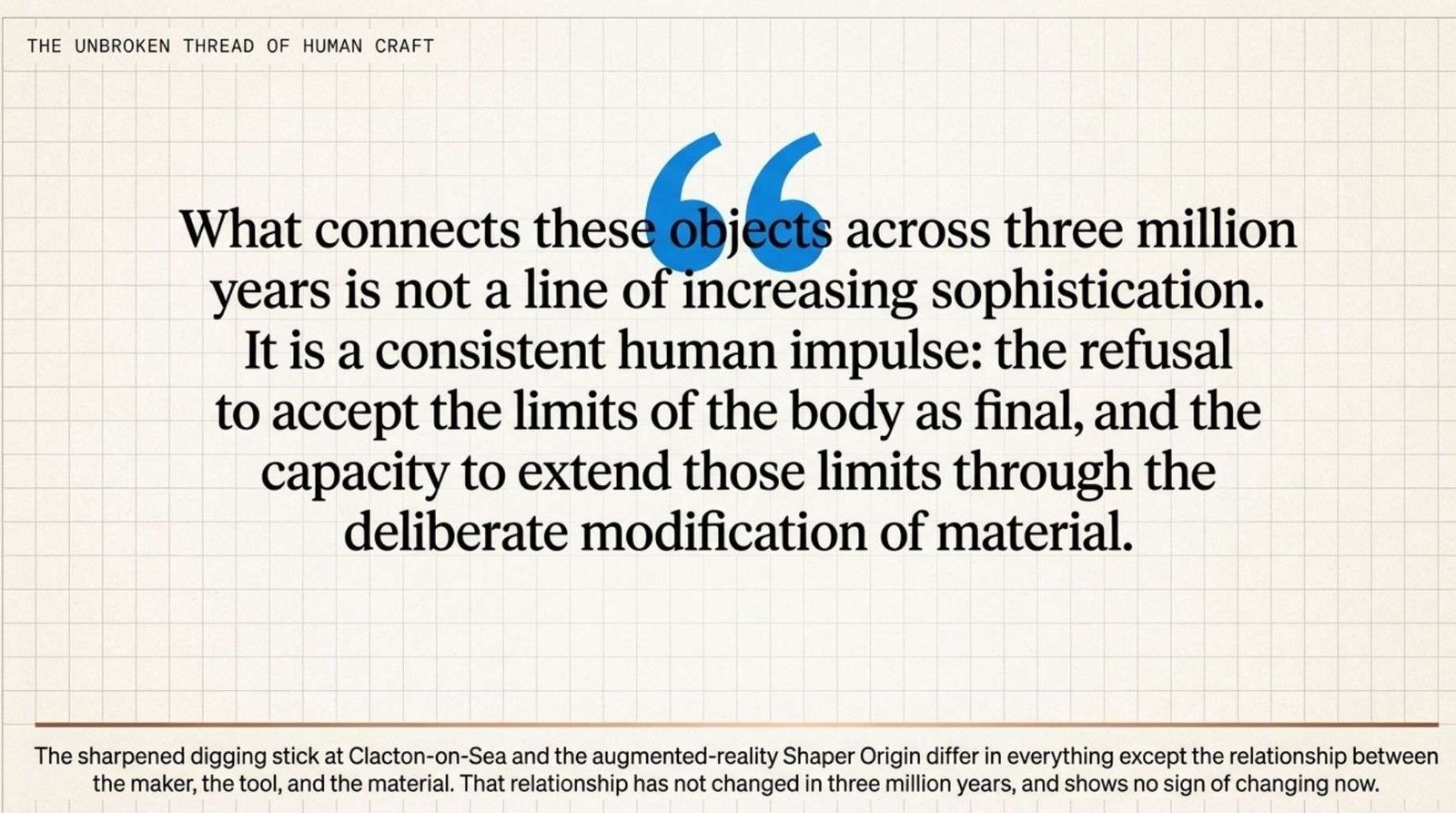
What connects these objects across three million years is not a line of increasing sophistication. It is a consistent human impulse: the refusal to accept the limits of the body as final, and the capacity to extend those limits through the deliberate modification of material.
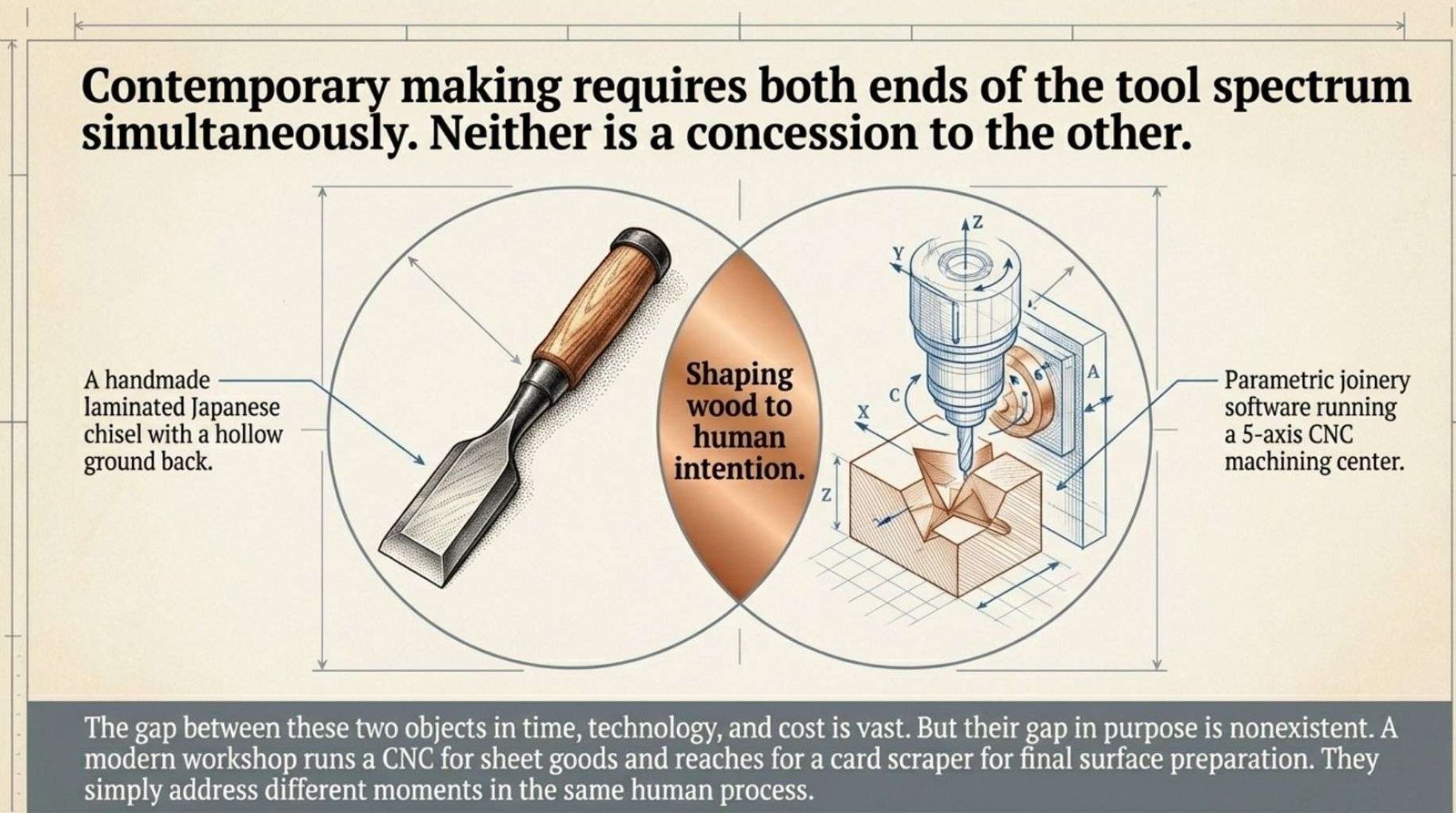
Woodworking sits at an interesting point in this history because it requires both ends of the tool spectrum simultaneously.
A contemporary furniture workshop might run a CNC router for sheet goods processing and reach for a card scraper and a block plane for final surface preparation. Neither tool is a concession to the other. They address different moments in the same process, each suited to what it does best.
The tools available to a woodworker in Australia today represent an extraordinary range. From a handmade Japanese chisel, laminated steel with a hollow ground back, to a parametric joinery software package running on a laptop connected to a five-axis machining centre: the gap between those two objects, in time, technology and cost, is vast.
The gap in purpose is narrower than it appears. Both are instruments for shaping wood to human intention.
That is what a tool has always been. An extension of the hand. A materialisation of the mind’s decision that what is possible should be larger than what the body alone can do.
The sharpened stick at Clacton-on-Sea and the Shaper Origin guiding a router cut with augmented reality correction are, at their root, the same kind of object.
They differ in everything except the relationship between the maker, the tool and the material. That relationship has not changed in three million years and shows no sign of changing now.